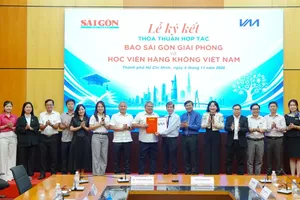
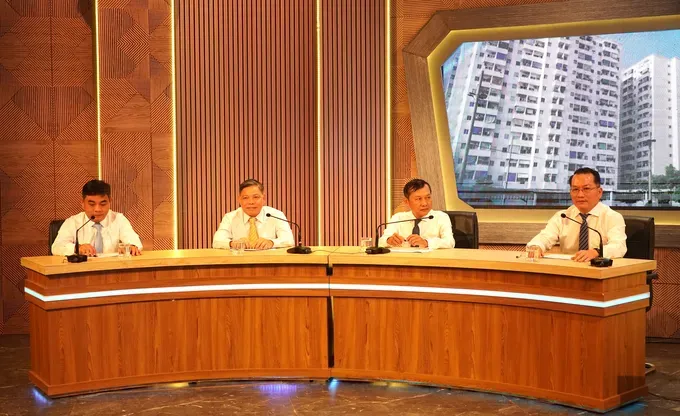
On November 8, the Standing Committee of the Ho Chi Minh City People's Council, in coordination with Ho Chi Minh City Radio and Television, held a public dialogue program titled “People Ask – Government Answers,” focusing on mechanisms and policies for developing social housing and rental accommodation.
Reviewing land reserves

Voter Nguyen Ngoc Hieu, a senior lecturer at the Vietnamese-German University, asked how Ho Chi Minh City was preparing the necessary resources to achieve its target of developing 181,257 social housing units and rental homes in the 2026-2030 period, nearly 10 times the target set for 2021-2025.
In response, Tran Chi Trung, Deputy Director of the Ho Chi Minh City Department of Construction, said the city was finalizing its land-use planning for social housing development through 2030, with a vision to 2040, targeting a total area of approximately 1,800 hectares.
The Department of Construction has reviewed 191 land plots covering a combined area of 600 hectares earmarked for social housing development. Of these, it has submitted a report to the Ho Chi Minh City People's Committee on 31 land plots under the management of state agencies and organizations, covering approximately 69.6 hectares and capable of accommodating around 39,000 apartments. These sites will serve as a basis for selecting project developers.
According to Phan Van Tuan, Deputy Director of the Ho Chi Minh City Department of Planning and Architecture, the city's Master Plan for the 2025-2050 period, with a 100-year vision, identifies the development of affordable housing as a key priority.
He said social housing and rental accommodation should be located near industrial parks, logistics hubs, major employment centers, and metro stations, with essential infrastructure developed in the Standing Committee of the Ho Chi Minh City People's Council and guests participate in the program.

Regarding administrative procedures, the Law on Urban Development and Resolution No. 54/2026/NQ-HDND allow authorities to consider approving detailed plans that differ from previously approved zoning plans, as well as updating them when zoning plans are adjusted, provided that all legal requirements are met.
This mechanism can help shorten approval timelines, but it does not permit arbitrary increases in population density or the bypassing of infrastructure requirements. The Department of Planning and Architecture will coordinate with the Department of Construction to review applications, determine which qualify for the new mechanism, and identify those that must follow standard procedures, Deputy Director of the Ho Chi Minh City Department of Planning and Architecture Phan Van Tuan added.
Regarding funding, Deputy Director of the Ho Chi Minh City Department of Construction Tran Chi Trung said the city was combining local resources, private-sector investment, and preferential credit.
The city has also introduced a mechanism for managing payments made by developers of commercial housing and urban area projects to fulfill their social housing obligations. In addition, it is coordinating the implementation of a VND145 trillion (US$5.7 billion) loan package and a loan program provided by the Ho Chi Minh City Finance and Investment State-owned Company (HFIC).
Expanding the supply of rental housing

Addressing businesses' concerns about the investment costs of rental housing projects, Deputy Director of the Ho Chi Minh City Department of Construction, Tran Chi Trung, said the city planned to make greater use of the Housing Development Fund to develop, receive, and manage its rental housing stock.
The city is also studying proposals for preferential credit policies, infrastructure support, reductions or exemptions from land-related financial obligations, and the introduction of "green channels" and "priority channels" to expedite procedures for social housing and rental housing projects.
Nguyen Thanh Toan, Deputy Director of the Ho Chi Minh City Department of Finance, added that under Resolution No. 09/2023/NQ-HDND, eligible projects can receive interest-rate subsidies on loans of up to VND200 billion per project for a maximum period of seven years.
The department is advising on a proposal to raise the subsidized loan ceiling to VND300 billion per project, extend the support period to 10 years, and broaden access to funding from credit institutions.
Voter Pham Thi Kim Thuy, an employee of Pouyuen Vietnam Co., Ltd., said many workers had to rent accommodation far from their workplaces, incurring additional travel time and expenses.
Nguyen Ba Khai, Deputy Head of the Ho Chi Minh City Export Processing and Industrial Zones Authority, said the city currently had 58 operational export processing zones and industrial parks, with nine worker accommodation projects comprising approximately 9,000 units already in operation. By 2030, the authority has been assigned a target of developing 10,000 units. It is currently supporting five projects with a combined capacity of around 3,100 units, while reviewing 23 hectares of land across 11 industrial parks for the development of worker accommodation in line with approved planning.
Responding to a proposal by Dang Huy Cuong, a representative of Pouyuen Vietnam, that manufacturing businesses be allowed to partner with qualified entities to invest in and operate worker accommodation facilities, Deputy Director of the Ho Chi Minh City Department of Construction Tran Chi Trung said the Ho Chi Minh City People's Committee had assigned the Department of Construction to advise on mechanisms for selecting project developers. Meanwhile, the Ministry of Construction is reviewing the Housing Law for submission to the National Assembly, with a view to expanding the range of entities eligible to participate in this sector.
Phung Thai Quang, Vice Chairman of the Ho Chi Minh City Federation of Labour, said the federation had partnered with nine businesses, aiming to provide 128,000 rental housing units for workers by 2030. The Hoa Sen An Ha project is expected to break ground in the first quarter of 2027.
The federation has also proposed converting 953 apartments in Vinh Loc B into rental housing for workers. The proposal is awaiting a decision from the competent authorities.
Tenants of social housing must belong to eligible groups as stipulated by regulations but are not required to meet the housing and income criteria applicable to those purchasing or leasing-to-own such properties.

Regarding voters' concerns about rental prices, service charges, and the use of unoccupied resettlement housing, Deputy Director of the Department of Construction Tran Chi Trung said social housing rents must be publicly disclosed and comply with state-prescribed pricing frameworks. Rental contracts and service charges must also be transparent, and residents are entitled to raise complaints about inappropriate fees.
The Department of Construction will advise on reviewing the stock of resettlement housing for which there is no immediate demand and propose converting such properties to other uses, subject to approval by the competent authorities. However, priority must be given to accommodating residents displaced by relocation and site clearance.
The city's plan to relocate households living along and over canals involves approximately 40,000 households and requires at least 16,000 resettlement units.
Of the target of 181,257 social housing units, the city has allocated 52,000 units for rental purposes.
Housing Development Fund offers loans of up to VND900 million per application
Nguyen Song Bao Ky, Director of the Ho Chi Minh City Housing Development Fund, said its homeownership loan program for eligible beneficiaries provides loans of up to VND900 million per application, with a repayment term of 20 years and an annual interest rate of 4.4 percent.
Over more than 20 years of operation, the program has supported more than 7,200 people and disbursed nearly VND4.2 trillion in loans.