The city is progressively quantifying its innovation and digital transformation capacity through specific indicators, using them as benchmarks to assess development effectiveness. A reporter from Sai Gon Giai Phong Newspaper met and interviewed Mr. Lam Dinh Thang, Director of the municipal Department of Science and Technology, about how the city measures and promotes these drivers.
Mr. Lam Dinh Thang said that the contribution of science and technology, innovation, and digital transformation has been clearly reflected in concrete indicators. The contribution of total factor productivity (TFP) to Ho Chi Minh City’s GRDP has reached 54.28 percent, with science and technology accounting for as much as 74 percent of TFP growth. This demonstrates that the city’s economy is undergoing a strong shift from labor-intensive development toward the more efficient utilization of knowledge-based resources.
The city has deployed more than 1,000 artificial intelligence (AI) cameras at 216 intersections, increasing average traffic flow speeds by 10 percent to 15 percent. The 1022 hotline and SOS system have reduced the processing time for public feedback reports from 10 minutes to just 1–2 minutes.
In the healthcare sector, over 99 percent of hospitals have implemented electronic medical records, with more than 3.1 million health records integrated into digital platforms. The education sector has achieved a 100 percent digital transformation rate across institutions. In public administration, the on-time processing rate for online applications exceeds 95 percent, while the rate of online submissions surpasses 70 percent.
However, several constraints remain, preventing the full realization of the potential of science and technology, innovation, and digital transformation.
Regulations governing research funding norms remain overly administrative in nature and are not yet aligned with the inherently high-risk characteristics of scientific research. The rate of commercialization of research outcomes from universities to enterprises has yet to meet expectations. Meanwhile, efforts to standardize, cleanse, and ensure interoperability of data between central and local authorities remain slow and are still in the process of being completed.
To remove bottlenecks and realize the goal of positioning Ho Chi Minh City as a leading regional hub for economic development, science, and technology, the city needs breakthrough approaches.
First, the Department of Science and Technology is advising on the development of advanced legal frameworks aimed at encouraging scientific research and accepting inherent risks in research activities; promoting the establishment of venture capital funds; and implementing regulatory sandbox models for emerging technologies such as artificial intelligence (AI), semiconductors, and green energy.
In addition, the city is accelerating the “triple-helix” linkage among the State, academia, and enterprises. The State plays a leading role by commissioning solutions to major urban challenges such as traffic congestion, flooding, pollution, and climate change; research institutes and universities focus on technological development, while enterprises take on the role of commercializing products.
Another key pillar is the development of a network of internationally standardized innovation centers. This initiative is being gradually realized, with the aim of forming a diverse system of centers that will serve as strategic infrastructure for the city’s innovation ecosystem.
This serves as a guiding principle for action, requiring the sector to move beyond the “ivory tower” of research to address the city’s practical challenges.
First is to “think genuinely and act decisively.” The sector will shift away from fragmented budget allocations toward a demand-driven mechanism based on commissioned tasks and output-based funding aligned with business needs and the city’s development priorities. Each research project, upon acceptance, must have a clearly identified application destination.
The second is to “measure substantively.” All science and technology, innovation, and digital transformation activities will be quantified through specific indicators, such as the rate of commercialization of research outcomes, the number of startups successfully raising capital, and the level of public satisfaction with online public services. Data will serve as the most objective metric for evaluating effectiveness.
Third is to “ensure accountability.” The sector will propose that the city introduce mechanisms to protect officials who are willing to think boldly, act proactively, and take responsibility in the field of science and technology. At the same time, accountability of agency heads will be clearly defined, particularly regarding delays in disbursing science and technology funding or implementing digital infrastructure projects.
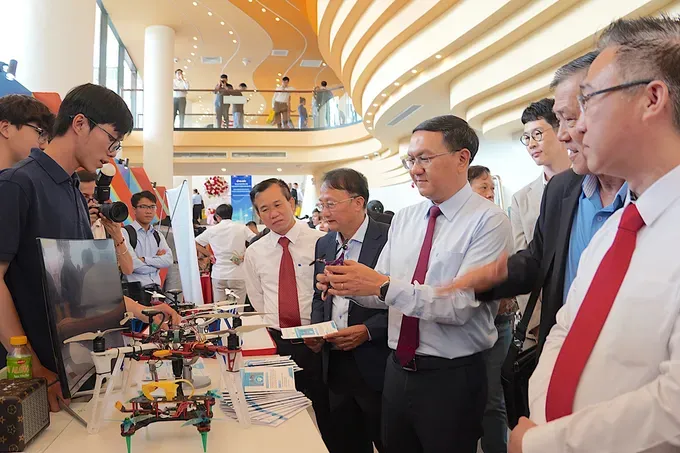
The city has been actively implementing a range of tangible initiatives, including piloting UAV-based delivery services in the Saigon Hi-Tech Park, launching a UAV (unmanned aerial vehicle) transport route between Can Gio and Vung Tau, attracting a US$2.1 billion AI hyperscale data center project, and announcing the development of the Northern Ho Chi Minh City Science and Technology Urban Area, along with new policies on commercialization.