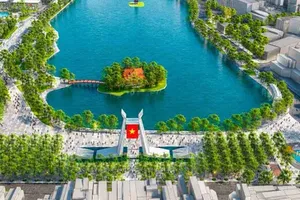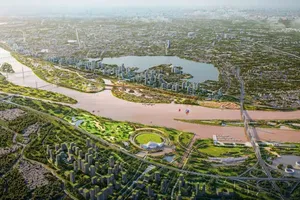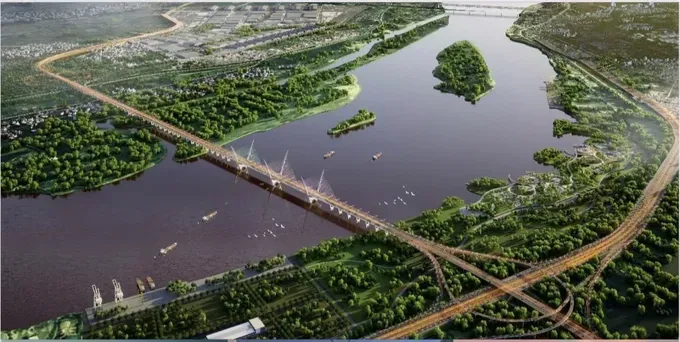
The Red River Boulevard Project will be deployed along both banks of the river, stretching from Hong Ha Bridge to Me So Bridge across 16 communes and wards. The preliminary investment is approximately VND855 trillion (US$32.4 billion), as stated by Permanent Vice Chairman of the Hanoi People’s Committee Duong Duc Tuan.
The project comprises several critical components:
- Right Bank: A traffic and landscape boulevard spanning nearly 45km; four entertainment parks covering over 1,000 hectares; and a 30km embankment system.
- Left Bank: A similar traffic and landscape boulevard spanning nearly 36km, along with four large-scale parks covering over 2,250 hectares and a synchronized embankment system.
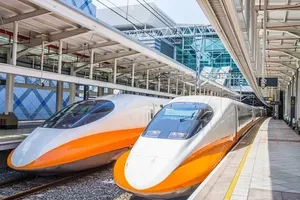
- Underground Metro: Notably, the project includes an underground metro line along the right bank, connecting with the urban railway network to create a modern, sustainable transport axis.
Parallel to this is a resettlement urban area project, to be implemented under the Build-Transfer (BT) model and located outside the main project scope, ensuring stable accommodation and better living conditions for displaced residents.
“This is a strategic project playing a pivotal role in restructuring urban space, linking transport infrastructure with ecological landscapes, culture, and new riverside urban areas. The goal is to complete the entire project by 2030,” said the Permanent Vice Chairman.
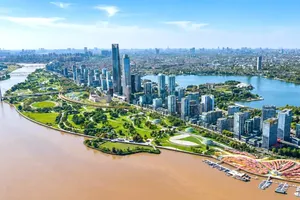
Meanwhile, the Southern Olympic Sports Urban Area Project has a total investment of approximately VND925 trillion ($35.1 billion). This project aims to qualify Hanoi to host major regional and international sporting events.
Spanning over 11,000 hectares across 11 communes, the project is divided into four main zones:
- Zone A: New urban development based on the Transit-Oriented Development (TOD) model, serving as the connection hub for the sports complex.
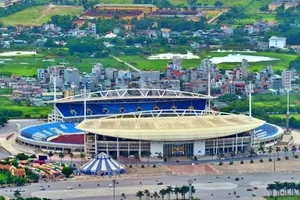
- Zones B, C, and D: Clear focus on developing sports cities and service cities associated with sports complexes and international-standard stadiums, including Trong Dong Stadium and a large-scale stadium for global events.
The sports complex and stadium are scheduled for completion in the second quarter of 2030, with the entire project finishing by 2035, creating a new development engine for southern Hanoi.
Assessing the significance of these two “mega-projects,” Secretary of the Hanoi Party Committee Nguyen Duy Ngoc affirmed their critical role. They contribute to realizing the goal of achieving GRDP growth of 11 percent or higher starting in 2026 and maintaining this throughout the 2026-2030 term.
Simultaneously, they will reshape the capital’s appearance towards a “Civilized - Distinctive – Creative” identity, gradually turning Hanoi into a creative, green, smart, and globally connected metropolis.
The Hanoi People’s Committee noted that Politburo Resolution No. 30 on the development of Hanoi clearly defines the requirement to develop urban areas on both banks of the Red River. This involves ensuring flood drainage and disaster prevention while effectively exploiting space and land funds.
Directives from General Secretary To Lam have consistently emphasized priority investment in synchronized, modern infrastructure to make the Red River axis a new symbol of the capital’s development.
Once completed, the Red River Boulevard is expected to fundamentally change the urban appearance of both riverbanks, forming a massive cultural-economic-ecological space. It will connect with other key infrastructure projects such as the Olympic Sports Urban Area, the road connecting Gia Binh Airport to Hanoi, and upcoming bridges across the Red River, creating a chain of interlinked development momentum.
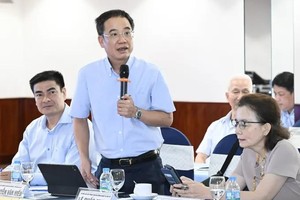
At the recent working session, the Hanoi People’s Council approved the principles and investment policy for the Red River Boulevard Project. Chairwoman of the Hanoi People’s Council Phung Thi Hong Ha assessed that the project demonstrates a long-term vision and “centennial thinking,” promising to create a green, modern landscape that serves as a lever for socio-economic development as well as a foundation for various feasible solutions to current social security problems.
However, many Council delegates noted that the project affects approximately 50,000 households. Therefore, special attention must be paid to site clearance and resettlement.
New housing arrangements must ensure better living conditions and form civilized resettlement areas while preserving historical relics and traditional riverside craft villages, combining tourism development with creative spaces to create sustainable livelihoods for residents.
According to the plan, these two key projects will commence on December 19, creating a ripple effect to welcome the 14th National Party Congress and setting a vibrant atmosphere for entering 2026 with the goal of double-digit economic growth.