Pivoting aggressively toward grassroots
In Bau Bang Commune, HCMC, a lottery ticket sellers’ labor union has just been established with 47 founding members. These wandering vendors, previously marginalized from social welfare, now boast a communal space for legal backing and access to social security policies. To date, hundreds of similar labor unions have been established across HCMC, drawing massive participation from informal workers like domestic helpers, motorbike taxi drivers, and electricians.
On a late weekend afternoon, the courtyard of the Hoang Mai boarding house in Phu Loi Ward echoed with the vibrant laughter of migrant workers. Hearty meals, entirely sponsored by the HCMC Federation of Labor were laid out in the residential alley, warming the hearts of those lacking recent family reunions.
For 26-year-old Da Thi Nguyet Hue from Binh Thuan Province, the meal sparked a deep sense of belonging. She explained that such intimate gatherings effectively bind workers together, offering a golden opportunity to share life’s struggles and joys.
Mr. Nguyen Xuan Hung, a 38-year-old truck driver tethered to HCMC for over a decade, echoed this sentiment. Noting this was the second union-coordinated feast, he elaborated, “This initiative doesn’t merely provide material sustenance; it’s a profound spiritual boost helping workers feel secure and deeply rooted in their community.”
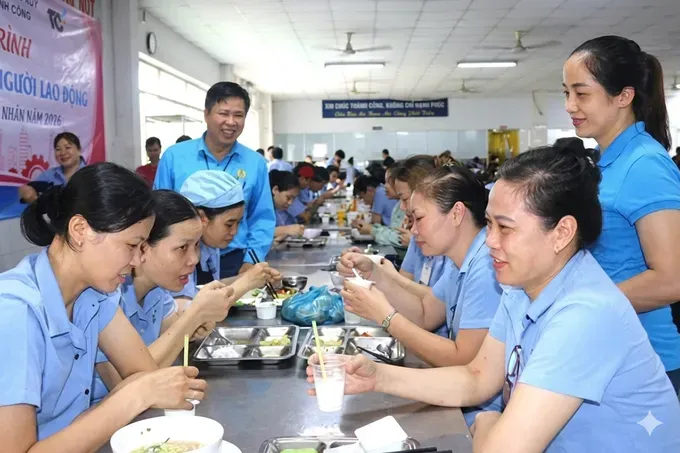
According to Vice President Ngo Duy Hieu of the Vietnam General Confederation of Labor, among the novel models emerging in recent years, the “Labor Union Meal” has been enthusiastically embraced by various enterprises and units, rolled out across numerous localities, and highly lauded by the broader society.
In 2025 alone, the program was successfully executed across 5,132 grassroots union branches, captivating over 2.17 million participating workers, backed by an impressive total funding pool exceeding VND148 billion (US$5.6 million).
Moving into 2026, the Vietnam General Confederation of Labor will relentlessly continue to anchor the “Labor Union Meal” as a cornerstone activity during Workers' Month. This flagship program is currently being tailored to nurture frontline manufacturing workers stationed within sprawling industrial parks and export processing zones.
Vice President Ngo Duy Hieu shared that one of the predominant themes tabled for the upcoming 14th Congress of the Vietnam General Confederation of Labor is the relentless drive to revamp the union’s organizational structure, ensuring it becomes leaner, vastly more efficient, and tangibly closer to the workforce. Consequently, the grassroots union network has been definitively pinpointed as the paramount center for all future union operations.
Standing Vice President Thai Thu Xuong of the Vietnam General Confederation of Labor stated that based on the strategic roadmap for the 2026-2031 tenure, the core breakthrough for the Vietnam General Confederation of Labor entails drastically elevating the quality of its staff members, particularly full-time officials and grassroots union presidents. If a grassroots labor union operates at peak efficiency, workers will invariably receive far more timely support regarding dialogue, collective bargaining, welfare benefits, and troubleshooting complex hiccups within labor relations.
In Da Nang, an inter-commune management model across Nam Phuoc, Duy Nghia, and Thu Bon communes is rolling out. Collaborating with local authorities, police forces, and social insurance agencies, this framework swiftly resolves labor disputes. Currently, the unit manages about 5,300 union members, reflecting a surge of 917 recruits.
Meanwhile, in Hai Phong City, labor unions maintain dozens of self-governing teams within worker boarding clusters, boasting nearly 1,000 participants. This model helps tenants access vital legal information and cultural activities while preserving security. Locales also established self-management teams and programs like “Worker Boarding House Self-Management Teams” and “Safe and Civilized Boarding Houses” to forge crucial connections between unions and laborers outside standard working hours.
Supercharging digital transformation
According to the Vietnam General Confederation of Labor, sweeping digital transformation anchors the upcoming tenure. The 14th Congress mandates vigorous sci-tech integration as a monumental breakthrough for 2026-2031, alongside staff enhancement. Furthermore, the union drafted a digital transition blueprint.
In HCMC, the Labor Federation is refining applications like the “AI Assistant” and “e-Handbook.” These apps empower staff to instantly access labor laws and welfare programs, drastically slashing processing times while broadening workers’ access to essential union services.
Meanwhile, Hanoi unions are investing in specialized software to manage finances, grassroots data, and enterprise metrics. This serves management needs as branch volumes skyrocket under the new two-tier local government model.
Concurrently, the Da Nang Labor Federation notes this digital pivot revolutionizes member engagement. Innovative activities aligning with modern habits, such as idea incubators, technical contests, and short-video safety campaigns, are successfully cultivating a dynamic workforce perfectly primed to thrive in a highly digitized labor environment.
Alongside elevating labor representation, the 14th Congress of the Vietnam General Confederation of Labor mandates constructing a more agile, dynamic apparatus. During the 2023-2026 tenure, the Vietnam General Confederation of Labor successfully recruited over 2.2 million members and established 15,000 grassroots syndicates.
Moving forward, aggressively expanding membership remains a paramount mission to broaden the union’s footprint, ensuring laborers access comprehensive welfare and rock-solid protection. The Congress zeroes in on forging a formidable union, laser-focused on genuinely shielding its workforce.
This demand for innovation isn’t merely bureaucratic; it intrinsically ties to how the union approaches everyday laborers. Workers desperately need faster interventions, smoother access to union utilities, and a platform amplifying their voices both on the factory floor and in daily life.
The Vietnam General Confederation of Labor reported that during the 2023-2026 period, nearly 23 million turns of members and workers received critical assistance during the Tet holidays, fueled by a staggering total budget hovering near VND15 trillion ($600 million). The aggregate resource pool dedicated to welfare endeavors phenomenally surpassed VND27.2 trillion ($1.08 billion).
President Nguyen Anh Tuan of the Vietnam General Confederation of Labor emphatically stressed that alongside upgrading the union staff’s quality, supercharging the digital pivot, and revamping collective bargaining dialogues, the trade union apparatus must proactively adapt to the volatile fluctuations of the labor market so they don’t lose their footing as a dependable pillar for members and workers alike.
Ultimately, these critical demands serve as the absolute focal points tabled for the 14th Congress of the Vietnam General Confederation of Labor for the 2026-2031 tenure, squarely aimed at building an indomitable, highly effective organization that continuously draws closer to the laborers it represents.