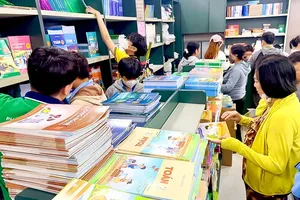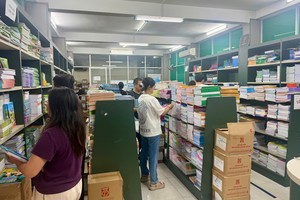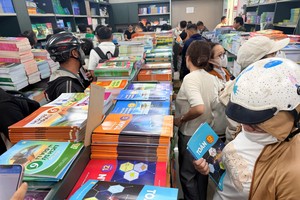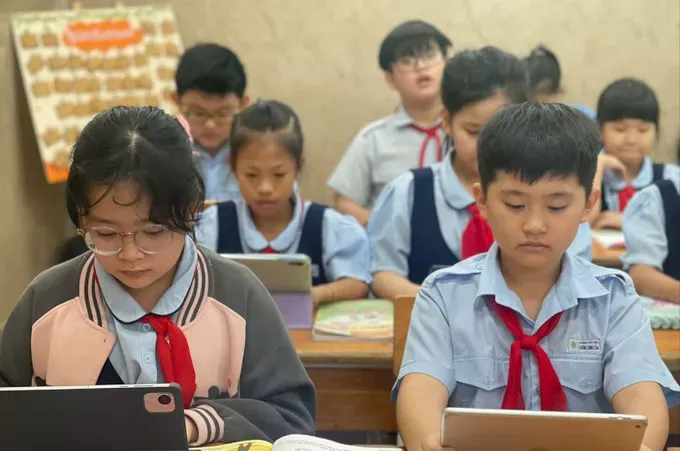
Teacher Chau Hien Duc from Luong Dinh Cua Primary School (sited in Ban Co Ward of HCMC) cautioned that if implemented effectively, electronic textbooks (e-textbooks) will reduce the need for printing, transportation, and storage of paper books, allowing students to go to school with lighter backpacks.
However, it should be applied as a pilot program in qualified schools (those with sufficient equipment, internet access, teacher readiness, and parental consensus) rather than being rushed into widespread adoption.
Furthermore, strict requirements regarding technology infrastructure, information security, copyright, formatting standards, and quality control must be met. In the initial phase, digital learning materials should be combined with traditional materials (print books) for flexible use depending on teaching conditions. E-textbooks should be viewed as a support tool, not yet a comprehensive replacement.
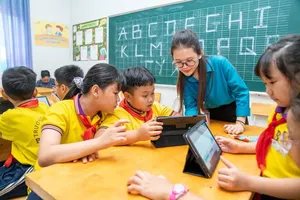
Particularly for young students, implementation must be extremely careful to ensure health safety, equity, and holistic development. Beyond basic features like searching, note-taking, and zooming, e-textbooks need to integrate audio, illustrations, videos, and interactive exercises to help students, especially first graders learning to read, understand and memorize knowledge more easily.
Teacher Vo Duy Trang from Ba Ria High School in Ba Ria Ward of HCMC commented that according to Article 6 in Chapter II of the draft Circular regarding the standards, conversion processes, and appraisal of e-textbooks, this new textbook type must have the ability to link with Learning Management Systems (LMSs) according to common standards.
If data communication standards are not clearly defined, each textbook set will use its own protocol, making it difficult for schools to integrate student grade data into a common management system. Specific technical standards for connecting with the LMS must be mandated.
Additionally, standards regarding infrastructure and information security need clarification, including the right of publishers to exploit student data (such as assignment results and learning history) for other purposes, like training Artificial Intelligence. Obviously, regulations on the ownership of user data generated during the learning process must be added.
Regarding technical testing, criteria for “User Experience” (UX) should be included in the report, rather than focusing solely on “latency and technical errors.” A bug-free application is not necessarily a good application if the user experience is poor (e.g., difficult to use, confusing menus). Therefore, a quantitative scale regarding user satisfaction during 10 percent of the experimental lessons is needed.
Teacher Truong Thi Thuy Trang from Le Quy Don Continuing Education Center in Tan Dinh Ward of HCMC stressed the need to place learners at the center.
Many students at continuing education centers work while they study. Therefore, e-textbooks offer significant convenience. If deployed in the right direction, e-textbooks will be a major catalyst for improving the quality of teaching and learning in continuing education.
However, e-textbooks also bring worries. If the software requires high-configuration devices while many students use low-end phones or have unstable internet, it will lead to inequality in access to learning materials. When using e-textbooks, teachers must innovate their methods and use devices during lessons, facing the risk of interruptions due to technical glitches. Without thorough training, e-textbooks could become a burden rather than a support tool for teachers.
E-textbooks need a friendly interface, no advertisements, and no unreasonable fees. The implementation process must be cautious, human-centric, and place the learner at the center.
More seriously, Vice Principal of Nguyen Trai Junior High School in Rach Dua Ward of HCMC Dao Vinh Bo cautioned against the misuse of e-textbook-related devices.
Before widespread rollout, communication and guidance must be strengthened so that teachers, students, and parents clearly understand the value, utility, and safe usage of e-textbooks. The education sector needs synchronous technical and management solutions, alongside guidelines for parents to coordinate with schools in managing students, preventing them from abusing devices to play games or access social media.
Using e-textbooks requires every student to have at least one internet-connected device, posing a challenge regarding the equipment roadmap given the economic disparities between regions and even between schools in the same area. Furthermore, determining the appropriate grade level for implementation to ensure student safety is a critical issue. Therefore, clear regulations on equipment standards, usage processes, quality accreditation, and safety guidelines are essential.