On September 21, 2024, the Prime Minister issued Decision No.1018/QD-TTg approving the Strategy for Developing Vietnam’s Semiconductor Industry until 2030, with a vision to 2050 (Strategy 1018), and Decision No.1017/QD-TTg approving the Program for Developing Human Resources for the Semiconductor Industry until 2030, with an orientation to 2050 (Program 1017).
Immediately after the strategy and decision were issued, the Ministry of Education and Training (MoET) urgently implemented relevant contents. Based on the MoET’s orientation, training institutions quickly reviewed and opened new majors while increasing enrollment quotas for integrated circuit (IC) and semiconductor disciplines.
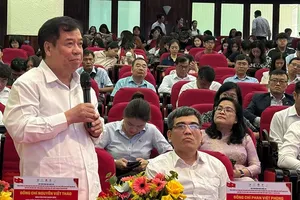
According to Deputy Director Nguyen Anh Dung of the Higher Education Department (under the MoET), during the 2025 university admission period, the total number of successful candidates in STEM (Science, Technology, Engineering, and Mathematics) fields reached over 237,000. Among them, more than 137,000 students were admitted to training programs related to ICs and semiconductors.
Additionally, many training institutions with strong capabilities have issued policies to attract talent, helping to improve the teaching and research staff in the semiconductor field. Currently, the MoET is submitting policies on scholarships and tuition fees to the Government to support learners in these majors.
The implementation of Strategy 1018 and Program 1017 has also created a ripple effect throughout the entire education system. At the general education level, vocational guidance linked with STEM education is being promoted, contributing to early orientation for the recruitment pool of technology sectors.
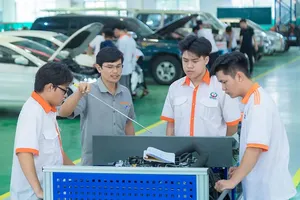
At the university and vocational education levels, training programs related to electronics, ICs, information technology, and automation are being reviewed and adjusted according to practical needs.
Concurrently, strengthening connections between training institutions and enterprises, industrial parks, and hi-tech parks has promoted the proactive participation of businesses, forming a “3-party” linkage model: State - School - Enterprise.
Regarding the requirement to develop human resources for the semiconductor industry, the Ministry of Science and Technology (MoST) is currently building a forecast of human resource demand until 2030 for the semiconductor industry and core digital technology sectors.
During implementation, it noted that many difficulties remain. The domestic semiconductor ecosystem is not yet synchronous; technological capacity is limited; and there is a shortage of high-quality human resources. Furthermore, infrastructure, laboratory systems, and licensed IC design tools at academic institutes are lacking and do not meet requirements.
The MoST proposes continuing to perfect the legal framework and policies for semiconductor industry development. At the same time, priority should be given to investing in chip fabrication plants (fabs), developing a comprehensive semiconductor ecosystem, and strengthening human resource training.
The Ministry also proposes forming research and development (R&D) centers and joint laboratories between the State, schools, and enterprises.
Meanwhile, the Vietnam Academy of Science and Technology (VAST) stated that it has proactively opened and implemented specialized training programs directly related to semiconductors at both undergraduate and postgraduate levels. Simultaneously, it is developing a team of lecturers and gradually investing in laboratories, research infrastructure, and tools serving training and practice.
VAST is also promoting training and research linkages with businesses and international cooperation, especially with partners in countries and territories with strengths in semiconductors such as Taiwan (China), the Republic of Korea, Japan, and Europe.
Like the MoST, VAST acknowledges that many difficulties persist. The Academy recommends prioritizing investment in laboratory infrastructure, perfecting mechanisms to attract high-quality human resources, expanding training programs, and increasing support for learners. VAST also proposes strengthening coordination with the MoET and relevant ministries and sectors to implement programs in a profound, substantive, and sustainable direction.
Evaluating the one-year preliminary review of implementing Strategy 1018 and Program 1017, Deputy Minister of Education and Training Nguyen Van Phuc requested training institutions to focus on innovating training programs closely linked to the practical development of the semiconductor industry; developing a team of lecturers and experts; increasing investment in facilities and laboratories; and pushing for digital transformation.
Along with this, synchronous solutions should be deployed, such as expanding enrollment scale, attracting experts, and perfecting financial policies to support learners, thereby strengthening the synergy between stakeholders in developing the semiconductor ecosystem.