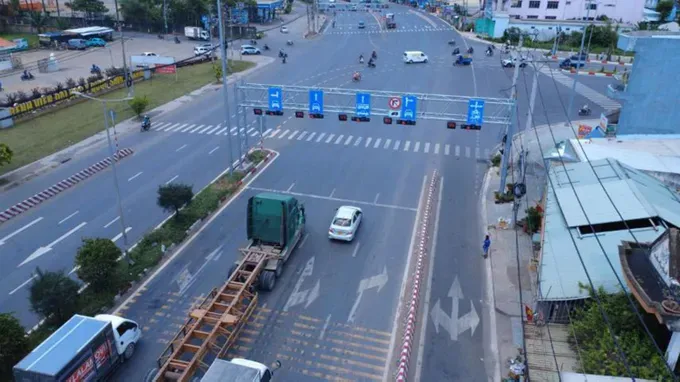
Under Ho Chi Minh City's new traffic arrangement, vehicles intending to turn left, turn right or make a U-turn must enter the third lane, adjacent to the motorcycle lane. In contrast, the section of National Highway 51 in Dong Nai City still requires left-turning vehicles to use the lane closest to the median. The differing traffic schemes on the same highway have forced many motorists to change lanes immediately after crossing into the neighboring locality.
Nguyen Quang Vu, a truck driver transporting goods from Bien Hoa in Dong Nai City to Cai Mep Port in Ho Chi Minh City, said that despite being aware of the new lane arrangement, he occasionally followed his old driving habits and moved into the lane nearest the median before realizing he needed to switch to the third lane. In heavy traffic, such last-minute lane changes can be difficult and increase the risk of collisions.
At some intersections, drivers who discovered they were in the wrong lane made last-minute lane changes to enter the correct turning lane, increasing the risk of accidents if motorists behind them were unable to react in time.
Drivers of fixed-route passenger buses said the new lane configuration was not the problem; rather, they were concerned that different localities had adopted different traffic schemes along the same national highway.
Drivers usually rely on both habit and road signs. Having to change lane selection immediately after crossing an administrative boundary can easily lead to confusion, especially at night or during peak traffic, driver Nguyen Van Phi said.
The inconsistency poses an even greater challenge for first-time users or those unfamiliar with National Highway 51. Near the boundary between Phuoc Thai Commune in Dong Nai Province and My Xuan Commune in Ho Chi Minh City, some drivers may only realize they are in the wrong lane when approaching an intersection, forcing them to brake suddenly or change lanes abruptly.
According to the Ho Chi Minh City Department of Construction, the section of National Highway 51 within the city currently carries an average of about 10,000 vehicles per day.
A representative of the Dong Nai City Department of Construction told Sai Gon Giai Phong Newspaper that the department would meet with relevant agencies on July 15 to conduct a field survey and discuss a unified lane configuration for the highway section under its jurisdiction.
Calls for consistent traffic management
Many drivers acknowledged that the new lane arrangement offers several advantages. Drivers of tractor-trailers and container trucks said relocating the left-turn lane to the third lane provides a wider turning radius, allowing large vehicles to make left turns and U-turns more safely without encroaching on adjacent lanes.
However, because the arrangement differs from conventional traffic patterns, many motorists urged authorities to install additional electronic information boards and advance warning signs to help drivers adapt.
Following the successful implementation of the new lane configuration on its section of National Highway 51, the Ho Chi Minh City Department of Construction proposed that its counterpart in Dong Nai City adopt the same traffic arrangement to ensure consistency along the entire route. However, the proposal has yet to be implemented.
Drivers are calling on transport authorities in both localities to coordinate a unified traffic management plan for the entire highway, saying a consistent lane configuration would help ease congestion, reduce traffic conflicts, and improve traffic flow for trucks and other vehicles traveling between Ho Chi Minh City and Dong Nai City.
They added that while traffic management reforms are necessary, consistency should be prioritized on major transport corridors such as National Highway 51 to ensure safer and smoother travel.