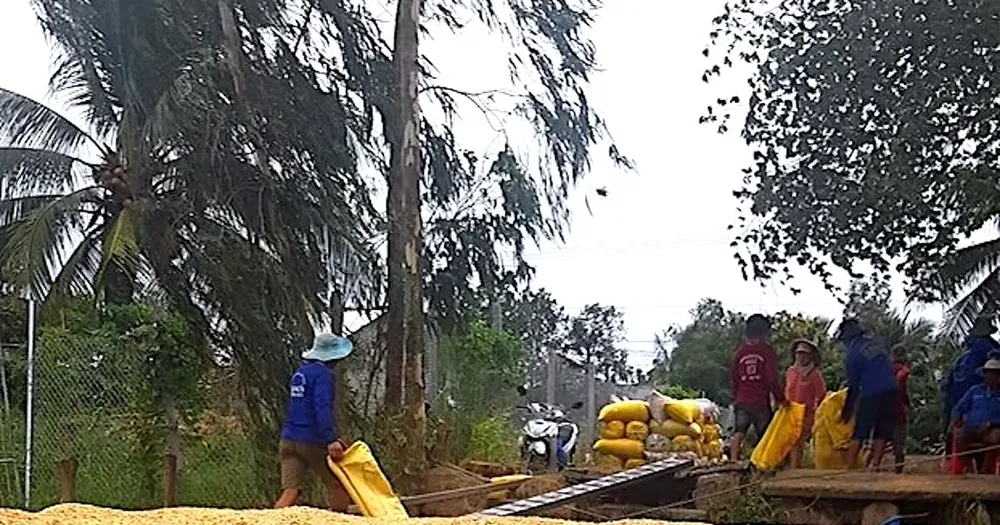
Nearly a month after the Prime Minister’s Directive No.21 regarding rice production and consumption management, the market still shows no signs of recovery. In the Mekong Delta, traders are merely purchasing winter-spring rice at VND5,000 – 5,500 (US$0.19) per kilogram, plummeting by VND2,200 – 2,700 ($0.09) compared to the beginning of the crop. With this dismal price, farmers renting land for cultivation will inevitably incur severe financial losses.
Meanwhile, the region has only harvested approximately 50 percent of the nearly 1.5 million hectares of winter-spring rice; the remainder is fully ripe but is being harvested cautiously due to an agonizing lack of commercial outlets.
Confronting this frustrating predicament, the Ministry of Agriculture and Environment alongside Mekong Delta provinces determined that facilitating credit support for enterprises to stockpile rice is the “optimal choice.” This is a familiar remedy, yet it remains glaringly insufficient, and at this time, it’s undeniably sluggish.
When the winter-spring crop enters its peak harvest and prices sharply drop, activating the stockpiling policy means the intervention severely lags behind the market. Its role in price regulation is virtually obliterated; the sole achievement is merely psychological reassurance.
Besides, not every enterprise can easily access preferential loans. Banks are still compelled to ensure strict credit safety, while rice stockpiling harbors a variety of latent risks, including prices continuing to plummet, uncertain export scenarios, and severely limited collateral.
For small and medium-sized enterprises, which are the primary driving force in rice procurement, capital barriers constitute a towering, insurmountable wall. Even if they secure loans, the agonizing equation consisting of interest costs, warehousing, wastage, as well as deeply uncertain commercial outlets compels numerous enterprises to opt out. Consequently, the policy exists, but both enterprises and farmers remain profoundly hesitant and frustrated.
This harsh reality demonstrates that a sole reliance on temporary stockpiling will inevitably lead to the vicious cycle of “a bumper crop with a price drop”. The fundamental problem doesn’t lie in a deficit of policies, but rather in the tragic reality that policies merely react after the devastating damage has already been inflicted.
What is desperately required is a remarkably different approach featuring proactive intervention from the very beginning of the crop, rather than scrambling for a desperate rescue at the end. The focal point is integrating enterprises deeper into the production chain, from placing orders and supplying materials to guaranteeing product consumption via contracts signed meticulously before the sowing phase.
When price risks are equitably shared from the outset, farmers no longer have to shoulder the painful burden alone during every harvest season. In An Giang and Dong Thap provinces, several linkage models adhering to this trajectory have proven that farmers’ selling prices are significantly more stable compared to selling through independent traders. This is the crucial direction that must be robustly replicated, not treated as a mere exception.
Concurrently, the capacity for forecasting export markets must be elevated to a substantive level. Vital information regarding demand, pricing fluctuations, and technical barriers from major markets must reach localities, enterprises, and farmers sufficiently early to strategically adjust production plans, not to be helplessly read after the rice is already piled high in the courtyards.
Regarding credit policies, instead of a blanket application, the support mechanism must be designed and linked to specific supply chains possessing unambiguous output consumption contracts. Capital flows directed precisely into stable production models will generate authentic efficacy, rather than merely compensating for temporary, devastating losses.
In the long term, avoiding the formidable infrastructure puzzle is an impossibility. Currently, the system of storage warehouses, processing plants, and logistics in the Mekong Delta remains severely deficient, transferring immense consumption pressure into individual harvest seasons rather than distributing it evenly. Diversifying export markets and alleviating dependence on a few traditional buyers also constitutes a pivotal element to ensuring that rice retains a remarkably more sustainable value.
Plunging rice prices aren’t a novel phenomenon, yet the response mechanisms can’t remain perpetually obsolete. It’s high time to decisively transition from a frantic “rescue” mindset to fundamentally reorganizing the market structure, ensuring that farmers no longer have to live in agonizing suspense during every harvest season.