According to data from the State Bank of Vietnam (SBV), total outstanding credit across the banking system increased by about VND2.2 quadrillion (US$85.2 billion) in the first nine months of 2026, helping provide capital for production, business activities, and key infrastructure projects. The active participation of banks, together with support mechanisms from the SBV, is providing an important boost to economic growth.
Banks are expanding funding for key infrastructure projects
According to the SBV, as of September 30, total outstanding credit in the banking system reached about VND20.75 quadrillion, up 11.59 percent from the end of 2025. Credit flows into the industrial and construction sectors posted positive growth. By the end of August 2026, outstanding loans in these two sectors totaled about VND4.9 quadrillion, up 12.05 percent from the end of 2025.
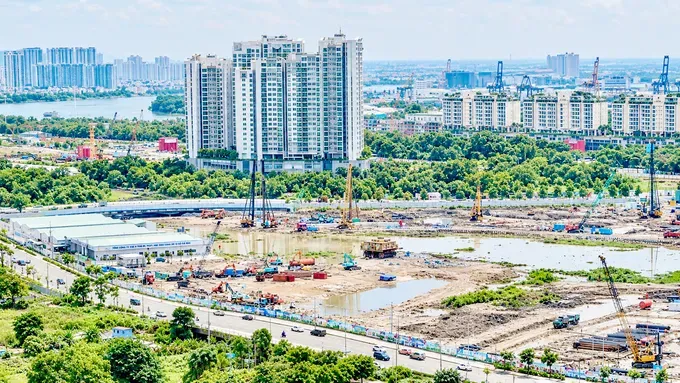
At commercial banks, construction lending rose sharply. By the end of September 2026, outstanding construction loans at Techcombank reached VND66.7 trillion, up 152.7 percent from the end of 2025, while VPBank's figure stood at VND68.9 trillion, up 27.73 percent.
The increase indicates that bank funding continues to expand, providing crucial resources for construction activities and infrastructure development. Many banks have proactively financed and arranged funding for large-scale transport projects. In mid-September 2026, Agribank signed a credit agreement for the Bao Loc-Lien Khuong Expressway project under the public-private partnership (PPP) model. The project has a total investment of VND17.718 trillion, of which Agribank will provide VND2.987 trillion in loans.
Similarly, BOT Saigon-My Thuan Company and a consortium of six banks led by Vietcombank signed a syndicated credit agreement with a total credit limit of nearly VND27.094 trillion to expand the Ho Chi Minh City-Trung Luong-My Thuan Expressway. NCB agreed to arrange a minimum credit facility of VND6.8 trillion through the end of 2027 for North Hanoi Infrastructure and Urban Investment Company while also coordinating to meet an expected funding demand of VND17 trillion for the road linking Gia Binh Airport with Hanoi.
Another notable development came in early July 2026, when the SBV instructed banks not to include outstanding loans for 18 major projects in their credit growth limits, aiming to facilitate and expand funding flows into sectors with spillover effects on GDP growth.
In addition, a credit program of up to VND500 trillion for power infrastructure, transport infrastructure and strategic technologies attracted registrations from 21 banks and will run through 2030. By the end of August 2026, outstanding loans under the program had reached VND16.91 trillion.
Rapid credit growth is increasing pressure on long-term funding sources.
SBV Deputy Governor Pham Thanh Ha said the banking sector has implemented various measures to create room for credit institutions to provide funding for priority sectors and key projects with regional connectivity and spillover impacts, helping achieve double-digit economic growth targets. In the fourth quarter of 2026, commercial banks are being guided to focus funding on growth drivers while maintaining strict control over lending to higher-risk sectors.
According to forecasts by VPBank Securities, credit growth for full-year 2026 could reach 16.5 percent, exceeding the SBV's guidance target of 15 percent. The main driver is expanded lending capacity resulting from the exclusion of 18 key projects from credit growth limits. With total funding demand estimated at VND752.138 trillion and expected disbursements of VND210.047 trillion in 2026, the mechanism is projected to contribute about 1 percent to overall credit growth.
Nguyen Tri Hieu, an economics, finance and banking expert, said that for full-year GDP growth to reach around 10 percent, fourth-quarter GDP growth would need to be about 12.5 percent. He noted that infrastructure construction investment should be prioritized because it not only creates social infrastructure but also generates employment and demand for construction materials, thereby supporting economic expansion.
However, FiinGroup Chairman Nguyen Quang Thuan said the banking system would find it difficult to meet all long-term funding needs for infrastructure. Such projects typically require 10 years to 15 years to recover investment costs. In addition, medium- and long-term international funding sources accessible to some banks remain modest.
While bank credit remains a vital source of funding for industry, construction, and infrastructure, Deputy Director Nguyen Xuan Bac of the Credit Department for Economic Sectors at the State Bank of Vietnam (SBV) notes that it can't be the sole channel for capital provision.
Developing infrastructure requires a diverse combination of resources, including state budget allocations, bank loans, Official Development Assistance (ODA), and capital from international organizations and foreign investors.