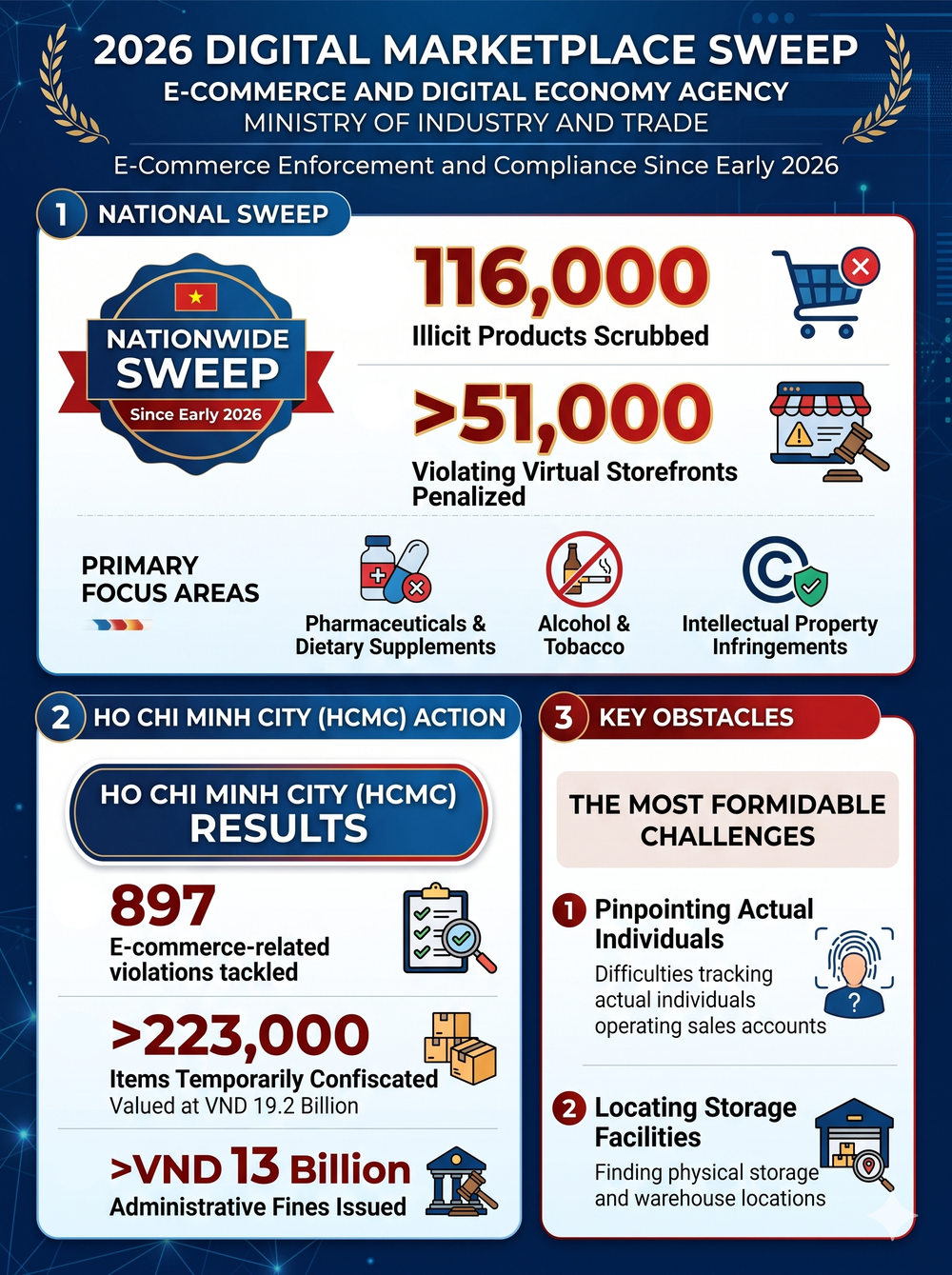
For Deputy Director General Lai Viet Anh of the E-commerce and Digital Economy Agency (Ministry of Industry and Trade), the recent crackdown is yielding tangible results. Authorities reportedly scrubbed 116,000 illicit products and penalized over 51,000 violating virtual storefronts since early 2026. This comprehensive sweep primarily honed in on pharmaceuticals, dietary supplements, alcohol, tobacco, and intellectual property infringements.
In HCMC, Deputy Director Nguyen Quang Huy of the municipal Market Management Department noted they’ve tackled 897 e-commerce-related violations this year. Forces temporarily confiscated over 223,000 items valued at VND19.2 billion (US$740,000), issuing administrative fines surpassing VND13 billion ($501,000). However, the most formidable challenge lies in pinpointing actual individuals operating sales accounts and locating physical storage facilities.
Sellers continuously alter accounts, addresses, and delivery mechanisms, systematically dispersing merchandise across multiple warehouses. Consequently, functional forces are compelled to synergize online surveillance with on-site inspections, meticulously cross-referencing transactions, invoices, and vouchers to track down violating entities accurately.
This complex reality necessitates a strategic method, transitioning from merely penalizing virtual storefronts to rigorously tracing sellers, merchandise origins, and sophisticated distribution networks. The 2025 E-commerce Law, effective as of July 1, 2026 alongside Decree No.248/2026/ND-CP, establishes a highly specific roadmap for the electronic authentication of sellers and livestreamers. Accordingly, this stringent authentication requirement will be rigorously enforced starting January 1, 2027.
Still, mere identification is just the initial step. Seller information must be thoroughly cross-referenced against tax data, payment records, invoices, transportation logs, and warehouse inventories in strict accordance with prevailing regulations.
From July 1, 2025, e-commerce platforms incorporating payment gateways will fall under regulatory purviews dictating the deduction, declaration, and remittance of taxes on behalf of business households. Controlling cash flows must also be inextricably linked to product traceability, particularly when livestreamers, sellers, and storage facilities encompass distinct entities.
Interconnecting data streams spanning platforms, tax authorities, market management agencies, and logistics providers will drastically facilitate the accurate determination of responsibilities. It effectively prevents attempts to spawn new accounts for re-offense.
Authenticating sellers must be inherently coupled with robust dispute resolution mechanisms, particularly when vendors remain unresponsive. For Lawyer Nguyen Hai Nam from Cong Quyen Law Office in HCMC, concrete evidence is paramount. Consumers need to retain invoices, order details, product images, labels, and communication logs when demanding refunds or lodging formal complaints, he explained.
Initially, buyers should proactively contact sellers for specific resolutions; if unsatisfied, they can legitimately request platform intervention. Should they uncover counterfeit merchandise, consumers possess the prerogative to alert market management authorities or submit petitions to the National Competition Commission or the Consumer Protection Association for requisite guidance.
If explicit hallmarks of fraud or counterfeit trafficking surface, these must be promptly reported to the police. Buyers also retain the legal right to file lawsuits demanding compensatory damages. Nevertheless, shielding buyers can’t rely solely on individual perseverance. Platforms are obligated to publicly disclose reception focal points, processing protocols, response timeframes, and coordination responsibilities, enabling buyers to track outcomes effectively.
Addressing brand impersonation, expert Nguyen Minh Man proposed enterprises should proactively safeguard their intellectual property, publicize official transaction channels, and deploy QR codes alongside authenticated vouchers. Management agencies ought to swiftly tackle impersonating accounts while constructing highly reliable databases enabling consumers to verify corporate credentials.
Guaranteeing personal data security is also paramount. It’s imperative to clearly delineate the scope of data collection alongside the specific responsibilities borne by all parties when breaches transpire. More importantly, a relentless tracking mechanism should be firmly established so citizens know exactly where to report issues and when to anticipate results. This actively prevents scenarios where platforms merely scrub products before letting the incident fade into obscurity.
Tightening managerial oversight must coincide with cultivating a healthy competitive environment. According to Chairman Huynh Anh Dung of the HCMC Consumer Protection Association, platforms must transparently disclose fee structures, pricing, shipping logistics, and transaction conditions.
This empowers buyers with adequate information while granting sellers access to highly stable policies. A transparent environment unequivocally shields legitimate enterprises from counterfeit goods and unfair competition.
HCMC is currently propelling e-commerce models transcending conventional online retail boundaries. On September 29, the HCMC Department of Industry and Trade, collaborating with Arobid Technology JSC., officially launched the Expo Platform. This sophisticated application integrates artificial intelligence to seamlessly connect enterprises with domestic and international buyers.
Subsequently, on October 1, the HCMC Investment and Trade Promotion Centre formally signed a cooperative agreement with Arobid to develop the ITPC Platform, facilitating trade promotion within the digital ecosystem.
For Deputy Director Le Van Danh of the HCMC Department of Industry and Trade, digital platforms serve as the extended arm of traditional trade promotion. Following a two-month trial run, the platform logged over 26,000 visits originating from 116 countries, garnering interest from over 100 investors. Substantial opportunities are also expanding within cross-border B2B e-commerce.
According to Head Nguyen Do Thao Quyen of Business Support at ICOM 2 Center, an authorized Alibaba.com agency in Vietnam, over 2,000 Vietnamese enterprises actively operate on the platform, predominantly concentrated in agriculture, textiles, and handicrafts. To harness this potential efficiently, enterprises must meticulously meet quality standards and bolster supply capacities while rigorously controlling participation costs.
Director Nguyen Huu Tuan of the E-commerce Development Center postulated that the market is steadily transitioning into a growth phase heavily prioritizing value and sustainability. With an estimated scale of approximately $32 billion, equivalent to nearly 12 percent of the nation’s retail sales, e-commerce still harbors immense untapped potential. Enterprises are strictly obligated to adhere to regulations concerning electronic invoicing.
Management agencies relentlessly continue perfecting legislative frameworks, supporting enterprises in technological adoption, and strengthening surveillance to steer toward a safe market.
For Dr Huynh Thanh Dien, Vietnamese enterprises still possess substantial potential in Business-to-Business transactions and logistics. Ultimately, the e-commerce market only truly flourishes when counterfeit goods are decisively intercepted, buyers are comprehensively protected, and Vietnamese enterprises possess sheer capacity to safeguard data and preserve the immense value they generate.

Deputy Director General Lai Viet Anh voiced that operating within the digital realm, particularly via livestreams, currently poses unprecedented challenges in managing merchandise and protecting consumers. This is primarily because the seller, broadcaster, and merchandise owner can encompass entirely distinct entities. Broadcasting locations shift constantly, while actual merchandise is stockpiled elsewhere, creating immense hurdles in attributing responsibility and tracking transaction footprints.
The 2025 E-commerce Law as well as Decree No.248/2026/ND-CP explicitly stipulate that platforms must systematically authenticate livestreamers’ identities according to a prescribed roadmap. They’re required to retain livestream data for a minimum of one year and promptly scrub violating content, executing removal requests within 24 hours of receiving formal directives. Furthermore, sellers and livestreamers are strictly mandated to provide thoroughly truthful information regarding their merchandise.
The Ministry of Industry and Trade determinedly focuses on elevating platform responsibilities concerning seller authentication and merchandise control. They’re bolstering coordination with the Ministry of Health to rigorously supervise and penalize illicit business practices and illegal pharmaceutical advertising.

For Chairman Huynh Anh Dung of the HCMC Consumer Protection Association, consumers must exercise profound prudence. Faced with an alarming proliferation of counterfeit goods, online shoppers ought to prioritize reputable storefronts while strictly examining origins, return policies, and hidden fees. They should proactively report issues to management agencies upon detecting infractions.
For sellers, transparency remains their absolute lifeblood. As platform costs invariably escalate, enterprises should heavily prioritize optimizing operations and publicizing prices rather than merely shifting financial burdens onto buyers. In the long term, architecting an equitable competitive environment with strong domestic digital platforms will substantially slash costs and shield legitimate enterprises.

Ms. Nguyen Do Thao Nguyen, Head of Business Support at ICOM 2 Center, noted cross-border B2B e-commerce unlocks fresh opportunities for Vietnamese enterprises. Importers can place modest orders to test samples before expanding; concurrently, supplier verification tools and artificial intelligence applications substantially mitigate inherent risks.
Since 2022, search volumes on Alibaba.com have skyrocketed by 160 percent, with participation costs ranging from approximately $1,999 to $10,000 annually. Therefore, enterprises must thoroughly calculate return on investment (ROI) and strictly meet quality standards. Technology creates connectivity, but flawlessly executing orders ultimately dictates their ability to retain international partners.








)