")
AI restructures film production
Artificial intelligence (AI) is becoming a member of the production process. What AI is bringing to the Vietnamese film industry is not a revolution that replaces humans, but a gradual shift in production methods. At the same time, it is confronting the industry with challenges related to copyright, data, and the role of human creativity.
So far, no Vietnamese theatrical film has been produced entirely by AI, but the technology has already been applied in multiple stages of filmmaking. The most notable examples are Chot Don (Confirm the order) directed by Bao Nhan and Namcito, and Mai No Mot Loi Tam Biet (Forever indebted to you for saying goodbye), directed by Jordan Schulz, where AI was used to replace actors' images following legal issues.
This demonstrates that AI is becoming both a production tool and a risk management solution, allowing film crews to avoid costly reshoots and delays to release schedules.
AI is also expanding creative possibilities in filmmaking. Director Pham Vinh Khuong has experimented with AI-produced films through Cham (Touch) and Loi Nguyen Anh Trang (Moonlight Curse). Two animated films, and De Men: Cuoc Phieu Luu Toi Xom Lay Loi (Cricket: The Adventure to the Muddy Village), directed by Mai Phuong have also used AI in stages such as idea development, character design, and data synthesis.
The horror film Quy Nhap Trang (The Corpse), directed by Pom Nguyen, used AI to compose and perform its theme song. Many other projects have employed AI to design movie posters and promotional images.
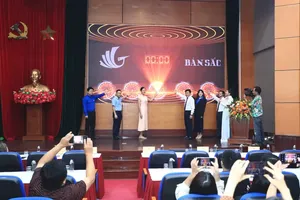
The emergence of competitions such as the Chanh Phuong AI Film Competition and Huyen Thoai Viet Qua Lang Kinh AI (Vietnam AI Film), launched by the Vietnam Association for Cultural Industry Development in collaboration with the Vietnam Fund for Supporting Literary and Artistic Creativity, also shows AI is becoming more deeply integrated into the film ecosystem.
According to director Charlie Nguyen, AI has proven most effective during post-production. Errors such as unwanted people appearing in scenes, imperfect backgrounds, or inadequate lighting can be corrected more quickly, significantly reducing the need for reshoots. More importantly, AI expands creative possibilities by helping screenwriters and directors visualize large-scale scenes or complex settings that were previously constrained by production budgets.
Domestic filmmakers are using AI tools developed by Hollywood, meaning many existing features will soon be widely adopted to reduce production costs, including storyboard creation, data management, audio processing, and actor lip-sync synchronization.
From another perspective, Dr. Vu Hoai Nam, head of the Applied AI Department at the Posts and Telecommunications Institute of Technology, and film critic Nick M (Mai Nhu Ngoc), deputy general director of TV360, both believe AI also holds significant potential in pre-production, production, and distribution.
"During distribution, AI can support translation, subtitling, dubbing, and data processing, creating more opportunities for Vietnamese films to reach international markets," film critic Nick M said.
According to Associate Professor Dr. Nguyen Thi Thu Phuong, director of the Vietnam Institute of Culture, Arts, Sports and Tourism, AI is already changing the operating structure of the domestic film industry. Previously, filmmaking followed a relatively stable sequence of creation, production, distribution, and archiving. In today's digital environment, however, films continue to exist as data that can be reused, processed, and circulated independently from the original work.
Meanwhile, Trinh Thi Thuy Lien, chief executive officer of VinStudio, said AI is no longer simply a technology concept but is directly affecting production costs, competitiveness, intellectual property value, and the future of the film industry.
Artificial intelligence is emerging as both a promise and a peril for Vietnam’s film industry. On one side, it offers a chance to close the gap in technology and special effects with global cinema giants. On the other, it raises urgent questions about safeguarding national identity and intellectual property in the digital era. The copyright framework should not be built on prohibiting technology, but on providing balance, emphasized Pham Thi Kim Oanh, Deputy Director of the Copyright Office of Vietnam. She noted that the law must uphold the principle of protecting genuine human creativity, while also ensuring an open and transparent environment that encourages businesses to invest in and apply cutting-edge scientific advances.
Clearer rules are needed for data and copyright
While AI expands creative possibilities, it also creates legal gaps.
According to lawyer Hoang Ha of the Ho Chi Minh City Bar Association, Vietnam has established legal foundations related to AI, including the Artificial Intelligence Law 2025, the amended Intellectual Property Law 2025, the Personal Data Protection Law 2025, and Decree No. 142/2026/ND-CP detailing several provisions and implementation measures of the Artificial Intelligence Law. However, regulations specifically governing AI in filmmaking remain incomplete.
"In my opinion, the biggest gap lies in determining authorship and ownership of scripts, images, music, or film scenes generated by AI. The law has affirmed that authors must be human, but it has yet to establish specific criteria for assessing the level of human creativity when AI is used," lawyer Hoang Ha said.
In addition, the use of copyrighted films, scripts, voices, or images to train AI systems is currently regulated only in principle. There are still no clear mechanisms governing permission, licensing fees, the right to refuse the use of works, or verification of data sources. The law also lacks specific provisions on creating "digital actors", recreating the faces or voices of artists, including deceased performers, as well as the scope of consent, duration of use, the right to withdraw consent, and remuneration.
According to Professor Ho Tu Bao of the Vietnam Institute for Advanced Study in Mathematics, the emergence of "digital actors" and "digital humans" represents a profound transformation that raises questions over ownership of faces, voices, and acting styles. As a result, filmmaking is becoming a major battleground for data rights and intellectual property.
From a regulatory perspective, Pham Thi Kim Oanh, deputy director general of the Copyright Office of Vietnam, identified two major challenges.
The first concerns input data. Legal conflicts arise when technology companies scrape and store copyrighted films in AI training datasets without permission, without identifying authors, and without paying royalties to lawful copyright holders.
The second is determining the legal status of AI-generated works and whether they qualify for copyright protection. Any answer carries significant legal consequences and requires new quantitative criteria to clearly distinguish between the use of AI as a tool and works independently created by machines.
In practice, the United States, South Korea, China, and the United Kingdom all limit copyright protection for AI-generated works. According to Bui Thi Bich Lien, a law lecturer at FPT University, Vietnam faces the same challenge as AI-assisted works remain in a legal gray area, posing substantial financial risks for businesses.
Looking further ahead, Professor Ho Tu Bao warned that the key issue for the film industry is not whether AI should be used, but ensuring that AI does not undermine human value. AI can be an extremely powerful tool, but it can't possess vision, a worldview, or life experiences to bring into artistic creation. In the AI era, preserving the central role of humans in creativity will remain the industry's most important boundary.