Between July 1 and October 28, 2025, thirty-four provinces and cities processed more than 14.5 million administrative dossiers, with 83 percent handled online. All communes, wards, and special administrative units paid salaries through the State Treasury, while local authorities assumed 56 percent of delegated tasks. These achievements demonstrate how the two-tier local government model is taking effect, reflecting the Party and State’s commitment to disciplined, responsible governance.
Administrative discipline strengthens public service
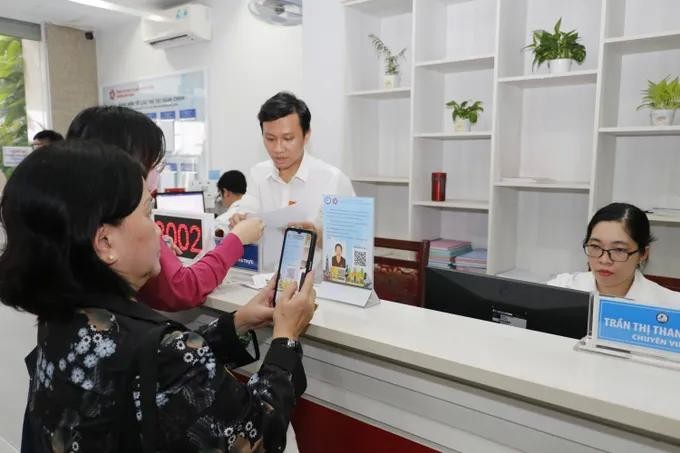
Late in the working day, the Lung Nam Commune Public Administration Service Center in Cao Bang Province was still crowded. Civil servants remained diligently at their desks assisting citizens, among them Hoang Van Thanh and his wife, ethnic Mong villagers from Lung Mung Hamlet, who came to apply for a VND40 million loan for livestock farming. They were unfamiliar with digital procedures and lacked complete documentation. Seeing their confusion, a commune officer patiently filled out the forms for them, guiding each step of the verification process.
After helping the couple complete their loan application, Hoang Van Dung, an officer at the commune’s Culture and Social Affairs Division, turned to assist other residents. “Under the two-tier local government model, there’s much more work than before, but fewer staff. Everyone has to multitask. Today I’m on duty at the service center; tomorrow I’ll be handling cultural and social paperwork. There’s no free time,” he shared.
In Lung Nam, limited facilities, outdated computers, unstable internet, and frequent software errors are daily challenges. Yet according to officer Hoang Van Dung, the greatest difficulty is that many residents are poor, illiterate, lack smart phones, or don’t speak Vietnamese fluently. Each time they come for administrative services, staff must guide them step by step, often writing or submitting forms on their behalf, and sometimes even using their own personal accounts to complete online filings.
From the mountain commune of Cao Bang to the megacity of Ho Chi Minh City, despite vast differences in geography and pace of development, one common trait stands out: the dedication and enthusiasm of civil servants operating within the two-tier local government system.
At the Go Vap Ward Public Administration Service Center in HCMC, fifteen counters handle around 600 applications a day, including property records. Officials not only receive and return results but also assist residents with online submissions and the digitization of documents, often working through lunch. Staff take turns eating quickly before returning to their desks, while specialists in the back offices rush to process documents so results can be delivered by early afternoon.
According to Deputy Director Nguyen Chi Thanh of the Go Vap Ward Service Center, the staff make an effort to finish their duties despite the heavy workload. “Many days, even after official hours, officers stay late to digitize and input data until midnight to ensure residents receive their results the next day,” he said.
Building trust by simplifying administrative procedures
Located more than 60 kilometers from central Hanoi, access to Minh Chau Commune primarily depends on ferry crossings over the Red River or a detour of over 30 kilometers. As a result, Minh Chau has long been considered a "low-lying" area in terms of geography and in public services and social welfare.
For generations, local residents have been accustomed to crossing the river by boat or ferry, often spending an entire day just to complete simple administrative procedures at Tay Dang town (in the past). Things began to change when the two-tier local government model was officially implemented in Minh Chau Commune. An online public administration system and a public service point were established right at the communal People's Committee headquarters, bringing public services directly to residents' doorsteps.
Meanwhile, at the Public Administration Service Center of Ho Chi Minh City’s Tay Nam Ward, to facilitate residents, the ward has assigned two volunteers to guide people in completing procedures both in person and online via the public service portal. The ward has also arranged a space with beverages and free Wi-Fi for residents to use while waiting for administrative procedures to be processed.
To streamline administrative procedures, the People's Committee of Tay Nam Ward launched the “No Appointment Day” model. Thanks to this initiative, Tay Nam Ward has established a mechanism for receiving administrative requests regardless of jurisdictional boundaries, enhancing transparency in the processing of documents. Citizens visiting the ward’s Public Administration Service Center now experience faster and more convenient service.
Although organizational frameworks can be reorganized and processes made more efficient, discipline and accountability continue to serve as the cornerstone of enduring governance. From the distant areas of Lung Nam to the lively avenues of Go Vap, and from the shores of Minh Chau to the core of Tay Nam, a cohesive spirit is emerging that civil servants are committed to accomplishing every task for the populace and upholding every obligation to the populace.
During the socio-economic discussion session of the 10th session of the 15th National Assembly on the afternoon of October 29, Deputy Prime Minister Pham Thi Thanh Tra remarked that the transition to a two-tier local government model is truly a ‘revolution’ in organizational structure. Administrative discipline, a sense of responsibility, and the determination to “build while improving” have enabled the new model to stabilize quickly. Over 83 percent of administrative procedures are now handled online, and 56 percent of tasks have been delegated to the local level—these “speaking numbers” affirm the right direction.
More importantly, public trust is being rebuilt through these very changes.