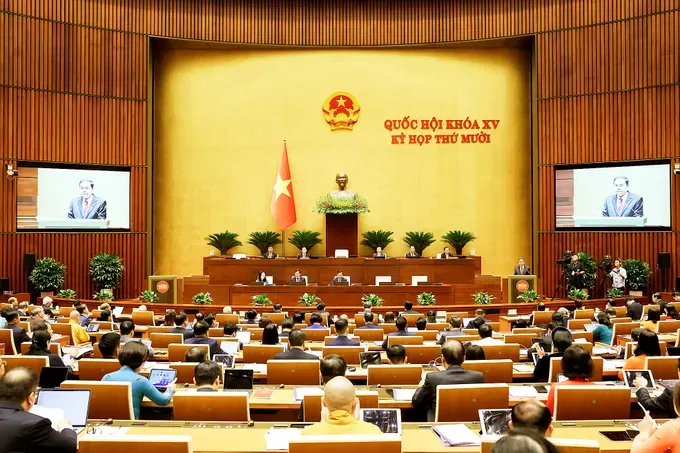
On January 6, 1946, the first General Election elected the National Assembly (NA) of the Democratic Republic of Vietnam, initiating the history of the Vietnamese NA. Through 15 terms, including nearly 40 years accompanying the “Doi Moi” (Renovation) process, the NA has continuously perfected institutions, creating an important legal foundation for the country’s development and integration.
The year 2025 was marked by a series of important resolutions, forming a comprehensive and synchronous development ecosystem.
To bring Party resolutions to life, the legislative machinery ran at full speed. On December 11, 2025, the 15th NA concluded its 10th session. In 40 working days, it reviewed and passed over 60 laws and resolutions, marking the session with the largest volume of legislative work in history. In total for 2025, across the 9th and 10th sessions, the NA passed 85 laws and over 70 resolutions, including 26 legal normative resolutions.
Notably, to meet development requirements in the new situation, at the 9th session, the 15th NA passed a resolution amending and supplementing several articles of the Constitution of the Socialist Republic of Vietnam. Passing this resolution, along with many laws regarding organizational apparatus, created an important legal basis for innovating, arranging, and operating the 2-level local government apparatus starting July 1, 2025, in line with the Party’s policy.
The NA also passed a series of resolutions to pilot superior mechanisms. Among them, the Resolution on the International Financial Center allows large private corporations to invest in high-quality infrastructure and financial services in Ho Chi Minh City and Da Nang City; a trio of resolutions on specific mechanisms for major projects in the Capital; pilots for Da Nang; and pilots for HCMC.
Beyond quantity, legislative work witnessed a breakthrough in mindset. It innovates towards turning laws and principles into framework while assigning the Government to detail regulations for flexibility. This embodies the spirit that “law must go one step ahead, paving the way for innovation, taking life and the people’s benefits as the measure of policy.”
There are many proofs of this legislative motto. To institutionalize Resolution No.68-NQ/TW dated May 4, 2025 on private economic development, the Law on Investment (amended) concretized the “post-check” mindset, drastically cutting conditional business lines and thoroughly decentralizing investment approval authority to localities.
The Corporate Income Tax Law (amended) applies preferential rates of 15-17 percent for small and medium-sized enterprises (SMEs), the majority component of the private economy.
The Personal Income Tax Law (amended) raises the tax-exempt revenue threshold for household businesses from VND200 million (US$7,600) to VND500 million ($19,000) per year, reducing the burden for millions of individual households.
The Law on Recovery and Bankruptcy (amended) simplified market exit procedures, protecting creditors’ rights and creating opportunities for private entrepreneurs to “start over” after risks.

To adapt to the 4.0 industrial revolution and to institutionalize Resolution No.57-NQ/TW, many important laws were drafted and issued for the first time to regulate new fields in socio-economic life, creating a foundation for new governance models, such as the Law on Digital Transformation, the Law on Artificial Intelligence (AI), and the Law on E-commerce.
To develop human resources and realize Resolution No.71-NQ/TW dated August 22, 2025 on breakthroughs in education and training development, the NA issued a trio of education laws (effective simultaneously from January 1, 2026, comprising the Law amending the Law on Education; the amended Law on Higher Education; and the amended Law on Vocational Education.
However, practical life is diverse and constantly changing, giving rise to countless new issues. Therefore, reviewing law implementation and assessing policy impact must be done regularly to timely detect and remove obstacles, preventing them from becoming bottlenecks hindering the country’s development journey.
Exhibiting documents on the 80-year journey of the Vietnamese National Assembly
On January 5, in Hanoi, the National Library of Vietnam opened the documentary exhibition “The National Assembly of Vietnam – An 80-Year Journey of Construction and Development.”
The exhibition displays nearly 800 documents across four sections, recreating the 1946 General Election; the National Assembly’s role in the struggle for national independence and reunification; and its role in the “Doi Moi” process alongside key decisions over 80 years.
The exhibition applies modern digital technologies, allowing viewers to access documents in vivid, visual forms convenient for research and interaction.
On the same day in Hanoi, Su That National Political Publishing House, in coordination with the National Assembly Office, organized a ceremony to introduce the book “80 Years of the National Assembly of Vietnam – Historical Imprints,” celebrating the 80th anniversary of the first General Election and looking towards the 14th National Party Congress.



)