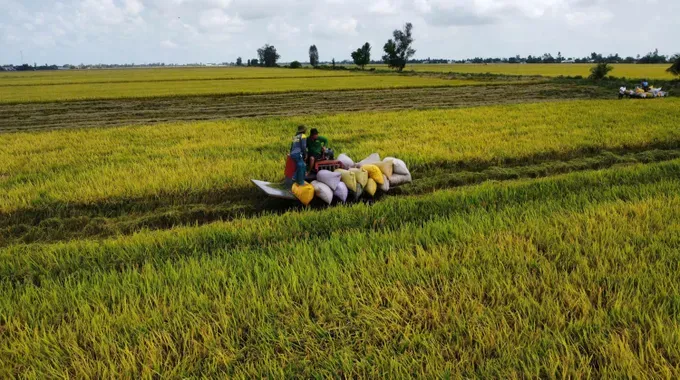
Across the fields in the Dong Thap Muoi region of Tay Ninh Province, the Winter-Spring rice is fully ripe, yet harvesting activities remain sparse. In several unharvested paddies, overripe rice has resulted in significant grain shedding.
Farmer Nguyen Van Loi from Tan Hung Commune informed that Dai Thom 8, OM18, and OM5451 rice varieties are currently being purchased by traders at merely VND5,500-6,000/kg (US$0.23), which is VND600-1,000/kg ($0.04) lower compared to the 2024-2025 Winter-Spring crop.
“After waiting a week for prices to inch up to no avail, my family just had to accept selling 3.5 hectares of OM18 rice at a low price. Deducting expenses, we barely broke even this crop. The primary cause is the sharp drop in rice prices, while the costs of fertilizers, pesticides, and combine harvester rentals have surged due to recent volatile fuel prices,” shared Mr. Loi.
In An Giang and Dong Thap provinces, thousands of rice farmers face a similar predicament. Dinh Van Hoa in An Giang Province reported his three hectares of rice fully ripened on March 10, but traders failed to arrive despite signed contracts and early deposits.
“They keep making promises, then call proposing a reduction in the selling price. Witnessing cases where failed negotiations led traders to forfeit deposits, while delayed harvesting causes substantial grain shedding, I agreed to sell at VND5,800 ($0.22) a kilogram, a VND200 decrease from the deposit price to avoid severe revenue loss,” Hoa explained.
He predicted that with rice prices dropping and massive harvesting costs, numerous farmers risk financial losses this season, particularly those renting land. According to rice export enterprises, declining prices stem primarily from the Middle East regional conflict, which drove up fuel, logistics, and maritime transport costs, compelling traders to purchase rice at lower prices.
Faced with this development, the agricultural sectors of localities in the Mekong Delta are deploying numerous solutions to support local rice farmers.
Deputy Director Tran Thanh Hiep of the An Giang Province Department of Agriculture and Environment stated his agency recently collaborated with the provincial Department of Industry and Trade to organize a conference promoting rice consumption, drawing 20 prominent enterprises and 40 exemplary cooperatives. Through this event, multiple purchase contracts were successfully signed.
“Furthermore, we proposed that the Department of Industry and Trade continue coordinating with the Northern and Southern Food Corporations to sign direct purchase contracts with cooperatives. Local commune and ward committees are instructed to organize monitoring of harvesting and consumption progress, formulating immediate resolution plans. We absolutely can’t allow ripe rice to remain unharvested,” Deputy Director Tran Thanh Hiep affirmed.
Chairman Pham Thai Binh of the Board of Directors of Trung An Hi-Tech Farming JSC. in Can Tho City evaluated that amidst a highly volatile export market and soaring transportation and logistics costs, purchasing rice for temporary storage is deemed an effective solution to stabilize prices. To expand the procurement of rice for temporary storage, banks should broaden credit limits for rice enterprises.
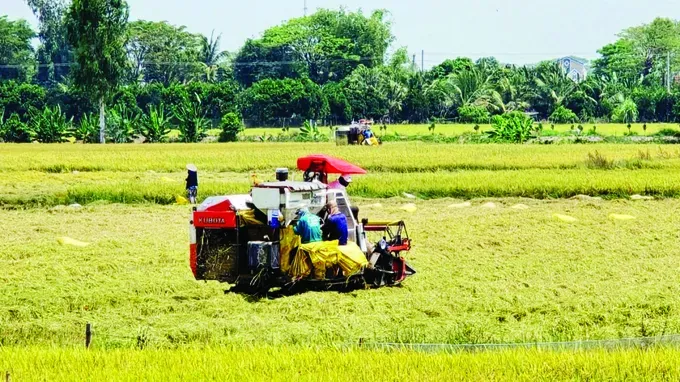
The Prime Minister directed the State Bank of Vietnam to allocate capital with reasonable interest rates and establish preferential credit mechanisms for enterprises. This supports buyers with substantial capacity to intensify temporary rice storage purchases from farmers. Chairman Pham Thai Binh recommended implementing this swiftly by compiling a comprehensive list of trading and exporting businesses needing to purchase rice for temporary storage.
Based on this, banks could provide brief loans to facilitate consumption. Abundant capital allows enterprises to proactively purchase crops without hasty sales. For farmers, receiving advance payments for materials and securing reliable consumption outlets with guaranteed favorable prices will simultaneously reduce production costs and boost income by thirty percent.
The Tay Ninh agricultural sector indicated they are perfecting the rice supply chain connecting farmers, cooperatives, and enterprises. Organizing production in stable zones with underwriting contracts and traceability elevates quality and mitigates output risks.
“Maintaining a system of support solutions for the rice sector is of paramount importance to ensure production efficiency, while concurrently striving toward the objective of maintaining a minimum profit margin of approximately 30 percent for rice growers.”
Deputy Minister Phung Duc Tien
Meanwhile, experts propose the Ministry of Agriculture and Environment intensify commercial negotiations, expand markets, and dismantle technical barriers.
Enhancing international dialogue and updating quality standards empowers enterprises to proactively meet specific market requirements. In addition, maximizing Vietnamese overseas trade offices and leveraging signed free trade agreements are crucial solutions to broaden export destinations and effectively reduce reliance on a few traditional global buyers.
Deputy Minister of Agriculture and Environment Phung Duc Tien analyzed that falling rice prices aren’t a new issue. Therefore, support solutions for the agricultural sector must be consistently and promptly deployed. Localities need to accelerate the program developing one million hectares of high quality and low emission rice in the Mekong Delta to enhance crop value.
Also, the State Bank must collaborate with financial institutions to establish credit mechanisms with appropriate interest rates supporting enterprises in purchasing, processing, and exporting rice. Another pivotal solution is organizing temporary storage during peak harvest seasons to stabilize the market. Localities must decisively implement these specific strategies.
For the 2025-2026 Winter-Spring rice crop, the Mekong Delta region has a sown area of nearly 1.5 million hectares, with estimated rice production reaching 10-11 million tonnes. Currently, localities in the region have only harvested about 40 percent of the area. Plummeting rice prices, coupled with escalating harvesting and transportation costs, are causing thousands of farmers to encounter severe output difficulties.
Statistics from the Customs Department under the Ministry of Finance reveal that in the first two months of 2026, Vietnam exported approximately 1.27 million tonnes of rice, generating $594 million, an increase of 3.5 percent in volume but a decrease of 11.9 percent in value compared to this time last year, owing to a sharp drop in the average rice export price. The Philippines remains Vietnam’s largest rice consumption market, reaching 178,100 tonnes over the two months.