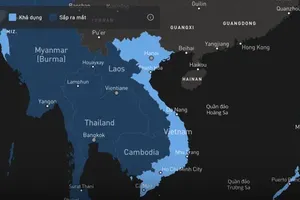
According to the recently released Speedtest Global Index by Ookla, the technology company behind the global Speedtest internet speed measurement tool, Vietnam’s mobile internet speed rose 10 places in July to rank 10th worldwide, with a median download speed of 205.58 Mbps. Fixed broadband also climbed one place to rank seventh globally, with a median download speed of 307.11 Mbps.
The results are significant not only in terms of rankings but also reflect substantial improvements in the quality of Vietnam’s connectivity and telecommunications infrastructure following years of investment in fiber-optic networks, transmission infrastructure and, particularly, the commercialization of 5G networks.
In Ookla’s July mobile internet rankings, Vietnam was the market with the strongest improvement in ranking. In less than two years, the country’s mobile internet speed has risen sharply. At the end of 2024, download speeds stood at about 87 Mbps, ranking 37th worldwide. By March 2025, the speed had increased to about 144 Mbps, putting Vietnam among the world’s 20 countries with the fastest mobile internet for the first time.
By July 2026, the speed had surpassed 200 Mbps, placing Vietnam among the global top 10. For fixed broadband, speeds rose from about 159 Mbps at the beginning of 2025 to more than 307 Mbps by mid-2026, nearly doubling in about 18 months.
Vietnam’s continued improvement in internet rankings is not the result of a short-term campaign but the outcome of years of investment. Coordination between policy and investment is gradually helping complete the digital infrastructure ecosystem. As of August 2026, Vietnam had about 131.7 million mobile broadband subscriptions and nearly 24.8 million fixed broadband subscriptions.
Following the trial period, domestic telecommunications companies have increased investment in 5G networks since late 2024, expanding the number of base stations and optimizing transmission infrastructure. The country currently has 42 commercial data centers, with a total designed capacity of about 372.75 MW, providing a foundation for the development of cloud computing, AI and large-scale digital services. These figures show that Vietnam’s digital infrastructure foundation continues to expand.
Although Speedtest results do not fully reflect every aspect of internet quality, Vietnam’s ranking among the world’s top 10 in median download speeds for both mobile and fixed broadband is important for the development of the digital economy.
High-quality digital infrastructure can help businesses reduce operating costs, increase Vietnam’s attractiveness to technology investors, and promote the development of data centers, cloud computing, AI and high-tech industries. It is also an important condition for implementing digital government, the digital economy and digital society in line with Vietnam’s development goals.