With AI now able to write, code and process data, businesses and society are looking for “AI builders” who can develop, operate and manage AI agents for practical applications.
The launch of ChatGPT in late 2022 triggered a global boom in generative AI. However, the rapid adoption of AI has also raised growing concerns over cybercrime, misinformation and fraud in education.
At the Vietnam AI Forum 2026, held recently in Hanoi, Professor Alisha Holland, Director of Graduate Programs at Harvard University’s Kennedy School of Government, said that modern education is struggling to assess how students interact with AI.
Rather than debating whether AI should be permitted or banned, she said schools should develop frameworks to measure students’ critical thinking and ability to use AI effectively.
After years of competing to build increasingly powerful AI models, the world is now moving toward the development of trustworthy AI. From the European Union’s AI Act to guidelines and principles promoted by OpenAI, Google and Meta, responsibility, trust and transparency are becoming increasingly central to AI development.
Nguyen Anh Tuan, Executive Director of the Boston Global Forum, described students as “architects of society” in the AI era rather than simply future engineers. He encouraged young people to consider who would benefit, who could be harmed and how technology could strengthen trust before building any product.
Mr. Nguyen Khuong Duy, Product Director at FPT AI Factory, said that Vietnam has a large pool of enthusiastic, hands-on engineers, but still lacks clear direction and a supportive environment to turn ideas into real-world applications.
He called for deeper government guidance on AI training and adoption across different industries.
The rise of AI builders
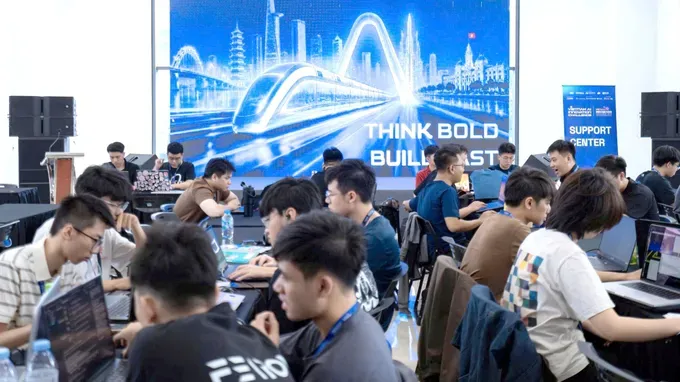
At the Vietnam AI Innovation Challenge 2026, Vietnam’s largest national AI programming competition, more than 50 real-world challenges from businesses and local authorities were presented to 340 teams, which had just 48 hours to develop AI-based solutions.
Tran Van Luc, born in 2003 and Director of Awake Drive Joint Stock Company, said that his team developed a platform that provides real-time Vietnamese-English interpretation for meetings.
The challenge was less about coding than about quickly understanding users’ needs and identifying the features that would deliver real value, he said.
With AI increasingly capable of handling technical tasks, the competitive edge of AI builders lies in product thinking, customer understanding, financial knowledge and team-management skills, he added.
According to Tran Viet Hung, Director of AI for Vietnam, ChatGPT, Gemini and Claude can be likened to “engineers” that are always ready to work.
The competitive advantage is shifting from simply using AI to managing AI agents, identifying problems and setting goals, developing solutions, and coordinating AI systems to execute them.
The ability to rapidly assess AI-generated results is equally important, as AI can still produce inaccurate or unreliable outputs, he said.
Speaking to Sai Gon Giai Phong (SGGP) Newspaper, Thao Griffiths, Meta’s Public Policy Director for Vietnam, Laos, Cambodia and Myanmar, said that the link between university research and businesses remains a weak point in Vietnam’s AI ecosystem and should be strengthened through competitions and practical collaboration.
Vietnam’s hosting of APEC in 2027 presents an opportunity to put AI at the center of regional discussions. She expressed hope that Vietnamese AI talent will gain greater international exposure and that Vietnam will attract leading AI professionals from around the world for competition and collaboration.
A stronger combination of the country’s growing AI ecosystem and business readiness could make an important contribution to the country’s goal of achieving double-digit economic growth over the next five years, she added.
Mastering AI infrastructure
AI infrastructure can cost more than US$2,000 per hour when left idle, making performance and processing optimization one of the sector’s major challenges.
Mr. Nguyen Khuong Duy said that the next generation of AI builders should therefore be trained to understand how AI systems operate at a deeper level. They need to be able to evaluate AI-generated results, adapt to new human-AI interaction models and master AI infrastructure, rather than focusing solely on developing applications.
As AI becomes increasingly accessible, the ability to use it will no longer be enough. The emerging advantage will belong to those who can build, orchestrate, evaluate and responsibly deploy AI to solve real-world problems.