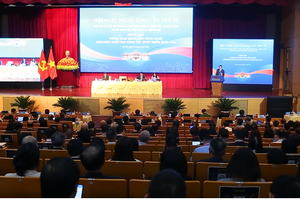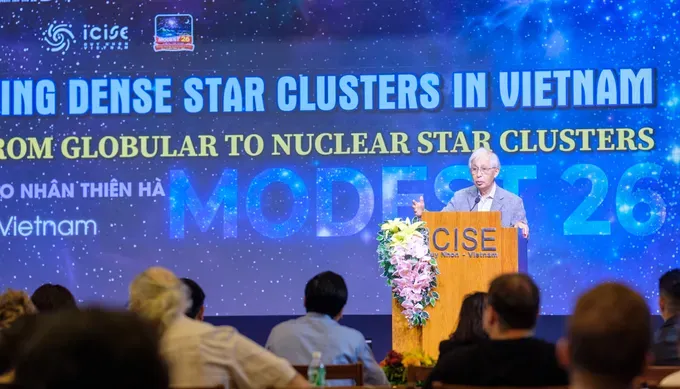
On August 17, the Rencontres du Vietnam Association, in collaboration with the international MODEST-2026 Organizing Committee, opened the international conference on “Modelling and Observing Dense Star Clusters in Vietnam Dense Stellar Systems from Globular to Nuclear Star Clusters” (MODEST-26) in Gia Lai Province.
Taking place from August 17 to 22, the conference brings together more than 70 scientists, young researchers, and PhD candidates from 24 countries.
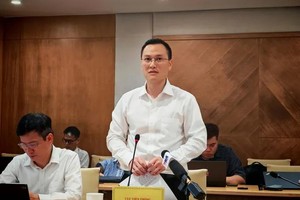
According to Dr. Tran Thanh Son, Deputy Director of the International Center for Interdisciplinary Science and Education (ICISE), MODEST is an international research community focusing on the modeling and observation of dense stellar systems. The first MODEST conference was held in 2002 and has since become an annual scientific forum for stellar dynamics, numerical simulations, stellar evolution, binary and multiple-star systems, compact objects, and gravitational waves.
The hosting of MODEST-26 in Vietnam provides an opportunity to strengthen scientific exchanges and promote research cooperation between the international MODEST community and Vietnamese scientists, while expanding links with research communities across the Asia-Pacific region.
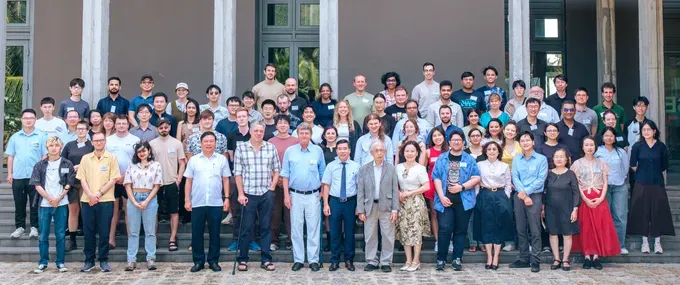
Under the theme “Dense Stellar Systems, from Globular Clusters to Galactic Nuclear Star Clusters,” MODEST-26 focuses on the modeling and observation of single, binary, and higher-order multiple-star systems.
The conference also addresses compact objects such as neutron stars, millisecond pulsars, black holes, and X-ray binary systems. These are key targets in multimessenger astrophysics, which combines data from electromagnetic radiation and gravitational waves.
Participants are also exchanging views on modeling methods, data-analysis techniques, and the training of the next generation of astrophysicists.
As part of the conference, scientists are discussing the formation and evolution of dense stellar systems throughout cosmic history, the role of star clusters in galactic archaeology, and the formation and development of nuclear star clusters and their interactions with intermediate-mass and supermassive black holes.
Astronomical transients and gravitational-wave sources are also being studied in the context of future multimessenger observations.