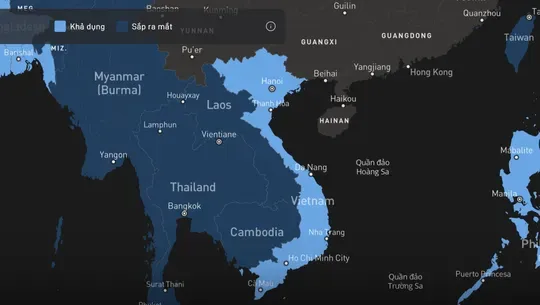
On August 13, Starlink officially launched its satellite internet services in Vietnam. Customers can effortlessly access Starlink’s website to register for the service. However, on the map of Vietnam featured on the service registration page, the names of the two archipelagoes, the Paracel Islands and the Spratly Islands, both under Vietnam’s sovereignty, didn’t show up.
By 11:00 p.m. on August 13, this glaring omission hadn’t been rectified.
Following a prompt report by Sai Gon Giai Phong Online, by the morning of August 14, the Starlink satellite internet service map in Vietnam had successfully displayed the complete names of the two archipelagoes, the Paracel Islands and the Spratly Islands, which firmly belong to Vietnamese sovereignty.
Previously in February, Starlink Services Vietnam LLC was granted two licenses by the Authority of Telecommunications under the Ministry of Science and Technology to provide telecommunications services featuring network infrastructure.
This authorized the company to roll out pilot services utilizing low Earth orbit satellite technology across Vietnam, accommodating a maximum of 600,000 subscribers, equivalent to roughly 2.5 percent of the total fixed broadband subscribers currently existing in the country.
Based on information published on the website, the Starlink service tailored for households in Vietnam costs VND1,131,990 (US$43.4) per month for a speed of 100Mbps, and VND1,711,100 ($66) per month for the maximum speed package. The initial payment sits at VND10,848,800 ($416) including taxes, wherein the Standard 4X equipment is priced at VND10,269,900 ($394) alongside a shipping and handling fee of VND578,900 ($22).
Starlink is a sophisticated satellite internet system developed by the US-based company SpaceX, operating on a vast network of thousands of low Earth orbit (LEO) satellites. Unlike traditional internet services that heavily rely on fiber optics or ground-based network infrastructure, Starlink beams signals directly from satellites straight down to the user’s receiving equipment.