AI negatively exploited
Previously, distorted information was confined to obscure websites and blocked if malicious signs appeared. However, in recent years, ill-intention people shifted entirely to social media channels with large user bases and high interaction, easily triggering a “herd mentality” effect with just a few lines of text or short videos.
Fabricated content often no longer requires real people. A paragraph of text, an AI voiceover, and a few illustrations are enough to create a video full of accusations, which is then shared continuously across numerous pages and groups.
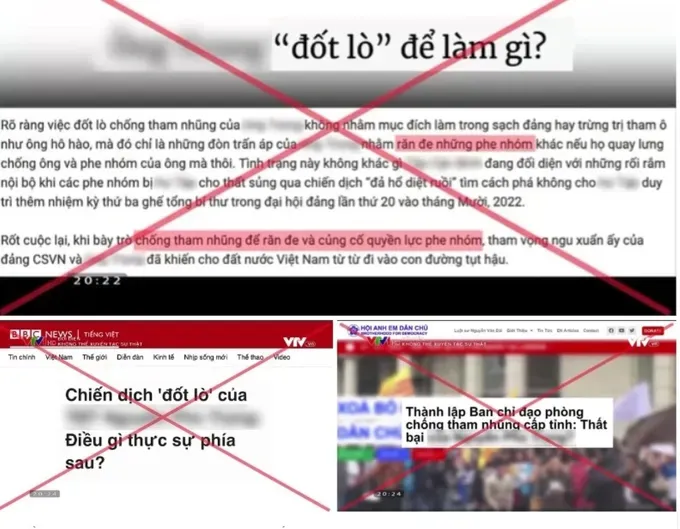
For instance, a social media channel named “KTV Viet Thanh” with over 50,000 followers recently posted a video featuring an AI-generated commentator analyzing and distorting the truth about Vietnam’s political situation before the 14th National Party Congress. The content included baseless accusations such as “A calculated chess game is opening up” or “Power truces between factions.”
More sophisticatedly, malicious individuals cunningly use AI to launch a “new version” of sabotage tactics, such as using software to generate fake news, creating deepfake videos (grafting one person’s face/voice onto another) where leaders appear to make false statements, or even setting up chatbots to automatically comment and spread distortions to mislead the online community.
Head Ngo Tuan Anh of the Data Security Department at the National Data Association explained that in the digital age, by simply inputting text and a few sample audio clips, AI systems can generate new audio matching the desired voice. While using AI to mimic celebrities is often for engagement or scams, impersonating Party and State leaders to distort facts and smear reputations is far more dangerous, causing public confusion.
Proactively holding ground
Cyberspace is currently being actively defended, not abandoned. Holding the “ideological ground” in the digital age involves not only speaking the truth but doing it quickly, with verification, and in a relatable manner for readers to cross-reference. This approach is being implemented from government agencies to grassroots military units.
Recently, following the rearrangement of the 2-tier local government apparatus, many wards and communes in HCMC have actively established Facebook fanpages to update local information regularly. These pages post local activities while refuting distorted content when necessary.
Take the Fanpage of the An Nhon Ward Party Committee as an example. It has recently posted a reminder: “Do not confuse legal democracy with abusing democratic freedoms to oppose the Party and State.”
Meanwhile, the Binh Thoi Ward Fanpage posted the message: “Be alert to tricks borrowing political rhetoric for sabotage.” The Ben Thanh Ward Fanpage, named “Thu Ngu Flagpole”, posted: “Strongly remove toxic information opposing the Party Congress in cyberspace.”
Not only local authorities but military and police units also maintain duty to propaganda channels on social media.
Lt. Col. Ngo Truong An, Political Commissar of the Gia Dinh Regiment, stated that cyberspace has become an important “front” in ideological work. Refutation is no longer just the task of superiors but requires proactivity from grassroots units.
At the Gia Dinh Regiment, the Fanpage “Rung Lang An Nhon Tay” is operated by political officers and tech-savvy Ho Chi Minh Communist Youth Union members. The page shares unit stories and updates refutations when false narratives regarding the military appear.
The page “HCMC Patriotic Youth” of the HCMC High Command is also a trusted source for young people to verify information. Established based on the scheme to prevent “peaceful evolution” and directives from the General Department of Politics, it is supported by a team of theoretical experts. When false information arises, experts analyze it with evidence to refute it, providing readers with a clear reference source.
The Lai Thieu Ward Police Fanpage regularly posts updates on security and fire safety while warning viewers to be vigilant against AI deepfake tricks in the context of the upcoming 14th National Party Congress.
The HCMC Party Committee’s Commission for Propaganda and Mass Mobilization assesses that cyberspace is a vital front for fighting toxic information and fake news, particularly the rising use of AI and cyberattacks on state systems.
Consequently, the system of Steering Committee 35 (responsible for protecting the Party’s ideological foundation) at all levels has been consolidated. Functional agencies have proactively reacted fast to false information, verifying and providing official information for effective rebuttal.
Recently, the HCMC Commission for Propaganda and Mass Mobilization and Center 286 (under Military Region 7) signed a coordination regulation. This program helps HCMC shift from a reactive state of “chasing” fake information to proactively grasping, forecasting, and preventing ideological security risks early.
Colonel Nguyen Duc Tuyen, Commander of Center 286, noted that before the 14th National Party Congress and the elections for the National Assembly and People’s Councils (2026-2031 term), toxic and fake news causing social media chaos is very complex. This is the time hostile and reactionary forces intensify sophisticated sabotage. Therefore, the coordination helps deploy a program to clean cyberspace, removing dirty information and smears against leaders, contributing to the success of the 14th National Party Congress.
Truong Hoang Duc from the Academy of Politics Region II argued that manual methods are insufficient against sophisticated cyber sabotage. He called for inter-agency regulations applying AI to protect the Party’s ideological foundation. Specifically, he proposed establishing a “Regional AI Cyberspace Information Monitoring and Analysis Center” under Steering Committee 35 to serve as a technological focal point for identifying and preventing toxic content.