These days, the Dong Thap Muoi region in Tay Ninh Province is entering its fishing season. Practical observations reveal that, alongside conventional fishing methods, residents still use undersized nets or electric pulses to catch aquatic products, especially along the canals in Tuyen Binh, Tan Hung, and Vinh Hung communes.
Lieutenant Colonel Doan Chi Hai, Chief of the Vinh Hung Commune Police in Tay Ninh Province stated that the local police have regularly maintained patrols and controls recently. Since the beginning of the flood season, the commune police have confiscated and destroyed 3 electric shock devices and 24 nets that did not meet the size regulations for aquatic exploitation. However, violators often use electric shock equipment at night to evade law enforcement.
Similarly, in Dong Thap Province, the use of explosives, electric shocks, and poisons to harvest aquatic products has posed a serious threat to aquatic resources for many years. Recently, the Tan Phuoc 1 Commune Police discovered two cases of individuals using electric shock tools for fishing. Seized evidence included 2 batteries, 2 electric pulse units, 2 dip nets, 1 composite boat, 1 gasoline engine, and other related items.
This situation is also common in the provinces of Ca Mau, An Giang, Vinh Long, and Can Tho City. Preliminary statistics from local authorities reveal that in the pineapple field areas of the Dong Thap Muoi region in Dong Thap Province, 165 suspects are believed to be illegally fishing with electric pulse devices.
The U Minh region in Ca Mau Province has long been famous for its abundant freshwater fish resources. However, due to prolonged, uncontrolled overexploitation, these resources have increasingly declined. Although many farmers want to restock and restore the fish populations, they are deterred by the fear of theft, particularly the use of electric shocks that kill both mature and juvenile fish.
Lieutenant Colonel Phan Van Minh, Deputy Head of the Advisory Division of the Dong Thap Provincial Police, pointed out that the use of electricity for fishing is widespread, especially during the flood season. “This behavior has severely impacted the ecological environment and aquatic resources, and can even result in human fatalities,” warned Lieutenant Colonel Phan Van Minh.
According to the Department of Agriculture and Environment of Dong Thap Province, functional agencies have developed plans to inspect the transport, storage, and use of banned fishing gear in the area. Simultaneously, they are stepping up public awareness campaigns so citizens understand that protecting aquatic resources is everyone’s responsibility.
Recently, Ca Mau Province has synchronously deployed multiple measures to prevent destructive fishing practices, in accordance with Directive No. 17-CT/TU and Directive No. 27-CT/TU of the Standing Committees of the Ca Mau and Bac Lieu Provincial Party Committees.
Since 2024, forces have mobilized citizens to hand over more than 3,430 electric shock devices and destroyed 1,210 of them. They have also organized the signing of commitment pledges with 177,000 households; handled 1,320 violations with fines totaling over VND5.6 billion ($214,000); penalized 42 cases of trading and storing illegal electric shock tools; confiscated various banned fishing gears; and prosecuted 12 cases involving 12 defendants for the crime of destroying aquatic resources.
Among these, several cases were brought to public mobile trials, resulting in prison sentences for many defendants. This serves as both a deterrent and an educational measure to prevent citizens from engaging in destructive fishing.
Chairman Tran Ro Y of the Farmers’ Association of Nguyen Phich Commune in Ca Mau Province reported that the commune is currently implementing a project to restore freshwater field fish resources across 150 hectares, with 15 households supporting.
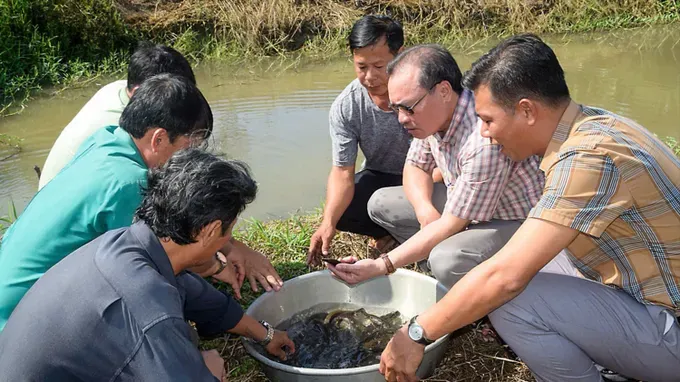
Participating families will invest in building embankments, renovating ponds and ditches, and then releasing fingerlings (mainly snakehead fish and yellow catfish, the species typical of the U Minh region). Currently, this model is developing well, bringing an income of VND20-30 million (US$764-1,146) per year for each household.
“People mainly harvest the large fish, leaving the small ones to continue growing before catching them to sell. Now people feel more secure and are no longer afraid of electric shock fishers catching both large and small fish alike,” shared Chairman Tran Ro Y.
Director To Hoai Phuong of the Ca Mau Department of Agriculture and Environment informed that in the coming time, the province will continue to intensify patrols, inspections, and close coordination between all provincial levels and local authorities to stop destructive fishing. The province will also continue to urge residents to hand over explosives, electric shock devices, toxic chemicals, and banned fishing gear, and to sign commitments against using destructive harvesting tools.