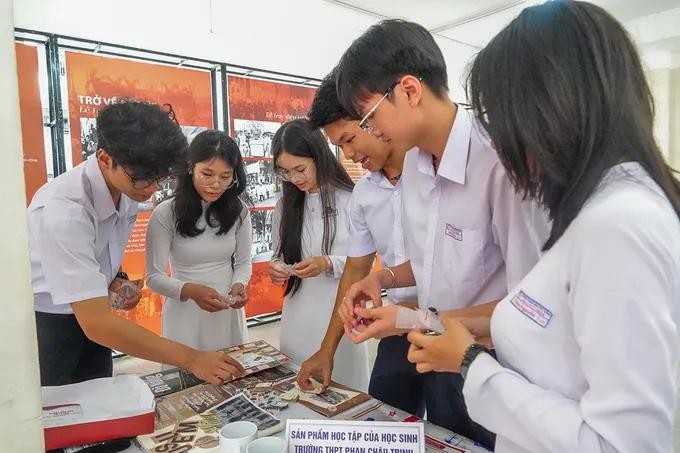
The board game Tai hien chien dich Hue - Da Nang ( Reenacting the Hue-Da Nang Campaign), handcrafted by students at Phan Chau Trinh High School in Hai Chau Ward of Da Nang City, is opening up a more relatable and vivid approach to history for the younger generation.
Inspired by the familiar mechanics of Monopoly, the board game created by students of class 12/3 at Phan Chau Trinh High School features entirely unique content. The entire game revolves around the events, landmarks, and historical milestones of the Spring 1975 offensive in the Da Nang-Hue region.
Ho Minh Quan, a student from class 12/3, recounted that the team spent many late nights poring over documents, verifying sources, and weaving historical narratives into the game. He admitted that collaborating on such a demanding subject as history was far from seamless.
"There were many times we argued and had conflicts, but in the end, we all sat back down to edit every detail. The most memorable part was processing the visuals right before exam season; everyone was busy, but we still dedicated a full day to finishing it," the twelfth grader shared.
Nguyen Thien Nhan explained that the idea came from a shared concern about how to make history feel less “dry” for students. The members wanted to integrate history into a game so that peers could learn while playing. The group experimented with various formats, from traditional games like O An Quan (Mandarin Square Capturing) and jump rope to modern games. After much consideration, Monopoly was chosen because it easily incorporates events and timelines. Crucially, the game had to be entertaining while helping players absorb knowledge naturally.
Learning history through experience
According to Ms. Nguyen Thi Viet Ha, Head of the History Department at Phan Chau Trinh High School, the students' creativity aligns with the experiential learning orientation of the 2018 General Education Program. Since the beginning of the year, the department has developed plans for students to learn history through hands-on experience. Students visit museums such as the Da Nang Museum, the Cham Sculpture Museum, the Hoang Sa Exhibition House, and the Military Zone 5 Museum, or conduct their own group trips.
Each journey is designed as a "learning script," from preparation and reconnaissance to a system of specific questions and tasks. At the destinations, students participate in "stations" to study artifacts and record information for data collection. "Instead of writing traditional reports, the school encourages students to find new forms of expression and create products to promote the country's culture and history," Ms. Ha stated.
During this process, the class 12/3 group proposed the idea of the "Reenacting the Hue-Da Nang Campaign" board game and received support from their teachers. However, to finalize it, the students had to revise it many times. Some details that seemed minor required redoing because they were factually inaccurate, such as AI-reconstructed images of the Hai Van Pass in March 1975, military vehicle models, soldiers' uniforms, and attack directions. "Everything must ensure historical accuracy and requires careful cross-checking and verification," Ms. Ha shared.
Every detail was critiqued and adjusted, with information checked against multiple official sources. This process not only perfected the product but also helped students gain a deeper understanding of history. Pham Tan Ngoc Thuy, Deputy Director of the Da Nang Department of Education and Training, assessed that this new approach suits the psychology of the age group. It makes History more vivid and accessible while fostering creative thinking and teamwork skills among students.