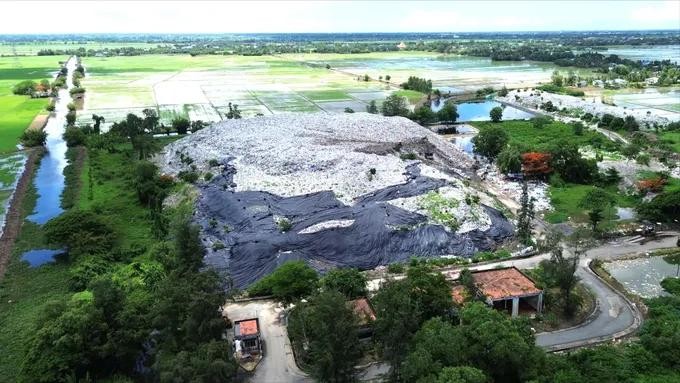
Many southern provinces and cities are struggling to manage solid waste. In some localities, hundreds of thousands of tons of garbage have accumulated, while disruptions in waste collection have affected the environment and residents' quality of life.
Garbage collection delayed in residential areas
As she packed piles of household garbage into large sacks and tied them shut, dweller Vo Thi Thu Ba, who lives on Street 21 in Residential Area 586, Hung Phu Ward, Can Tho City, said, "For the past 10 days, the waste collection company has not come to pick up our garbage. My family and our neighbors have had to do this to reduce the foul smell."
According to resident Thu Ba, garbage collection has been severely delayed since late April 2026. At first, collections were delayed by three to four days, but later the delays stretched to as long as 10 days. As garbage decomposed, foul odors spread throughout the neighborhood. When residents raised complaints, they were given various explanations, including workers taking sick leave, overloaded landfills, and unpaid wages for collection staff.
The problem is not limited to Residential Area 586. Large piles of garbage have also accumulated along streets in Cai Rang, Tan An, and Ninh Kieu Wards. On Truong Vinh Nguyen and Le Binh streets in Cai Rang Ward, mixed waste has formed large heaps, with leachate flowing onto the roadway.
Hundreds of thousands of tons of waste accumulated
In An Giang Province, hundreds of households in Binh Hoa Commune have repeatedly complained to local authorities and relevant agencies about environmental pollution caused by the Binh Hoa landfill. A representative of An Giang Urban Environment Joint Stock Company, the province's waste collection operator, said that although the landfill has exceeded its capacity, it continues to receive more than 300 tons of waste each day from three wards and 11 communes.
According to the An Giang Province Department of Agriculture and Environment, the province has 24 open-air landfills that have ceased operations after exceeding capacity, with an estimated backlog of nearly 154,000 tons of waste.
In Dong Thap Province, numerous landfills are also under intense pressure. The most serious case is the Long Chanh landfill in Binh Xuan Ward, where more than 40,000 tons of waste have accumulated. According to reports, the landfill is overloaded while management by the responsible operator has been neglected. In addition to organic and inorganic waste, residents have also been dumping septic tank sludge at the site.
In Vinh Long Province, conditions have improved somewhat after the provincial Department of Agriculture and Environment built embankments and upgraded landfill cells at the An Hiep landfill, the province's largest disposal site. The amount of garbage piling up along streets, in markets, and in parks has declined. However, local residents said this is only a temporary solution, warning that the risk of another waste management crisis remains because the Ben Tre Waste-to-Energy Plant has yet to begin operations despite years of development.
The problem is not confined to the Mekong Delta. Eastern Lam Dong Province is facing a similar situation. The Phan Thiet Waste Treatment Plant in Tien Thanh Ward, invested in by Nhat Hoang Company, has been suspended since July 1, 2025. The Lam Dong Province Department of Agriculture and Environment said the company committed multiple serious violations of environmental protection regulations during the plant's operation and failed to fully comply with the conditions set out in its operating license.
To prevent interruptions in garbage collection, authorities have temporarily transported waste from Mui Ne, Phu Thuy, Phan Thiet, Ham Thang, and Tien Thanh Wards to the Binh Tu landfill in Tien Thanh Ward. However, the 26-hectare landfill has been in operation since 1999 and has long been classified as a facility causing serious environmental pollution requiring comprehensive remediation.
According to the Tien Thanh Ward People's Committee, the Binh Tu landfill has already exceeded its capacity and can no longer be expanded. The Lam Dong Provincial People's Committee has ordered intensified treatment of landfill leachate, increased odor-control spraying, and implementation of the Binh Tu landfill rehabilitation and pollution remediation project, with a total investment of more than US$3.36 million.
Delays in residential garbage collection and the accumulation of tens of thousands to hundreds of thousands of tons of waste at overloaded landfills underscore the severe pressure facing waste management systems across the Southern region. Alongside short-term measures, authorities urgently need to improve financing mechanisms, accelerate waste treatment projects, and strengthen waste collection and processing capacity.