Silk painting has made a powerful comeback in recent years, driven by the innovative spirit of a new generation of artists. From solo exhibitions to international fine art competitions, an increasing number of creators are embracing silk as a medium to explore fresh visual vocabularies.
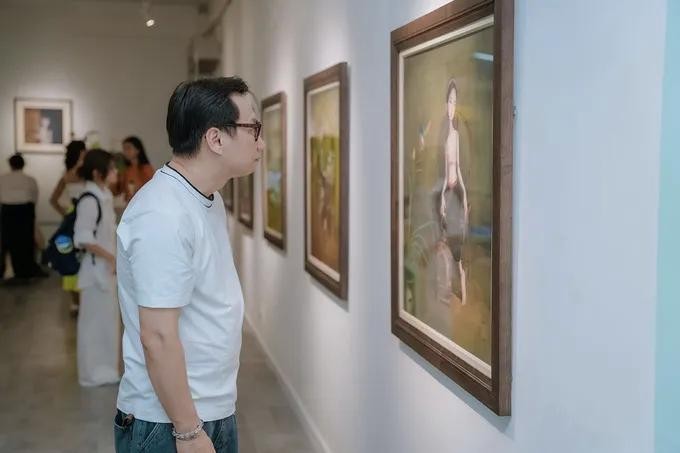
Silk painting holds a unique place in the history of Vietnamese fine art because it is categorized by its canvas material rather than the paint medium applied to it. Due to the soft, absorbent, and delicate qualities of silk, artists must master a notoriously challenging texture. This demanding process has defined the genre's aesthetic for decades, shaping the identity of Vietnamese art through pioneering masters like Nguyen Phan Chanh, Mai Trung Thu, and Le Pho.
However, for a long period, silk painting seemed to fade from the spotlight. Many artists found the medium restrictive, fearing that its inherent limitations would lead to a lack of breakthroughs or trap the work within predictable motifs. Consequently, the revival of silk painting in recent years stands as a significant development.
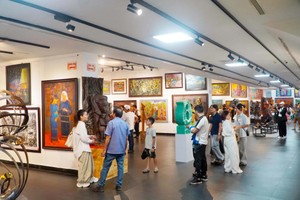
A prime example of this movement can be seen in What is Real?, a solo exhibition by artist Bui Tien that is currently on view at TomuraLee Gallery in 24 Road No. 1, An Khanh Ward, Ho Chi Minh City. As a Phu Yen native born in 1993, artist Bui Tien is recognized as a standout figure among the new generation of painters. This particular collection features 25 silk paintings, each distinguished by muted tones, serene faces, and complex layers of imagery that evoke a sense of drifting memories.
According to the artist, the most critical aspect of contemporary silk painting is not strictly adhering to traditional techniques or forcing formal differences, but finding a personal voice. "Silk almost forces the artist to engage in a dialogue with restraint," she explained. "If one lacks honesty with oneself, the work can easily become merely decorative or end up being nothing more than a display of technical skill."
A notable aspect of this resurgence is the response from younger audiences. At recent silk painting exhibitions, young people have made up a significant portion of the attendance, often lingering before works rather than passing by quickly—a common sight in other exhibition spaces.
Nguyen Thi Hoai Trang, 26, in Ban Co Ward, HCMC, noted that upon visiting What is Real?, she was surprised by how relevant silk painting could feel to modern life.
At the Nguoi giu thoi gian - Co Lai Hy (The Keeper of Time - A Rare Age of Longevity) exhibition currently running at Chillala space at 75 Xuan Thuy, HCMC’s An Khanh Ward, viewers are also finding delight in the works of artist Hoang Minh Hang, a painter who established her reputation prior to 1975. Her works, which balance academic rigor and technical precision with a contemporary breath, invite viewers to slow down and observe the evolution of an art form that is soft yet remarkably enduring.
Lecturer Nguyen Thi Thanh Truc of Van Lang University remarked, "I always thought silk painting was limited to certain subjects and expressions due to the nature of the material. However, seeing Hoang Minh Hang's work, I was truly surprised that such unique characteristics of modern painting could be expressed on silk."
This synthesis of tradition and modernity is creating a new face for contemporary art. Nguyen Thi Hoang Minh, a 9X-generation artist and lecturer at the Ho Chi Minh City University of Fine Arts, analyzed the phenomenon: "To build a beautiful silk painting composition, lines and shapes are essential elements."
Silk is not a medium that excels in depicting textures, heavy brushwork, or surface effects like other materials, she added. Therefore, the artist must be meticulous, gentle, and know how to yield to the surface of the silk. A beautiful silk painting also requires maintaining the transparency of the material’s surface, which distinguishes it from many other types of painting.
The return of silk painting is not merely a trend of retreating to traditional materials; it is an effort to revitalize heritage with a contemporary spirit. As the young generation of artists dares to step beyond traditional barriers, silk painting is escaping its own shadow, evolving into an artistic language capable of a broader dialogue with the modern world.