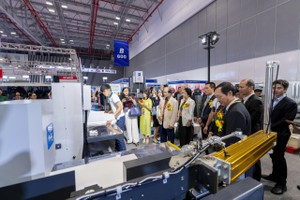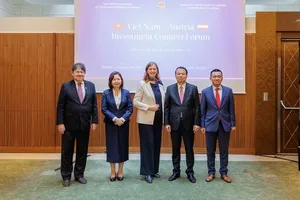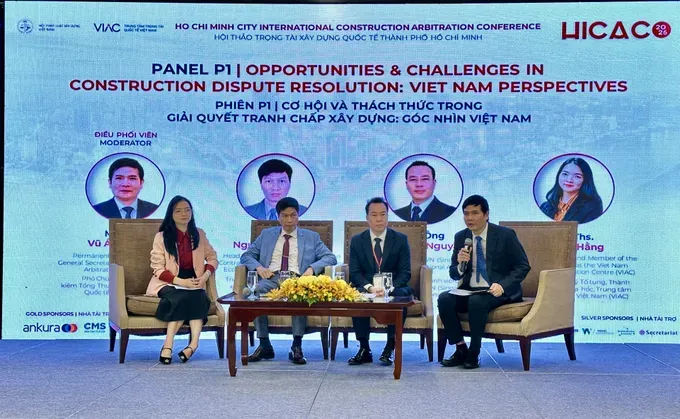
The conference held by the Society of Construction Law Vietnam (SCLVN), in coordination with the Vietnam International Arbitration Center (VIAC), drew the participation of nearly 200 legal experts from both Vietnam and abroad.
Speaking at the conference, Mr. Nguyen Nam Trung, Chairman of the Society of Construction Law Vietnam, noted that amid ongoing volatility in the global economy, Vietnam’s construction sector continues to demonstrate strong resilience, driven by a series of large-scale infrastructure projects. However, he cautioned that the expansion in project scale has been accompanied by increasingly complex legal risks.
According to him, a thorough understanding of evolving legal frameworks, coupled with the adoption of advanced international practices, is not only a practical necessity but also a critical determinant of business survival.
At the conference, lawyer Vu Anh Duong, Vice President and Secretary General of the Vietnam International Arbitration Center, observed that alongside emerging opportunities come significant governance challenges. Large-scale infrastructure projects typically involve multiple contract packages and numerous stakeholders and are subject to a wide range of variables, including legal frameworks, site clearance, materials supply, technical standards, and financing, as well as coordination among contractors and consulting entities.
He emphasized that the success of such projects depends not only on technical capacity or financial resources but also critically on effective contract management and robust risk control mechanisms.
From a regulatory perspective, Head of the Division for Construction Economics and Contracts under the Construction Economics Agency of the Ministry of Construction, Nguyen Bac Thuy, stated that the 2025 Law on Construction marks a significant step forward in refining the legal framework in alignment with practical requirements.
Accordingly, the law provides more detailed provisions on the principles of contract execution, contractual content, payment conditions, price adjustment mechanisms, and the handling of contingencies arising during project implementation. These regulations are designed to ensure transparency and fairness among stakeholders while minimizing disputes and complaints in construction activities.
The law also strengthens provisions governing contract administration, linking the responsibilities of participating stakeholders to project timelines, quality, and overall efficiency. The standardization of contractual terms is expected to enhance professionalism, mitigate legal risks, and ensure greater stability in construction investment activities.
Ms. Vu Thi Hang, Head of the Arbitration Secretariat and a member of the Scientific Council of the Vietnam International Arbitration Center, noted that construction disputes currently account for a significant proportion of cases resolved annually and are becoming increasingly complex.
Beyond purely legal matters, many disputes also involve deeply technical aspects, requiring the engagement of experts from multiple disciplines.
In response to this reality, the Vietnam International Arbitration Center has been proactively refining its organizational and case management approaches toward greater professionalism and flexibility, applying arbitral procedures tailored to the complexity of each case. These improvements underscore the gradual adaptation of Vietnam’s arbitration system to the demands of modern construction disputes, while aligning more closely with international standards.