The Ministry of Finance is drafting amendments to the Government's decree detailing the Law on Investment under the Public-Private Partnership (PPP) model. Among the proposed changes is a requirement to publicly disclose land funds used to compensate investors implementing projects under build-transfer (BT) contracts. Making such information mandatory is considered essential to ensure public oversight and prevent corruption and waste.
Ho Chi Minh City grants land for flood control project
In March 2026, the Ho Chi Minh City People's Committee decided to allocate three land parcels in Phuoc Long, Binh Quoi, and Tan My wards to Trung Nam Construction Investment Joint Stock Company.
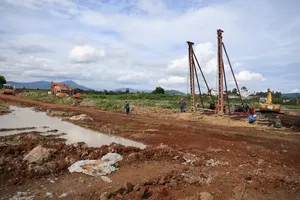
The three sites, covering a combined area of more than 26,000 square meters, will serve as payment for the first phase of the Ho Chi Minh City tidal flood control project, commonly known as the US$390 million flood control project, which Trung Nam Construction Investment Joint Stock Company is implementing under a BT contract.
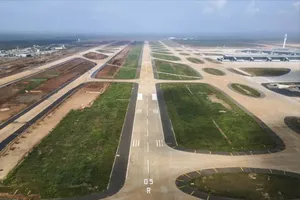
Previously, the BT model enabled the city to complete several landmark infrastructure projects that have contributed significantly to development, including the expansion of Pham Van Dong Boulevard linking Tan Son Nhat International Airport with the eastern part of the city.
At its meeting on April 18, the Ho Chi Minh City People's Council approved the first batch of land designated for payment to BT investors, consisting of 33 sites. Many are located in the city's central core, including a 0.48-hectare site at 8-12 Le Duan Street and a 0.6-hectare site at 2-4-6 Hai Ba Trung Street, along with several plots ranging from 0.5 to 1.5 hectares in the Thu Thiem New Urban Area.
The land allocated for payment must comply with the principle of equal value, minimizing the need for additional financial obligations. Regarding the land fund for compensating investors, Head Hoang Tung of the Urban Affairs Committee of the Ho Chi Minh City People's Council said the city is currently using its existing land reserves and is also considering exploiting land created along transportation corridors developed through BT projects.
According to Vu Anh Tuan, Director of the Transport Research Center (Vietnamese-German University), land used to pay investors in BT projects is a valuable public resource. Therefore, all information regarding location, area, planning, current use, and land allocation time needs to be fully and promptly disclosed. When this data is transparent from the investment preparation stage to the completion of payment, the public and supervisory agencies will have a stronger basis for monitoring, thereby limiting the risk of loss of state assets, preventing vested interests, and enhancing the accountability of management agencies. Transparency is not the ultimate goal but the foundation to ensure the proper use of public land, improve investment efficiency, and strengthen public trust in BT projects.
Mandatory land disclosure for BT projects to ensure transparency
According to the Ministry of Finance, earlier drafts of the decree only encouraged disclosure of information on land used to pay BT investors. However, based on feedback from the Government Inspectorate, the Ministry of Industry and Trade, the Ministry of National Defense, and provincial finance departments, the Ministry now proposes making disclosure mandatory because voluntary disclosure would not adequately ensure transparency or effective public oversight.
The Ministry also said public participation during the preparation and implementation of BT projects is necessary to strengthen oversight, prevent losses of state assets, and guard against special-interest influence.
"It is necessary to add provisions requiring the publication of investment policy decisions, project approvals, the location and size of land allocated as payment to BT project investors, as well as the responsibilities of the contract-signing authority to report to competent agencies during project implementation," the Ministry of Finance said in its report.
Do Thien Anh Tuan of the Fulbright School of Public Policy and Management said disclosure should be designed as a formal process rather than a token exercise, such as posting a standalone document online or displaying it only at the headquarters of a Commune People's Committee.
Moreover, he added that information should be published simultaneously on the National Procurement Network System, local government information portals, and at sites where land is being acquired to provide a comprehensive picture. In addition to legal documents, authorities should disclose land valuation methodologies, consulting firms involved, the full contents of BT contracts, and all subsequent project adjustments.
Experts also said information should be disclosed throughout the entire life cycle of a project, from the period before investment decisions are made until final settlement. They added that the process should include accountability mechanisms, regularly published monitoring reports, and strict penalties for individuals or organizations that delay disclosure or provide inaccurate information.