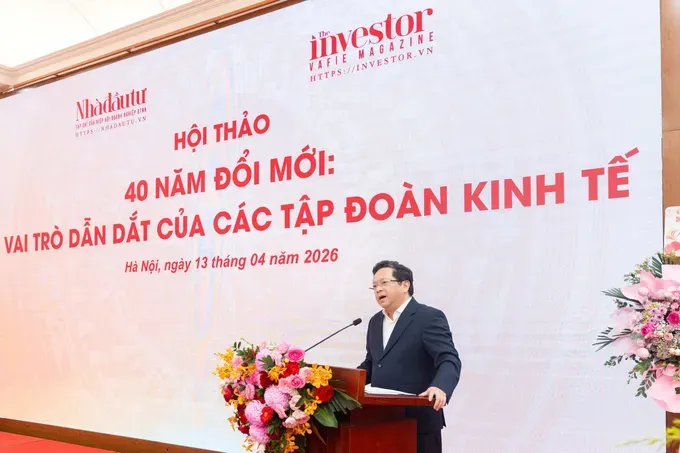
At a policy-focused seminar in Hanoi on April 13, specialists underscored the need to rethink the role of leading enterprises in Vietnam’s economic development.
Rather than measuring success by size, Dr. Bui Thanh Minh, Deputy Director of the Office of the Private Economic Development Research Board, argued that firms should be evaluated based on their innovation capacity and ability to build interconnected ecosystems that support broader business growth.
However, the biggest bottleneck at present is not just the lack of large enterprises, but the absence of a sufficiently numerous, well-connected, and capable business system to support firms in growing from small to medium, from medium to large, and ultimately into leading enterprises.
Mr. Dau Anh Tuan, Deputy Secretary General and Head of the Legal Department at the Vietnam Chamber of Commerce and Industry (VCCI), said that the private sector is experiencing a serious imbalance in its industry structure. Revenues of the largest private enterprises are concentrated in two sectors, including finance and real estate, accounting for more than half of total revenue, while processing and manufacturing make up less than 10 percent.
Drawing lessons from Taiwan (China), the Republic of Korea and Japan, experts recommend that Vietnam’s private sector promote a transition toward production and technology, increase investment in research and development, foster stronger business linkages, develop capital markets, improve corporate governance, and deepen international integration.
At the same time, attention should be paid to risks related to institutional limitations, dependence on FDI in production and export chains, insufficient depth in multi-sector models and the absence of leading firms.