As unpretentious as the character of Southern Vietnamese people, Lai Thieu pottery in Ho Chi Minh City has long been recognized for its familiar household wares that combine simplicity with refinement. For more than a century, the kilns have continued to burn, sustained by generations of artisans who quietly preserve the spirit of the land and its people.
Residents find themselves in pottery
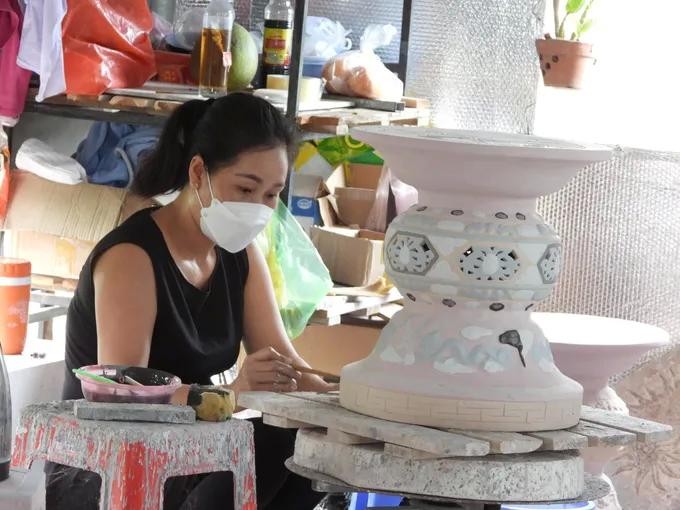
Phan Thi Huong, a resident of Lai Thieu Ward, began working with pottery at a young age and has remained devoted to the craft for nearly 40 years. For her, pottery is both a livelihood and a way of preserving her family's tradition.
“Whenever a bowl or plate takes shape, I feel as though I see my own life in it. My family has practiced pottery for generations, so from childhood I was familiar with the scent of clay, the sound of the wheel, and the glow of kiln fires,” Huong said.
Unlike many artisans who grew up around clay and kilns, Huynh Xuan Huynh came to Lai Thieu pottery through curiosity after encountering a neighbor’s pottery collection. His initial interest gradually turned into a passion and inspired him to study the history of the pottery village.
He discovered that behind the familiar bowls and plates lies a rich cultural heritage of Southern Vietnam. The more he learned, the more concerned he became as many traditional values of Lai Thieu pottery were fading from daily life.
Driven by a desire to preserve and promote the craft, Huynh founded Nang Ceramics in Lai Thieu and pursued a distinctive approach that connects traditional values with the needs of younger generations.
In addition to reviving traditional techniques, he has experimented with new glazes and contemporary designs to bring pottery closer to modern lifestyles. He also organizes pottery-making experiences for students and shares knowledge about the craft with the community, helping spread appreciation for Lai Thieu pottery.
For Huynh, preservation does not mean keeping everything exactly as it was in the past. More importantly, it means creating a new place for pottery in contemporary life so younger people can access, use, and connect with a material that has been associated with Lai Thieu for centuries.
Lai Thieu pottery: Preserving Southern Vietnam’s timeless craft
For decades, Lai Thieu pottery was a familiar part of life in Southern Vietnam, appearing in households through bowls, plates, and ornamental pots decorated with motifs such as chrysanthemums, banana trees, and roosters. However, changing consumer preferences and the emergence of new materials have gradually pushed many traditional products out of everyday use.
In response, pottery enthusiasts have stepped forward to preserve and promote the craft's heritage. Among them is Huynh Minh Thanh, head of the Lai Thieu Ceramics and Antique Pot Club under the Ho Chi Minh City Ornamental Creatures Association.
Originally established in 2013 as the Thuan An Antiques Club, the organization now has 29 members.
Thanh began collecting Lai Thieu pottery when he was young. Today, he owns more than 3,000 ceramic pieces, including many artifacts that are over 100 years old. Building the collection has required more than 25 years of dedicated searching and collecting across numerous localities.
For him, each artifact is more than an inanimate object; it tells a story about history and the skilled hands of past artisans. Among the highlights of his collection are antique Lai Thieu ceramic pots that once appeared in royal gardens and the homes of affluent families.
Collecting such pieces requires deep knowledge of ceramic bodies, glazes, and even the brushwork of decorative painters.
“Lai Thieu pottery has its own soul, reflecting the open and straightforward character of Southern Vietnamese people. I collect these pieces not for business, but to ensure that their historical values are not forgotten,” Thanh said.
Beyond collecting, the head of the Lai Thieu Ceramics and Antique Pot Club regularly participates in exhibitions to introduce the value of Lai Thieu pottery to the public. In the past, he dedicated part of a pottery-themed café in Lai Thieu Ward to displaying artifacts and creating a gathering place for pottery enthusiasts. He is currently reorganizing and expanding the exhibition area to welcome more visitors.
Through the activities of the Lai Thieu Ceramics and Antique Pot Club, many young people have had opportunities to learn about artifacts linked to the history of the pottery village. According to Thanh, this is another way to ensure that the values of Lai Thieu pottery continue to be preserved and shared.
Phan Sy Tuan, a representative of the Binh Duong Ceramics Association, said the pottery industry of the former Binh Duong Province has a history spanning more than 100 years.
Traveling north from central Ho Chi Minh City, traces of the pottery trade remain clearly visible in Lai Thieu Ward, Thuan An Ward, Thuan Giao Ward, and Chanh Hiep Ward.
In Lai Thieu Ward alone, there are still four to five traditional kilns that are between 80 and more than 100 years old.
Tuan suggested that the Ho Chi Minh City Department of Agriculture and Environment and relevant agencies should conduct surveys and assessments of the remaining historic kilns, identify suitable sites, and integrate craft village preservation with tourism development.