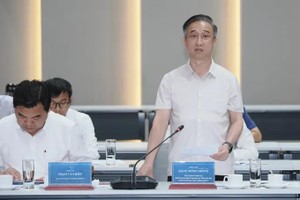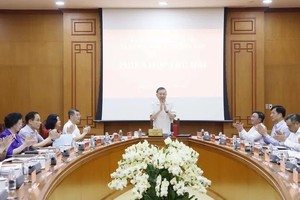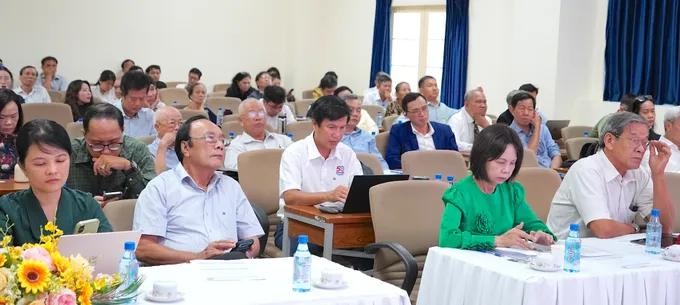
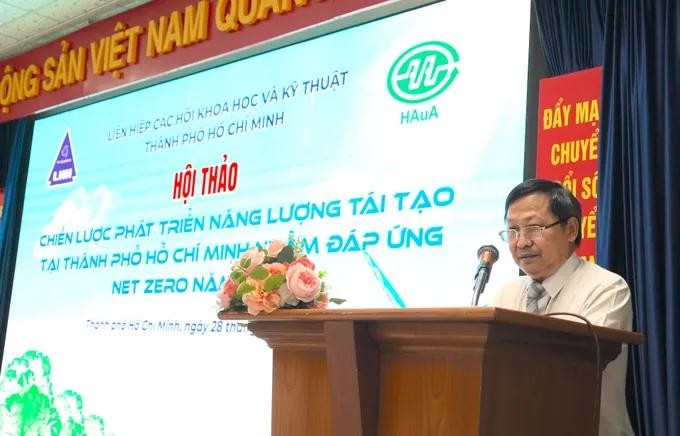
On July 28, the Ho Chi Minh City Union of Science and Technology Associations, in coordination with the Ho Chi Minh City Science Council, held a seminar titled "Renewable Energy Development Strategy for Ho Chi Minh City to Achieve Net Zero by 2050." More than 200 experts, scientists, and businesses from across the city attended the event.
In his opening remarks, Prof. Nguyen Van Phuoc, Chairman of the Ho Chi Minh City Union of Science and Technology Associations, said the city is implementing its Green Transition Project for the 2025-2035 period, which includes 10 pillars and 76 specific targets, with total funding needs estimated at VND900 trillion.
The city's guiding principle is to pursue rapid development alongside sustainability, linking economic growth with improvements in environmental quality and residents' quality of life. The project is being implemented as the city enters a new stage of development, with a much larger economic, industrial, urban, port, and energy scale than in the past.
At the same time, the city faces urgent challenges in ensuring energy security, reducing greenhouse gas emissions, adapting to climate change, and achieving net-zero emissions by 2050 while gradually becoming a green transition hub in Southeast Asia.
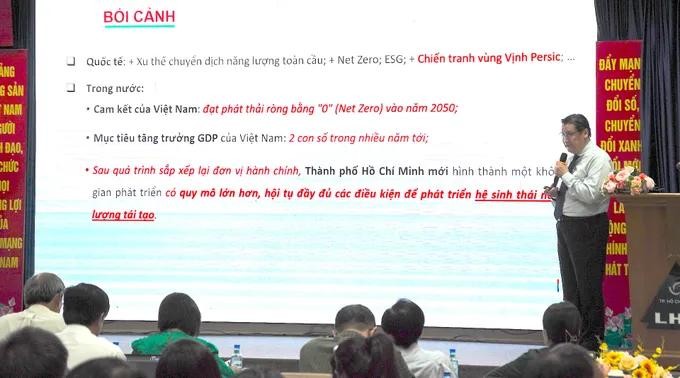

The seminar became a platform for policymakers, experts, and business leaders to debate the city’s energy future. Discussions centered on what proportion of renewable energy should make up final consumption by 2030, 2040, and 2050. Participants also examined which energy sources should be prioritized in different sectors, and what mechanisms and funding streams could support industrial parks, export processing zones, and enterprises in shifting toward low‑carbon models.
Another major focus was the transformation of the Cai Mep-Thi Vai port complex and the former Ba Ria-Vung Tau Province. The vision outlined includes developing the site into a green port, an offshore energy hub, and a green logistics center, positioning it as a cornerstone of the region’s sustainable growth strategy.
The city also discussed solutions for building a database system and a set of indicators to manage energy use, emissions, and progress toward its net-zero target.
Experts and scientists agreed that Ho Chi Minh City has all the necessary conditions to become a leading green energy and green industry hub in the country and the region. However, they noted that this potential will not automatically translate into economic growth. Achieving that goal will require a unified vision, integrated planning, transparent investment mechanisms, a modern power grid, a highly skilled workforce, and close coordination among the Government, businesses, scientists, and the community.
The experts proposed establishing a Ho Chi Minh City Energy Transition Coordination Council and a Smart Energy Operations Center based on big data and artificial intelligence, integrating information on power generation, electricity demand, energy storage, carbon emissions, and the electricity market.
"This center will support real-time system operations, improve the efficiency of renewable energy utilization, and reduce system operating costs," said Assoc. Prof. Le Hoai Quoc, Chairman of the Ho Chi Minh City Automation Association.
Assoc. Prof. Nguyen Thi Thanh Phuong, Director of the Institute of Environmental Industry, proposed that the city promptly implement four key measures: integrating hydrogen infrastructure into urban planning, developing technical safety standards, issuing investment incentives, and providing financial support for the transition to green transportation.