Today, April 7, is not merely World Health Day but also marks an extraordinary milestone, with Vietnam’s inaugural National Health Day, themed “Proactive Disease Prevention for a Resilient Vietnam.” This is by no means a simple promotional slogan; rather, it serves as a powerful launchpad for a strategic paradigm shift across the healthcare system, the society, and the populace.
Reflecting on the history of the medical sector, the country has thus far achieved robust development, resolutely mastering numerous advanced medical technologies. Nevertheless, a truly sustainable healthcare system can’t rely solely on the sheer volume of hospital beds or the continuous advancement of medical equipment and technology.
Reality clearly demonstrates that disease treatment expenses are consistently multifold higher than preventative investments. Also, a substantial majority of the population still harbors the mindset of only seeking medical examination and treatment when an illness strikes. Consequently, numerous hospitals, particularly at the central level, are continuously overloaded, while the grassroots medical network, the primary “shield” has yet to fully actualize its vital role in fundamental health protection and primary care.
Confronting this stark reality, Resolution No.72-NQ/TW dated September 9, 2025 from the Politburo regarding “Breakthrough Solutions to Enhance the Protection, Care, and Improvement of the People’s Health” was decisively promulgated. This resolution clearly and forcefully dictates a mandatory ideological shift from “curing diseases” to “preventing diseases,” aiming to comprehensively elevate the entire population’s well-being.
The message “Proactive Disease Prevention for a Resilient Vietnam” strongly emphasizes that health isn’t the solitary responsibility of the medical sector but demands the proactive self-discipline of every individual, alongside the fierce, synchronized involvement of the entire political system and the broader community.
Early and remote disease prevention signifies the rigorous control of risk factors, routine health screenings, and an unwavering commitment to a healthy lifestyle. When every citizen stands united as a resolute “warrior” protecting their own well-being, the strain on treatment facilities will drastically reduce. Societal resources will thus be optimally reallocated to fuel sustainable development rather than plunging into the consequences of illnesses.
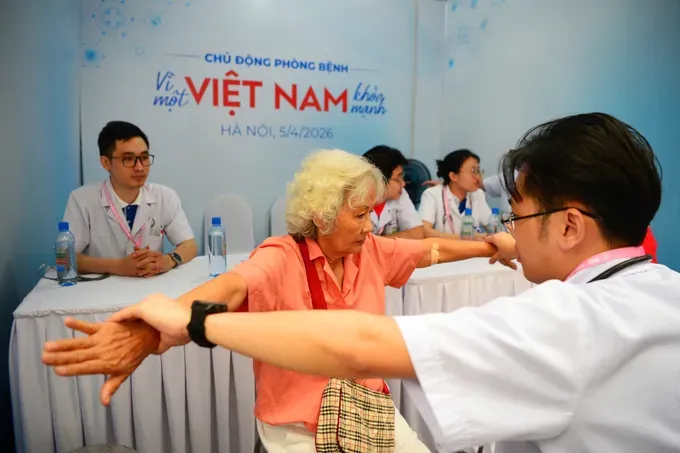
Resolution 72-NQ/TW also explicitly mandates the objective of guaranteeing citizens’ equitable rights in accessing healthcare services, strongly striving to bridge the gap in healthcare quality between urban and rural areas, as well as across different regions.
Therefore, aggressively intensifying investments, fortifying the grassroots medical network, fiercely accelerating digital healthcare transformation, deploying universal electronic health records, and advancing towards universally free periodic health check-ups are the concrete, unyielding steps to actualize this equitable right. This also embodies a profoundly humanitarian objective, striving for a just, civilized, and highly advanced public health foundation.
Enthusiastically responding to the first National Health Day, it’s essential to comprehend that a mighty and prosperous nation can only be built upon the bedrock of a physically and mentally robust populace.
For this monumental “revolution” to triumph, the most crucial prerequisite is that the State, the medical sector, and authorities at all levels must fiercely and decisively allocate superior investments toward preventive medicine and grassroots healthcare. Concurrently, every citizen must bravely and resolutely abandon harmful habits to proactively safeguard their greatest “asset”, their health.
The proactive disease prevention strategy is not a fleeting, short-term destination but a remarkably enduring journey. Guided by the strategic compass of Resolution 72-NQ/TW and fueled by the inspiring ripple effect of National Health Day, it’s highly possible to believe in a more robust Vietnam, where every single citizen is comprehensively protected by a modern, equitable, and profoundly humane healthcare network.