Ho Chi Minh City and southern provinces are entering the peak of the dry season, marked by prolonged heatwaves and arid conditions, pushing forest fire risks to critical levels. In many areas, the warning has reached Level V, the most extreme danger. In response, forest owners and local authorities are simultaneously deploying a range of forest fire prevention and control measures.
Deploying drones and surveillance cameras
The Dinh–Thi Vai mountain forest area, covering about 3,500 hectares across Chau Pha Commune, Tan Hai Ward, and Long Huong Ward of Ho Chi Minh City, is under the management of the Phu My Forest Protection Unit and remains at consistently high fire risk. The area contains more than 110 pagodas and hermitages scattered throughout the forest. During holidays and festivals, a surge in pilgrims increases the likelihood of ignition sources from incense burning and votive paper offerings.
Similarly, the Minh Dam mountain forest, spanning more than 2,100 hectares across Long Hai, Phuoc Hai, and Long Dien communes, is another critical fire-prone zone.
Adhering to the principle that “prevention is better than suppression,” forest rangers and management boards have implemented a series of proactive measures since the start of the dry season. These include clearing undergrowth, creating firebreaks in high-risk zones, and intensifying patrols and monitoring, particularly in vulnerable areas.
Head Dinh Hai Duong of the Long Hai forest management sub-zone under the Ho Chi Minh City Protection and Special-Use Forest Management Board noted that Minh Dam mountain has experienced multiple fires in previous years. Its proximity to tourist sites and local farmland significantly heightens the risk of fires spreading.
At the Phu My Forest Protection Unit, which oversees more than 12,000 hectares of forest across 15 communes and wards, authorities have introduced unmanned aerial vehicles (drones) and surveillance cameras at forest entry points to enable early detection of fires. In addition, three fire watchtowers, nearly 50 water reservoirs, and on-call response teams are maintained in a constant state of readiness.
Rapid response teams are established
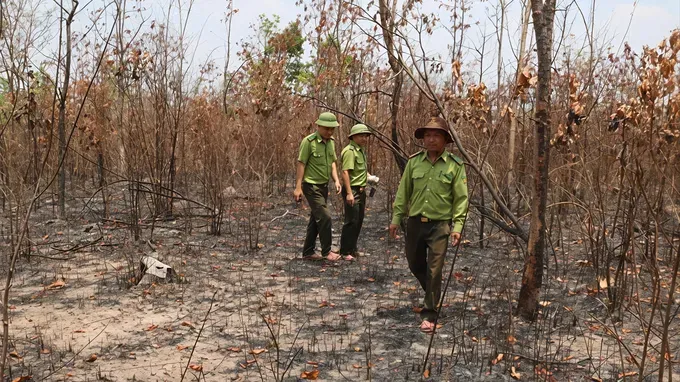
In recent days, under intense heat, the deciduous dipterocarp forests of Yok Don National Park in Dak Lak Province have entered their harshest period of the year. Trees shed their leaves en masse to cope with prolonged drought, leaving a thick layer of brittle vegetation on the forest floor. Even a small spark could trigger a major wildfire. The area is currently under Level V fire alert.
Director Pham Tuan Linh of Yok Don National Park said forecasts of extended heatwaves have prompted the park to proactively implement fire prevention strategies. These include forming rapid response teams to address outbreaks immediately, deploying forest rangers on 24/7 duty in high-risk zones, clearing vegetation, and establishing firebreaks, particularly along forest boundaries adjacent to farmland and residential areas.
Park authorities also conduct regular public awareness campaigns, urging residents with farmland near forest edges to ensure any burning of vegetation is supervised by officials.
Truong Thanh Ha, acting head of the Forest Protection Department of Gia Lai Province, said prolonged heat has pushed most western communes in the province to Level V fire risk. To mitigate threats, leadership has been assigned to oversee fire prevention and response operations around the clock, ensuring timely direction and readiness to mobilize personnel and equipment when needed.
Along the South-Central region, forests in Nui Chua–Phuoc Binh National Park in Khanh Hoa Province are also entering the most vulnerable phase of the dry season. At a monitoring station in Vinh Hai Commune, operations are visibly intensified. Patrol teams begin inspections of boundary areas early in the morning, and by midday, when temperatures peak and dry winds intensify, rangers remain highly vigilant over fire-prone slopes.
The park maintains dozens of monitoring posts staffed by hundreds of personnel on 24/7 shifts. Patrols, vegetation clearance, and strict adherence to the “four on-the-spot” principle ensure early detection and rapid response. According to Nguyen Danh, head of the Khanh Hoa Forest Protection Department, the Province has more than 529,000 hectares of forest and forestry land, of which over 109,200 hectares are at risk of fire.
In Ca Mau Province, fire prevention efforts are also being implemented aggressively. Director Tran Ngoc Thao of U Minh Ha Forestry One-Member Company, the unit managing the province’s largest fire-prone forest area of more than 23,350 hectares, said personnel, pumps, and firefighting equipment have been deployed around the clock in high-risk zones equipped with watchtowers. All specialized firefighting equipment is kept fully operational and fueled, ready for immediate deployment.
In An Giang Province, Director Le Huu Toan of the Department of Agriculture and Environment has instructed forest rangers to mobilize maximum manpower to implement fire prevention measures in special-use and protection forests. These include constructing firebreaks, reducing combustible materials by clearing dry vegetation in sensitive areas, and strictly controlling ignition sources, such as prohibiting hunting, honey harvesting by fire, and any use of open flames near forest edges.
A notable development in An Giang’s forest protection strategy is the application of modern technology. In Phu Quoc Special Zone, which has more than 36,000 hectares of complex forest terrain, forest rangers are working with Phu Quoc National Park to install smart camera systems at strategic high points. These systems can detect smoke and abnormal heat signatures and immediately relay alerts to the command center.