The public are keeping a keen eye on Nhan Co, the largest ever bauxite mine in Vietnam, which has just begun in Dak Nong Province. The project is expected to produce 650,000 tons of aluminum a year. SGGP paid a visit to the site to give readers a close up of the mine’s initial stage of production.

Of the country’s total bauxite reserves of 5.5 billion tons, Dak Nong has 3.4 billion tons.
According to Dak Nong’s provincial government, the province has nine bauxite mines occupying a total area of 561.8 square kilometers, or 8.6 percent of the province (6,514.5 square kilometers).
The Nhan Co project occupies 160 square kilometers, some two percent of the entire province.
To ease the public’s fears about the mine’s effects on the environment, the deputy director of Nhan Co Aluminum, Nguyen Phu Duong said, “The project will last for 30 years. The exploitation will be limited to an area of land between 50 hectares and 65 a year. Every year, we just dig down between three and four meters, or 12 at most deep, into the ground to get the ore.”
“After separating the bauxite from the earth, we will fill in land with fertile soil to level the surface and plant trees on the exploited areas to form forests,” he said.
Dak Nong provincial government asserted that the exploitation would benefit the region as impoverished soil would be replaced with better soil.
“Forests will cover the exploited land after two or three years. What’s more, the local people will live an improved life as the province will collect some VND547 billion in taxes from the project,” a government spokesman said.
Some 570 families have moved to give way for the project. SGGP reporter talked with a number of local people who had received compensation for their land.
Dieu Vuong, resident of Bu Dap Village said, “Two out of seven hectares of my family land have been taken over under the clearance and we’ve received VND600 million in return. Thanks to the compensation, I’ll build a new house for my family.”
Nguyen Van Son, living in Hamlet 1 said, “I had two hectares of mountainous land and 400 square meters of residential land. I was paid VND800 million as compensation for all. I‘ve bought several hectares of land in the neighborhood area at a price of VND200 million a hectare to settle down. I think the compensation price was okay.”
We went to Bu Dap Village, where 20 families had been asked to move. Dieu On, patriarch of a village of M’ Nong ethnic minority people said, “The village has 112 families. Twenty families have received compensation and moved to other places. No one complained about the compensation prices.”
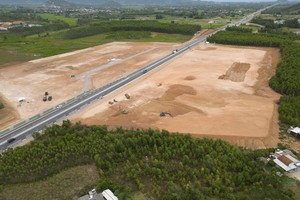
We went to the site where the aluminum plant will be built. Found on the land was 1.3 tons of piled ore. Dieu Phuong, a worker from Nhan Co said, “Although I’ve been training, I‘m paid VND 3.5 million a month.”
Nguyen Phu Duong said no foreign workers will be recruited to work for the plant.
He said that Chalieco, a subsidiary of Chalco, a Chinese engineering corporation, had won a contract to build the aluminum plant. Foreign workers have now been allowed to enter the country to work under the contract, but when the plant is completed, they have to return to their own country.
Mr. Duong added that when put into operation, the plant will employ local people only. At present, 317 local people have been recruited and sent to China for training to become technicians. Seventy others are also taking part in chemistry and geological courses in China.
We went to the valley where a 210-hectare reservoir will be built to contain 650,000 tons of mud to be eliminated from the Nhan Co mine.
We were told that the bed of the reservoir will built with compressed clay. The surface of the clay layer will be covered with a layer of high-density polyethylene and a layer of sand. This will prevent the penetration of red mud, with its high concentration of sodium hydroxide, into the environment.
After the reservoir becomes silted, the water will be pumped out and reused for bauxite mining again.
Mr. Duong said the plant will need 18 million cubic meters of water a year. The water obtained from the mud processing will be 10 million cubic meters a year. To meet the water shortage, Dak Nong’s provincial government has allowed the plant to repair Cau Tu reservoir, which has a capacity of 10 million cubic meters, to contain water.
The plant, as a result, can supply more than 1,000 cubic meters of surplus water to local people a year, added Mr. Dung.
Everything seems to be okay so far, but it is still too early to say how bauxite mining will affect the environment.
Once the plant is put into operation, the local government should maintain checks on activities in order to protect the environment.
Despite worries about mining’s effects on the environment, it will help thousands of people in the central highlands escape poverty.
The Nhan Co project occupies 160 square kilometers, some two percent of the entire province.
To ease the public’s fears about the mine’s effects on the environment, the deputy director of Nhan Co Aluminum, Nguyen Phu Duong said, “The project will last for 30 years. The exploitation will be limited to an area of land between 50 hectares and 65 a year. Every year, we just dig down between three and four meters, or 12 at most deep, into the ground to get the ore.”
“After separating the bauxite from the earth, we will fill in land with fertile soil to level the surface and plant trees on the exploited areas to form forests,” he said.
Dak Nong provincial government asserted that the exploitation would benefit the region as impoverished soil would be replaced with better soil.
“Forests will cover the exploited land after two or three years. What’s more, the local people will live an improved life as the province will collect some VND547 billion in taxes from the project,” a government spokesman said.
Some 570 families have moved to give way for the project. SGGP reporter talked with a number of local people who had received compensation for their land.
Dieu Vuong, resident of Bu Dap Village said, “Two out of seven hectares of my family land have been taken over under the clearance and we’ve received VND600 million in return. Thanks to the compensation, I’ll build a new house for my family.”
Nguyen Van Son, living in Hamlet 1 said, “I had two hectares of mountainous land and 400 square meters of residential land. I was paid VND800 million as compensation for all. I‘ve bought several hectares of land in the neighborhood area at a price of VND200 million a hectare to settle down. I think the compensation price was okay.”
We went to Bu Dap Village, where 20 families had been asked to move. Dieu On, patriarch of a village of M’ Nong ethnic minority people said, “The village has 112 families. Twenty families have received compensation and moved to other places. No one complained about the compensation prices.”
We went to the site where the aluminum plant will be built. Found on the land was 1.3 tons of piled ore. Dieu Phuong, a worker from Nhan Co said, “Although I’ve been training, I‘m paid VND 3.5 million a month.”
Nguyen Phu Duong said no foreign workers will be recruited to work for the plant.
He said that Chalieco, a subsidiary of Chalco, a Chinese engineering corporation, had won a contract to build the aluminum plant. Foreign workers have now been allowed to enter the country to work under the contract, but when the plant is completed, they have to return to their own country.
Mr. Duong added that when put into operation, the plant will employ local people only. At present, 317 local people have been recruited and sent to China for training to become technicians. Seventy others are also taking part in chemistry and geological courses in China.
We went to the valley where a 210-hectare reservoir will be built to contain 650,000 tons of mud to be eliminated from the Nhan Co mine.
We were told that the bed of the reservoir will built with compressed clay. The surface of the clay layer will be covered with a layer of high-density polyethylene and a layer of sand. This will prevent the penetration of red mud, with its high concentration of sodium hydroxide, into the environment.
After the reservoir becomes silted, the water will be pumped out and reused for bauxite mining again.
Mr. Duong said the plant will need 18 million cubic meters of water a year. The water obtained from the mud processing will be 10 million cubic meters a year. To meet the water shortage, Dak Nong’s provincial government has allowed the plant to repair Cau Tu reservoir, which has a capacity of 10 million cubic meters, to contain water.
The plant, as a result, can supply more than 1,000 cubic meters of surplus water to local people a year, added Mr. Dung.
Everything seems to be okay so far, but it is still too early to say how bauxite mining will affect the environment.
Once the plant is put into operation, the local government should maintain checks on activities in order to protect the environment.
Despite worries about mining’s effects on the environment, it will help thousands of people in the central highlands escape poverty.


)





)