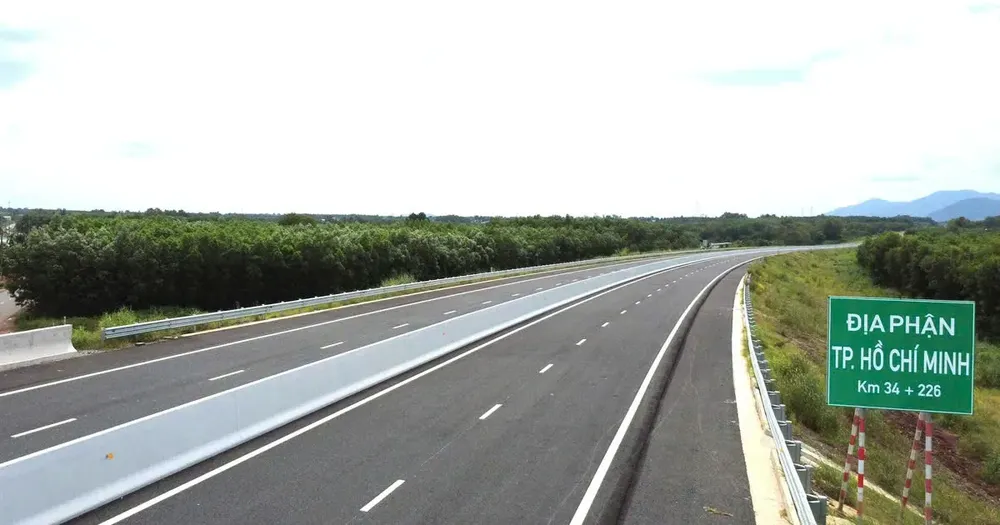
Recently, together with the opening to traffic of the nearly 54-kilometer-long Bien Hoa – Vung Tau Expressway, the interchanges connecting with the Ho Chi Minh City – Long Thanh – Dau Giay Expressway have also been put into operation. This development helps strengthen regional connectivity and maximize the project's investment efficiency.
At present, additional connecting infrastructure projects are being implemented, including a road linking the Bien Hoa – Vung Tau Expressway to the Vung Tau area and an elevated road running along National Highway 51, invested in by Dong Nai City, which will connect to the starting point of the expressway.
According to transportation experts, once these projects are completed, travel between the eastern coastal area, Dong Nai, and central Ho Chi Minh City will become more convenient and efficient.
Meanwhile, on National Highway 51, nearly six months after the implementation of a new lane-allocation scheme, the route has recorded positive improvements in traffic safety and congestion management.
According to official statistics, between November 17, 2025, and April 8, 2026, the number of traffic accidents on National Highway 51 fell by 64 percent, while the number of fatalities decreased by 60 percent and injuries dropped by 64 percent compared with the same period of the previous year.
These results demonstrate the initial effectiveness of the new traffic lane-allocation scheme and also reflect the positive impact of the Bien Hoa – Vung Tau Expressway being put into operation. At present, most passenger vehicles have shifted to the expressway, while trucks and container vehicles continue to rely primarily on National Highway 51.
A positive development in efforts to ease traffic pressure on National Highway 51 is Phuoc An Bridge, a key transportation project spanning the Thi Vai River and linking Ho Chi Minh City with Dong Nai.
According to the project developer, the bridge project, with a total investment of nearly VND4.9 trillion (US$186 million), is expected to complete the closure of its main span in June 2026 and be opened to traffic in September 2026, approximately eight months ahead of the original schedule.
Once operational, Phuoc An Bridge will significantly shorten the distance for transporting goods from the Cai Mep – Thi Vai port complex to provinces in the Mekong Delta, reducing reliance on National Highway 51, which currently serves as the primary freight corridor.
Beyond its logistics benefits, the bridge will serve as a critical link in the regional transportation network, providing direct connectivity to the Bien Hoa – Vung Tau Expressway, Long Thanh International Airport, and a number of strategic ring roads.
Meanwhile, construction of Provincial Road DT994, a nearly 77-kilometer coastal route connecting Ho Chi Minh City with Lam Dong via the Vung Tau – Binh Chau coastal corridor, is being accelerated. Many sections have already been completed or have entered the final stages of construction, with the project targeted for completion and opening to traffic in the first quarter of 2027. Once operational, the route is expected to create new opportunities for the development of tourism, logistics, and the marine economy across the region.
Another transportation project attracting significant attention is the Long Thanh – Ho Tram Expressway, which is expected to provide a fresh impetus for the development of Ho Tram, Binh Chau, and a chain of coastal tourism-oriented urban areas with substantial growth potential in the eastern part of the region.