The startup story of Ha Lam Tu Quynh, a former communications director at Google, has been widely told. But the distinctive core — how she spreads Vietnamese values through brand thinking and market vision — has not.
The global market is a prime target for Vietnamese entrepreneurs. Between 2024 and 2025, the "go global" movement gained massive momentum among the country's youth and business community. Driven by this ambition, Ha Lam Tu Quynh left the tech giant to introduce an authentic slice of Vietnam to the world stage.
The chosen vehicle for this international expansion was banh mi. The iconic sandwich presents an ideal export because it carries a distinct national identity, appeals to diverse palates, and relies on universally accessible ingredients.
Quynh pursued formal culinary training in the art of making banh mi under Chef Vo Quoc. The pair established a strict baseline for the concept, requiring the recipe to remain authentically Vietnamese, scale easily on a global level, and appeal broadly to international consumers. This partnership forced Chef Vo Quoc to rethink traditional boundaries because the team sought a scalable culinary product capable of capturing the global market rather than a standard recipe.
Using her brand perspective, Quynh pointed out a common formula for Vietnamese eateries abroad, including in Singapore: yellow walls, lanterns, non la hats, rural motifs. That model quickly signals a Vietnamese identity and connects with local Vietnamese, but it makes international customers treat the food as an exotic specialty.
Quynh’s goal was for banh mi to become an everyday global food. So Banh Mi Society’s Clarke Quay outlet in Singapore has no non la (palm-leaf conical hat), lanterns, or rural props. The identity centers on three colors: the yellow of the crust, green for health, and reddish brown for fillings. Everything is standardized and consistent from store to packaging. "I don't want people to feel foreign when they step in. I want them to come because the food is good," Quynh said. That simple, personal intent reveals a business philosophy that explains a common bottleneck for Vietnamese cuisine going global.
Every discovery has a cost for a pioneer. Quynh positioned her banh mi in the mid-market, stepping away from the cheap street-food image. She demanded consistency and precise ingredient weighing to the gram. Staff immediately pushed back as "unnecessary" and "unheard of"; they said she was "bringing Google's mindset into a banh mi shop."
They were experienced in Singapore’s labor environment, where hiring is already difficult under local-priority policies. Adding complex processes raised turnover risk.
Quynh understood the challenge but was clear about the necessary steps. She would not compromise. She showed up daily, stood at the counter when needed, gently reminded staff and demonstrated the weighing process herself. Her ownerly persistence made the standard sacred. The system ran on her solitary conviction.
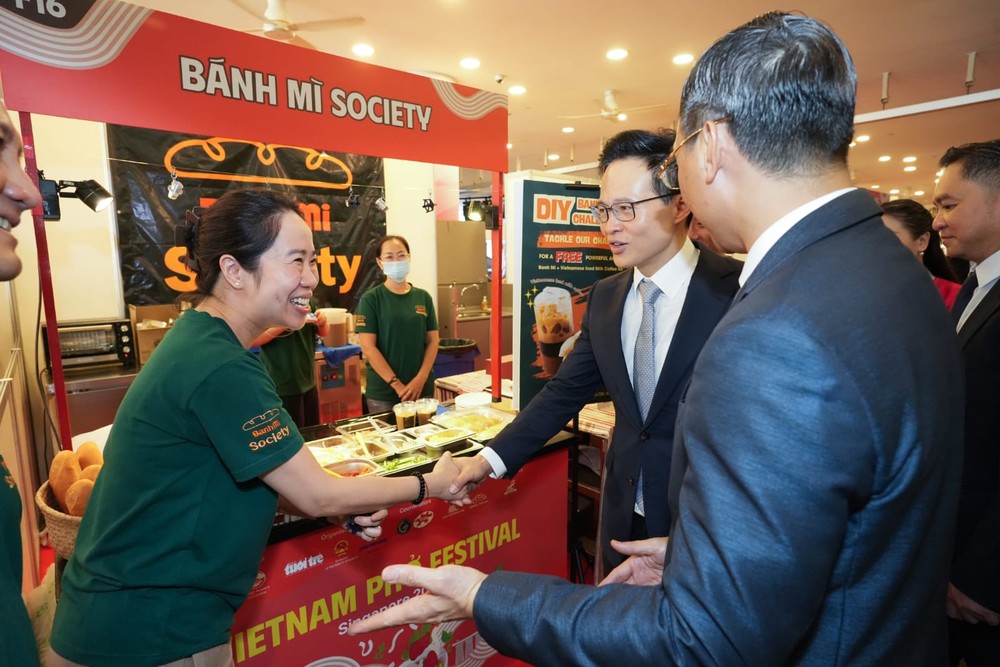
In October 2025, the Singapore Pho Festival took place. Quynh had initially hesitated to join, fearing risks for a new mid-market brand at a mass event. But she chose to participate to promote Vietnamese culture, with a different strategy.
On day, she displayed all ingredients for customers to experience making a full banh mi and gave them away for free; nothing was for sale. Banh Mi Society’s booth was small amid two established Vietnamese banh mi vendors. The first day ended with nervous tension — crowds surged, many complained because staff refused to sell. On day two, after the organizer's request, Quynh sold banh mi at a promotional price of 9 Singapore dollars, still 50 percent higher than the neighboring stalls. Staff and owner braced for criticism.
At 10 a.m., they arrived to an unbelievable sight: a long queue. Many had tried the free samples and were determined to buy; others had eaten at Clarke Quay and wanted the festival experience. By 11:15 a.m., they were sold out. Quynh apologized, organized supplies to reopen at 1 p.m., and sold out again an hour later.
One evening a woman visited Banh Mi Society and asked for the owner. Quynh’s husband, Le Nam, met her. The woman politely asked his role and said she had an important letter for the CEO. It turned out to be an invitation from the CEO and commercial director of the 4-star Park Regis by Prince hotel, proposing an official collaboration. The partnership made Banh Mi Society the first Vietnamese food brand chosen to work with a 4-star hotel in Singapore. For Quynh, banh mi had truly moved from cheap street food into the realm of culinary standards and refinement.
Her choice to give up expected comforts to "take Vietnamese banh mi to the world" with reason, experience and steadfast market vision is a sincere, convincing, and intellectual act of love. It offers a lesson for Vietnamese with global dreams: sometimes the journey to export a Vietnamese value doesn't start with emotion. It starts with deeply understanding that value, then persistently pursuing it to the end by world-class standards.