The rapid rise of artificial intelligence (AI) and social media is posing major challenges for news organizations in content moderation and legal risks.

The Vietnam Journalists Association held a seminar on the morning of September 9 titled “New provisions of the Press Law and legal sanctions: Identifying risks and protecting journalistic ethics.”
AI cannot take responsibility for journalists
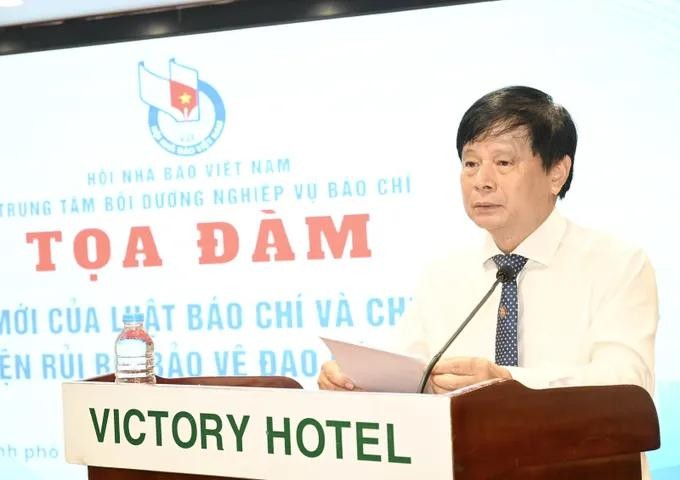
In his opening remarks, journalist Tran Trong Dung, vice chairman of the Vietnam Journalists Association in charge of the Southern region, said the press is operating in a media environment undergoing unprecedentedly rapid change.
The strong development of digital technology, social media and artificial intelligence, along with the emergence and spread of new media platforms, is profoundly changing the ways information is produced, distributed and received.
In this context, the demands placed on journalists are increasingly high. They must not only ensure that information is timely, accurate and engaging, but also strictly comply with legal regulations, uphold social responsibility and maintain professional ethical standards.
At the seminar, Nguyen Van Hieu, deputy director of the Press Department under the Ministry of Culture, Sports and Tourism, presented new provisions of the 2025 Press Law.

The deputy director noted that the 2025 Press Law and Decree No. 237/2026/ND-CP, which details the implementation of a number of provisions of the Press Law, require news organizations to comply with the Press Law, AI regulations and related rules when using AI to collect, produce, edit and distribute content.
News organizations must verify and review AI-generated or AI-assisted content and take responsibility for its accuracy and legality.
Risks from AI hallucinations
In a presentation titled “Managing legal and ethical risks in digital newsrooms”, Nguyen Duc Hien, Deputy Editor-in-Chief of Sai Gon Giai Phong Newspaper, said AI cannot take responsibility in place of journalists.
Sai Gon Giai Phong Newspaper has developed and will soon issue regulations governing the use of AI in journalistic operations.

According to journalist Nguyen Duc Hien, AI can summarize documents, translate, suggest headlines, analyze data, and generate images, audio and video, but it can also produce highly convincing false information.
When false information is published, AI does not issue corrections, face disciplinary action, pay compensation or assume legal responsibility in place of the news organization.
Therefore, newsrooms need internal regulations specifying what AI may be used for and what tasks must not be left entirely to AI, what content must be verified by humans, and who bears ultimate responsibility.
Presenting a paper titled “Experience in developing the internal editorial review process filter at Nhan Dan Newspaper,” journalist Nguyen Hoang Nhat, Deputy Head of Nhan Dan Online Department at Nhan Dan Newspaper, outlined four major risks in publishing: political and ideological risks; copyright and personal data risks; commercial risks; and artificial intelligence risks, particularly AI fabricating figures, a phenomenon known as “AI hallucinations.”
To address these risks, Nguyen Hoang Nhat said the process needs to establish four levels of safeguards on the content management system (CMS), involving data entry staff, editors, shift leaders, department leaders and the editorial board.
Deputy Director of the Press Department Nguyen Van Hieu said AI remains, by nature, a powerful tool supporting journalists. Formats such as infographics, long-form stories and e-magazines are already making effective use of the new technology.
However, not everyone using AI will get the same results. AI needs to be trained and provided with extensive materials to become more intelligent and accurate.
There are now general regulations on labeling AI-generated content under the 2025 Law on Artificial Intelligence.
Public disclosure of social media accounts of press agencies
Deputy Director Nguyen Ngoc Hoi of the Ho Chi Minh City Department of Culture and Sports said social media platforms provide an opportunity for press agencies to deliver official information to readers.

In the coming period, Ho Chi Minh City will publicly disclose a list of social media accounts operated by press agencies down to the neighborhood level, with the aim of expanding their reach and strengthening interaction with the public.
Ho Chi Minh City is currently operating social media listening software to detect duplicate or inaccurate information. Press agencies are required to restructure their operations to strengthen oversight of content production across digital platforms. The city will develop an application providing a list of reporters working in the area. Through the application, local authorities and businesses will be able to easily look up and verify information, helping ensure that reporters are properly registered and carry out their professional activities in accordance with the law.