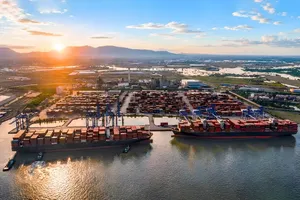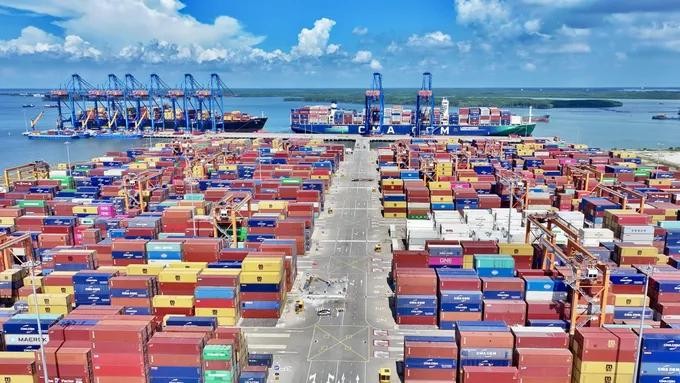
Nearly two decades after joining the World Trade Organization (WTO), Vietnam’s import-export turnover surged from US$100 billion in 2007 to successfully surpass $900 billion in 2025.
As of early November 2026, this trade turnover has reportedly breached the US$1 trillion threshold. This milestone undeniably affirms the trade scale and integration capacity of the Vietnamese economy. Simultaneously, it highlights the nation’s robust export potential, the pressing demand for importing raw materials alongside machinery and equipment, as well as its formidable market connectivity.
Vietnam currently ranks 18th globally in exports, 20th in imports, and proudly stands second within ASEAN regarding overall import-export scale. The nation’s trade relations have successfully extended to approximately 237 countries and territories. Vietnam is undeniably functioning as a crucial link within the international trade ecosystem.
However, it must be frankly acknowledged that a massive scale doesn’t necessarily equate to high-quality economic growth. The pressing question remains: exactly how much substantive value does this economy actually retain from these bustling commercial activities?
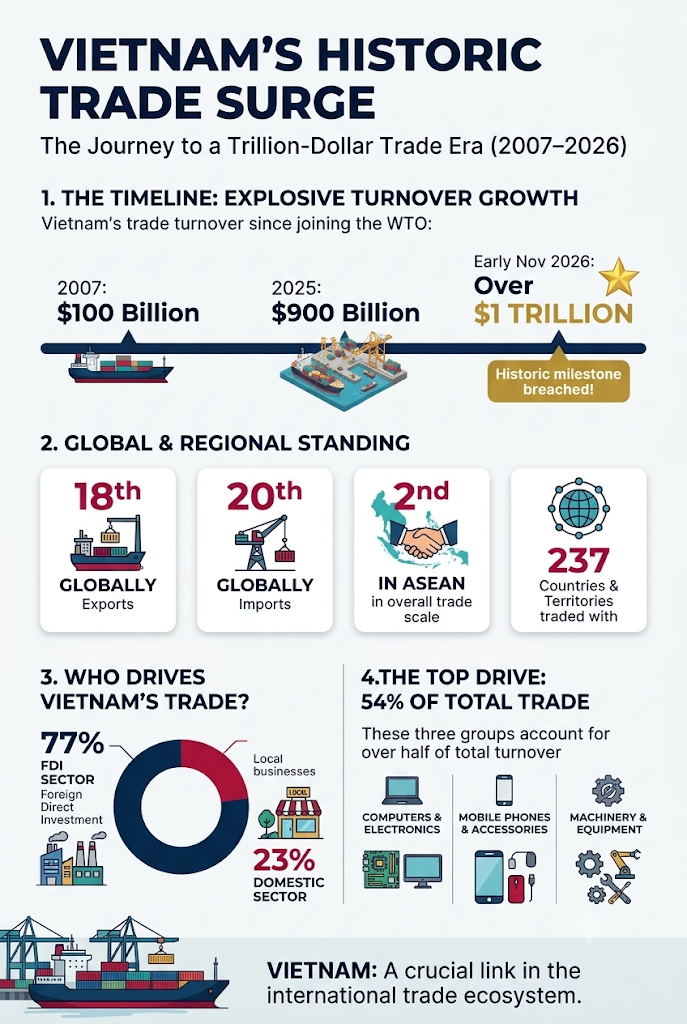
Statistics from the Vietnam Customs reveal that the foreign direct investment (FDI) sector contributes over 77 percent of the total import-export turnover, whereas the domestic sector merely accounts for roughly 23 percent. This stark proportion explicitly reveals that Vietnamese enterprises haven’t yet secured a commensurate foothold on the global trade playing field.
Successfully attracting numerous multinational corporations alongside FDI enterprises is undeniably a formidable advantage. Nevertheless, if Vietnamese businesses continuously remain outside the crucial stages of the major supply chain, it’ll be exceptionally difficult to translate export growth achievements into the intrinsic strength of the domestic economy.
The current structure of import-export commodities also poses several pressing issues. As reported by the Vietnam Customs, commodity groups like computers, electronic products and components; mobile phones and accessories; alongside machinery, equipment, tools, and spare parts jointly account for 54 percent of the nation’s total import-export turnover.
If the country continues executing stages characterized by low value addition, the export turnover in the coming years might still surge, but the actual value retained by Vietnamese businesses simply won’t be commensurate.
Amidst a backdrop where several major markets (such as the United States) are increasingly prioritizing balance and reciprocity in global commerce, Vietnam’s trade balance also needs to be viewed much more cautiously.
During the first 10 months of 2026, Vietnam ran a trade deficit of approximately $14 billion. A trade deficit isn’t necessarily a dire signal. If the imported goods primarily consist of machinery, cutting-edge technology, and raw materials serving industrial production, it can effectively serve as a foundational step of accumulation and capacity investment for long-term growth.
What absolutely must be done is to enforce effective controls, actively avoiding a scenario where imports surge without cultivating corresponding production capacity and added value.
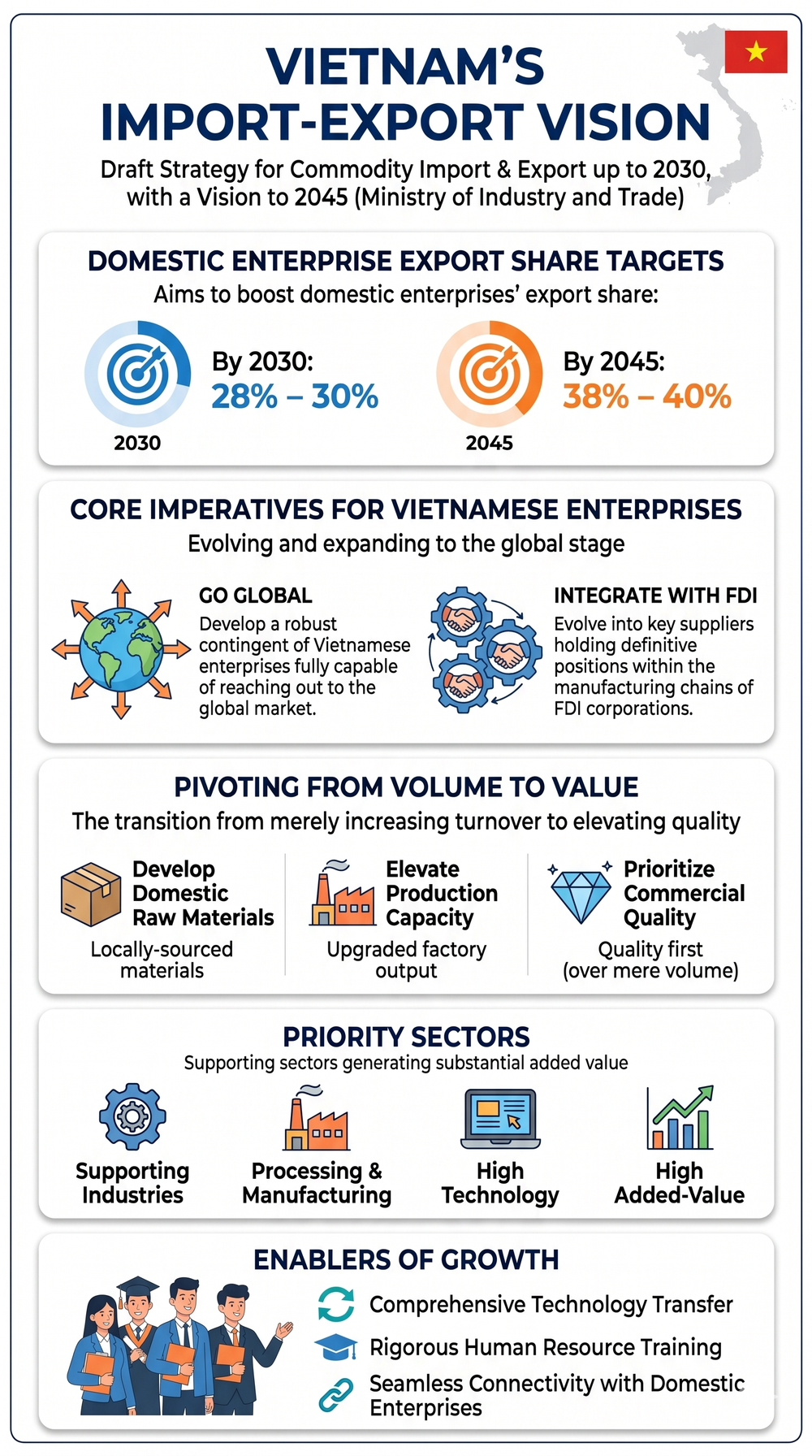
According to the draft Strategy for Commodity Import and Export up to 2030, with a Vision to 2045, which the Ministry of Industry and Trade is currently soliciting feedback on, Vietnam officially aims to boost the domestic enterprise sector’s export share to between 28 percent and 30 percent by 2030, and up to 38 percent to 40 percent by 2045.
Attracting foreign investment remains essential, yet it must inextricably go hand in hand with developing domestic enterprises. It’s impossible to demand that Vietnamese enterprises immediately compete against massive corporations that possess decades of accumulated capital, technology, and market dominance; however, in the long run, domestic businesses simply can’t stand outside the supply chain, continually riding the coattails of the FDI sector.
Over the ensuing years, the crucial imperative is to successfully develop a robust contingent of Vietnamese enterprises fully capable of reaching out to the global market, or alternatively, evolving into suppliers holding a definitive position within the manufacturing chains of FDI corporations.
To accomplish this, there’s a dire need to develop domestic raw material sources, drastically elevate production capacity, and pivot the main focus from merely increasing turnover toward elevating commercial quality. This involves heavily prioritizing supporting industries, processing and manufacturing sectors, high technology, and those specific industries generating substantial added value.
Alongside this, comprehensive technology transfer, rigorous human resource training, and seamless connectivity with domestic enterprises must act as mandatory prerequisites when attracting FDI investment.