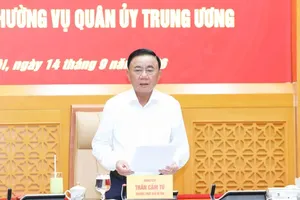
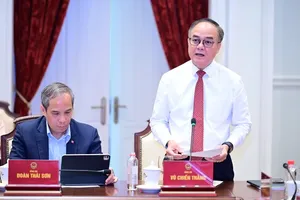
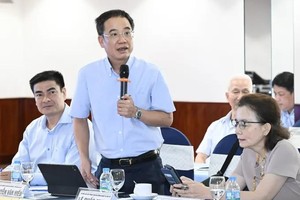
The National Assembly (NA) Standing Committee convened a national conference on Thursday to launch orientations and tasks for People’s Councils at all levels for the 2026–31 tenure.
The conference was held in person in Hanoi and connected online with 33 provinces and cities nationwide. NA Chairman Tran Thanh Man chaired the event.
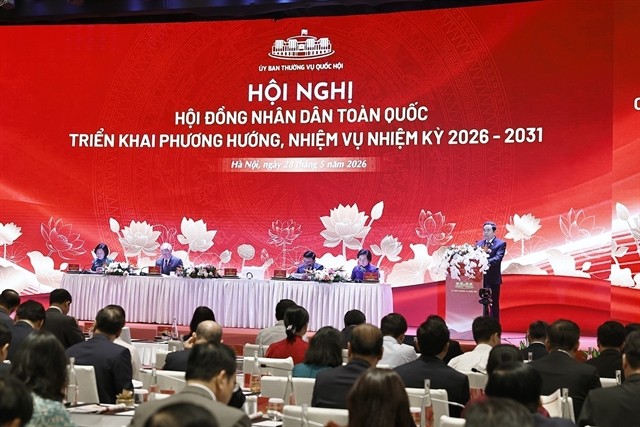
In his opening remarks, NA Chairman Tran Thanh Man stressed that the conference aims not only to review the performance of People’s Councils at all levels, but also to comprehensively assess the position and role of local people-elected bodies in the country’s new development phase.
It also provides an opportunity to evaluate achievements, shortcomings, limitations and lessons learned, while setting orientations for activities of People’s Councils during 2026–2031 amid efforts to streamline and improve the efficiency and effectiveness of the political system, and build modern, professional, people-centred local administrations that are close to and serve the public, he said.
The NA leader emphasised that the 2021–2026 tenure was an especially challenging period in the history of People’s Councils at all levels. The country faced unprecedented difficulties and challenges, including the Covid-19 pandemic, natural disasters and climate change impacts, while the global situation evolved rapidly in a complex and unpredictable manner.
Against that backdrop, under the close leadership and direction of the Party Central Committee, the Politburo and the Secretariat, along with guidance from the NA Standing Committee and close coordination with the Government, the Vietnam Fatherland Front and local Party committees, People’s Councils at all levels have made considerable efforts to overcome difficulties and continue affirming their role as local bodies of state power representing the people's will, aspirations and right to mastery.
However, the top legislator pointed out that the implementation of the two-tier local administration model still faces numerous difficulties and challenges, including expanded management areas, heavier workloads and higher requirements. The capacity of civil servants in some localities remains limited, leading at times to difficulties in handling tasks, while infrastructure and information technology systems are not yet fully synchronised.
These issues, he said, require continued attention and concerted efforts to address. He added that the Politburo and the Secretariat are set to conduct a review of the one-year implementation of the two-tier local administration model in early July 2026.
Chairman Tran Thanh Man noted that through the conference, the NA Standing Committee hopes to listen to opinions and practical experiences regarding the implementation of tasks during the 2021–26 tenure, as well as proposals on new tasks, solutions, determination, thinking and approaches for 2026–31.
He also asked for assessments of coordination mechanisms between the NA Standing Committee and NA agencies with provincial-level People’s Councils, as well as between permanent members of People’s Councils and Party committees, People’s Committees and Fatherland Front Committees at the same level.
Particular attention, he said, should be paid to experiences in promoting the role of People’s Councils in building breakthrough mechanisms to foster double-digit economic growth, the control over the exercise of power under the two-tier local administration model, and the application of science and technology, digital transformation and artificial intelligence (AI) to activities of People’s Councils.
The NA Chairman especially encouraged delegates to closely study Hanoi’s experiences in digital transformation and AI application in activities of the municipal People’s Council and the city as a whole, so that such practices can be adapted in their own localities in the coming time.