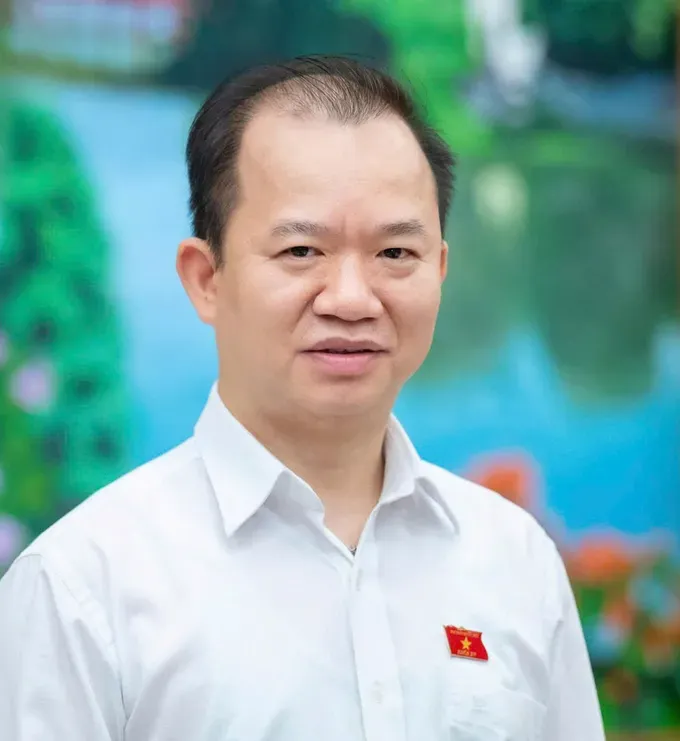
National Assembly (NA) Deputy Bui Hoai Son, a full-time member of the NA’s Committee for Culture and Social Affairs representing Hanoi, expressed particular interest in draft laws that directly dismantle bottlenecks in land, housing, investment, state budget, science and technology. At the same time, he paid close attention to fields with lasting impacts on human quality and social life, such as publishing, architecture, legal dissemination and education, and urban development.
For the draft Law on Urban Development, what voters in major cities expect isn’t simply a statute to expand construction space or boost real estate projects, but rather a strong legal framework to create livable, distinctive, safe, and sustainable cities.
The draft legislation must rectify the uncoordinated urban development between planning, transport infrastructure, housing, schools, hospitals, cultural spaces, and public services. It’s unacceptable to let housing and population figures surge while social infrastructure perpetually lags behind. Nor should cities trade away their heritage, landscapes, greenery, and urban memories for short-term economic gains.
According to his perspective, culture must be embedded directly into the urban development structure, rather than added as an afterthought once land, traffic, and commercial decisions are already finalized. The law also needs to clarify the accountability of municipal authorities, enhance citizen participation, and explore mechanisms for assessing the socio-cultural impacts of major projects.
The first extraordinary session demonstrates the National Assembly’s proactive spirit, responsibility, and rapid response capacity to urgent practical demands.
He argued that each bill must clearly answer three questions regarding where practice is entangled, what causes the bottleneck, and how new regulations will resolve that issue. Lawmakers shouldn’t amend statutes simply because they’re on the agenda; even less should they chase the sheer number of amended clauses without fully evaluating impacts of these changes on citizens, businesses, and state apparatus operations.
Additionally, sufficient time must be allocated for deputies to conduct substantive debates on differing viewpoints; listen to experts, affected parties, as well as voters; and resolutely refuse to pass inadequately prepared provisions.

Full-time Deputy Head Tran Thi Dieu Thuy of the HCMC National Assembly Delegation expressed complete concurrence with convening the first extraordinary session due to the urgency of the agenda items. Practical realities are demanding timely solutions that can’t wait any longer. Although traditional voter outreach meetings weren’t held, the HCMC National Assembly Delegation proactively organized a series of specialized seminars, examining practical obstacles closely to ensure that voters’ voices remain fully reflected on the assembly floor.
As an HCMC deputy, she is particularly attentive to the draft Law on Urban Development. She noted that one of the bill’s breakthroughs is a mechanism allowing the HCMC People’s Council to issue resolutions implementing the law immediately, without waiting for central government decrees.
To prepare for this legislation, HCMC reportedly organized roughly 20 meetings, soliciting input from domestic and foreign experts and delving deeply into social and cultural domains rather than just economics. The ultimate objective is to establish the strongest decentralization and empowerment mechanism so that HCMC can achieve double-digit growth sustainably.
Additionally, through voter feedback, she observed that the legislative “trio” amending laws on land, real estate business, and housing has also captured significant attention from citizens and enterprises. Ultimately, these are crucial policies aimed at removing barriers, capable of generating a fresh investment wave for the market and contributing to the double-digit growth target.

Meanwhile, full-time Deputy Head Nguyen Thi Viet Nga of the Hai Phong National Assembly Delegation deemed this an exceptionally important session due to the profound and widespread impact of the items under review. Despite not holding separate voter outreach sessions for this meeting, information and voter recommendations were still regularly received through petition work, correspondence, together with feedback from the press and associations, which were then forwarded to the National Assembly forum.
Regarding the draft Law on Urban Development, she voiced full support for the necessity of enacting the law to elevate governance efficiency in megacities. Her dominating perspective is that urban development must place citizens at its core. The law can’t merely aim to expand urbanized areas or inflate real estate values, but must also guarantee green spaces, flood resistance capabilities, public facilities like schools or hospitals, and suitable housing for low-income earners.
She also agreed that projects lacking sufficient conditions shouldn’t be passed due to scheduling pressure. It’s crucial to categorize content based on policy necessity, dedicating discussion time commensurate with the complexity and impact scope of each bill. Not every draft law essentially requires the same amount of discussion time. Laws directly involving human rights, civic rights, land, finance, organizational apparatuses, or local decentralization need to be allotted deeper debate schedules.