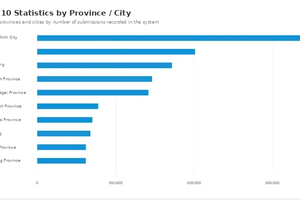
In an interview with SGGP Newspaper, Deputy Chief Justice of the Supreme People’s Court and Chief Justice of the HCMC People’s Court Pham Quoc Hung heavily emphasized that electronic courts essentially aim to help citizens access judicial services seamlessly, drastically reducing travel time alongside associated costs.

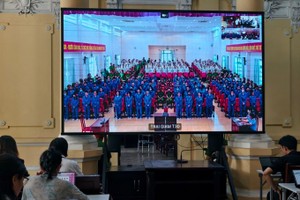
He explained that the entire system has reportedly acknowledged the profound impact of combining in-person and online adjudication, spanning from the Van Thinh Phat scandal all the way to Special Case VN10. For instance, the recent trial of Special Case VN10 featured a staggering 227 defendants, more than 40,000 case file pages, and approximately 120 lawyers.
The trial panel and direct litigation participants were physically present at the central broadcasting point. Meanwhile, remanded defendants participated straight from Chi Hoa Prison - T30 Detention Center, thereby guaranteeing real-time monitoring of the ongoing proceedings. Technological tools were carefully applied throughout the entire process, ranging seamlessly from electronic dossiers to the digital projection of evidence right in the courtroom.
Chief Justice Pham Quoc Hung genuinely find online trials to be highly feasible for massive cases. It firmly safeguards the legitimate rights and interests of litigation participants alongside courtroom security, while simultaneously slashing the hefty costs associated with escorting and protecting detainees.
As a formal recognition, point r, clause 1, Article 4 of the draft amended Criminal Procedure Code has officially proposed supplementing regulations regarding online court sessions, following a rigorous process of crystallizing practical realities.
He then mentioned other benefits that citizens can enjoy from this electronic court paradigm beyond the criminal sphere.
The HCMC People’s Court stands as a pioneering unit in applying information technology, making the construction of an electronic court a natural continuation of this evolutionary process. It has deployed application platforms developed by the Supreme People’s Court, ranging from online broadcasting, virtual adjudication, court judgment and decision publishing, online public services, virtual assistants, to the software managing various types of cases.
Every single case accepted and processed since October 1, 2025, has been entirely digitized. They’re relentlessly tracked on management software and interconnected with the national database.
Citizens can now access the legal system much more conveniently through publicly disclosed precedents, verdicts, and judicial decisions. Litigants can readily join online sessions, register for, and receive litigation documents via online public services without having to physically visit the courthouse. Ultimately, this drastically saves both time and financial resources for everyone involved.

Wholeheartedly agreeing with the perspective of the Supreme People’s Court Chief Justice, Chief Justice Pham Quoc Hung also informed the preparation of cadres and judges to elevate adjudication quality while fiercely guarding information security within this digital ecosystem.
Technology merely serves as a supportive tool; it simply can’t replace the accountability, professional procedures, and inherent conscience of a judge. In reality, overhauling established work habits is remarkably tougher than changing technology itself, so his organization has firmly resolved to transform the mindset of the entire workforce.
Judges and court clerks across two tiers of the people’s court system are actively undergoing training regarding information security and safety while operating within digital environments, and they’ve participated in numerous workshops focusing heavily on artificial intelligence applications.
Supplementing dedicated IT personnel has also been recommended to strategically advise leadership on rolling out digital transformation initiatives.
Currently, the Supreme People’s Court is architecting a “Comprehensive Case Management Platform.” Under this framework, all case files are digitized immediately upon acceptance and consistently updated throughout the entire resolution timeline. It leverages artificial intelligence to assist judges during complex professional procedures, and it forms a robust foundation tracking case resolutions in real time alongside a database of electronic dossiers, verdicts, and court decisions.
Once this platform becomes fully operational, it’ll significantly help orchestrate unified management while providing stellar support for professional activities, massively boosting adjudication quality.
The HCMC People’s Court is currently executing a focal mandate to materialize the requirement of 'spearheading digital transformation to elevate citizen service quality,' closely following action program No. 21-CTrHD/TU laid out by the HCMC Party Committee.
We’ve officially promulgated Plan No. 218-KH/DU, comprising approximately 20 specific tasks categorized into 7 groups. Among these, the two most groundbreaking task clusters involve accelerating digital transformation to architect electronic courts and thoroughly reforming judicial administrative procedures.
The court sector’s digital transformation must be inextricably linked with the city’s digital metamorphosis. It necessitates connecting and sharing vital data with relevant agencies, while strictly coordinating with the HCMC Public Security Department to establish online trial broadcasting points right inside detention centers.
For tasks inherently requiring citizen participation, such as submitting applications, documents, or evidence, serving legal texts, paying court fee advances, and joining online trials, the judicial sector firmly identifies citizens as the absolute epicenter, aiming to maximize convenience and drastically elevate service quality.
Deputy Chief Justice of the Supreme People’s Court and Chief Justice of the HCMC People’s Court Pham Quoc Hung