Artificial intelligence (AI), deepfake technology, and generative technologies are making fake news alongside spliced images and videos increasingly sophisticated, directly impacting the youth’s perception. In an interview with SGGP Newspaper, Director Le Quang Tu Do of the Press Authority (formerly Director of the Authority of Broadcasting and Electronic Information – Ministry of Culture, Sports and Tourism) heavily emphasized the pressing requirement to elevate proactive management rooted in technological capacity.

Within today’s digital environment, unverified information is frequently exploited to manipulate youth perception across social media platforms. Director Le Quang Tu Do outlined telltale signs young people must identify, forging a critical “resistance” against distorted content.
Cyberspace isn’t merely an entertainment realm; it’s a battleground where hostile forces maliciously exploit social issues to incite cognitive warfare. They don’t attack head-on. Instead, they deploy slow, steady tactics, bait-and-switching concepts to sow skepticism, negate history, plus rot ideological foundations from within.
Armed with open mindsets, young people easily become prime targets if they lack vigilance.
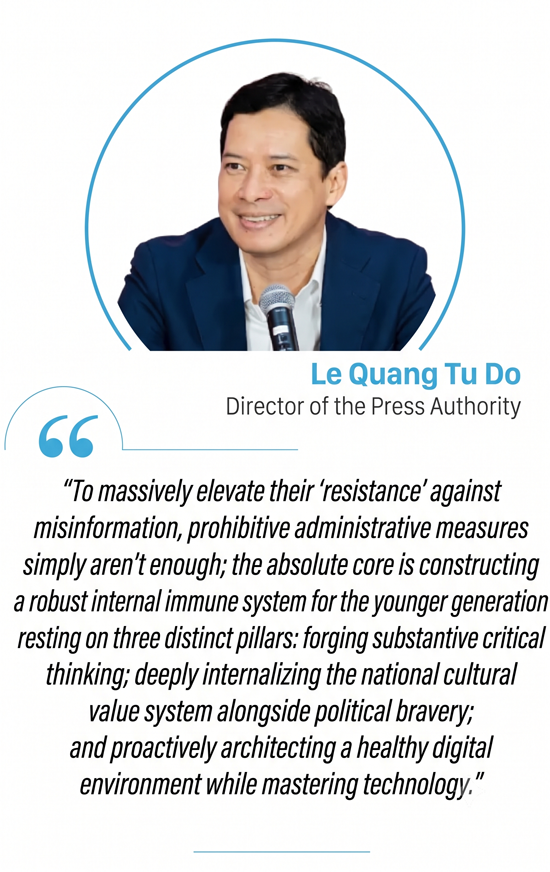
As toxic fake news spreads at breakneck speed to erode trust, the revolutionary press can’t lag behind. Relentlessly cleaning cyberspace with humanistic values, standard knowledge, plus national pride is undeniably the most effective vaccine. Once completely saturated with positive information, youth resistance automatically skyrockets, empowering them to accurately identify, automatically immunize against, and fiercely repel external distorted rhetoric.
Director Le Quang Tu Do stressed that in order to churn out more valuable cultural and educational products capable of truly captivating young people in cyberspace, besides intercepting toxic content, the press, cultural organizations, and content creators must implement a core principle: “Building” goes hand in hand with “combating,” wherein “building” is fundamental and long-term and “combating” is urgent and regular.
If the mere focus is on scrubbing toxic information while completely neglecting the creation of clean spatial zones and highly valuable cultural products to fill cyberspace, harmful information will inevitably find a way to flood back in.
Executing the Party and State’s major strategic orientations, specifically materializing the Politburo’s Resolution 80-NQ/TW regarding Vietnam’s cultural development in the digital era, the Ministry of Culture, Sports and Tourism is aggressively driving a strategy to architect a digital cultural ecosystem boasting concrete action pillars.
To begin with, culture must be transformed into an endogenous strength and a booming digital cultural industry. It’s necessary to view cyberspace not just as a communication hub, but as a vibrant new market and living space for the cultural industry. The Ministry is actively supporting and encouraging the digitization of cultural heritage, fostering tech-driven cultural industry sectors like wholesome video games, animation, digital art, and creative design to captivate the youth using the exact language, technology, and tastes of the digital generation.
Simultaneously, it’s advisable to amplify the profound role of artists, content creators (KOLs/KOCs), and the broader community. Artists and influencers serve as unofficial “cultural ambassadors” in cyberspace. An artist’s social responsibility in the digital era doesn’t merely stop at obeying the law; it inherently involves bravely utilizing their immense talent and prestige to inspire, radiate positive energy, and bring traditional culture, history, and patriotism much closer to the young public.
Concurrently, the revolutionary press must fiercely maintain its pioneering role within the digital environment. To successfully attract the youth, the press must spearhead the shift in expressive modalities toward multimedia journalism, data journalism, podcasts, and vivid, insightful short videos that perfectly capture the rhythm of modern life. The press must genuinely act as the “mainstream current” orienting information; it must be a hub providing rock-solid, reliable knowledge, helping young people cultivate critical thinking so they can confidently step into the digital space armed with steadfast cultural bravery.
Based on the practical realities of managing online information recently, the Director listed the focal solutions, carried out by the entire political system, for detecting, intercepting, and handling distorted, toxic content while simultaneously forging a healthy digital environment for the youth.
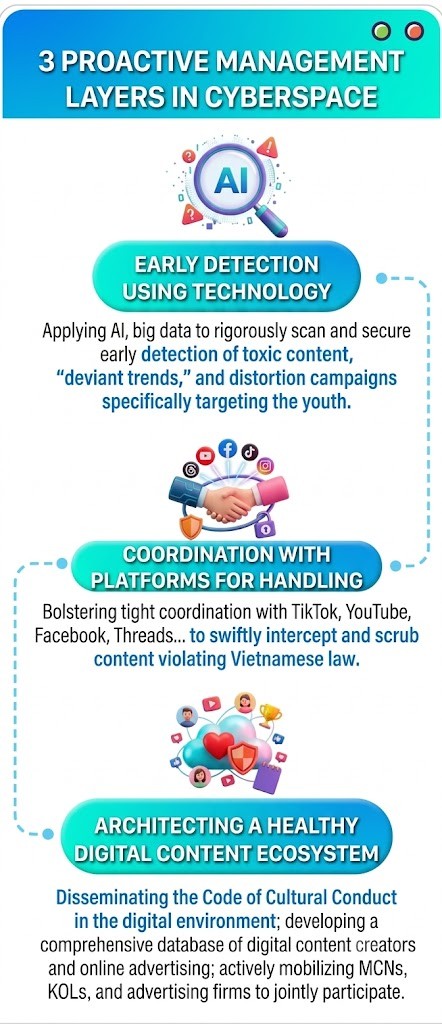
First, AI and big data are applied to secure early detection of toxic content and distortion campaigns targeting the youth. Alongside this, authorities are bolstering coordination with platforms like TikTok, YouTube, or Facebook to scrub content violating Vietnamese law.
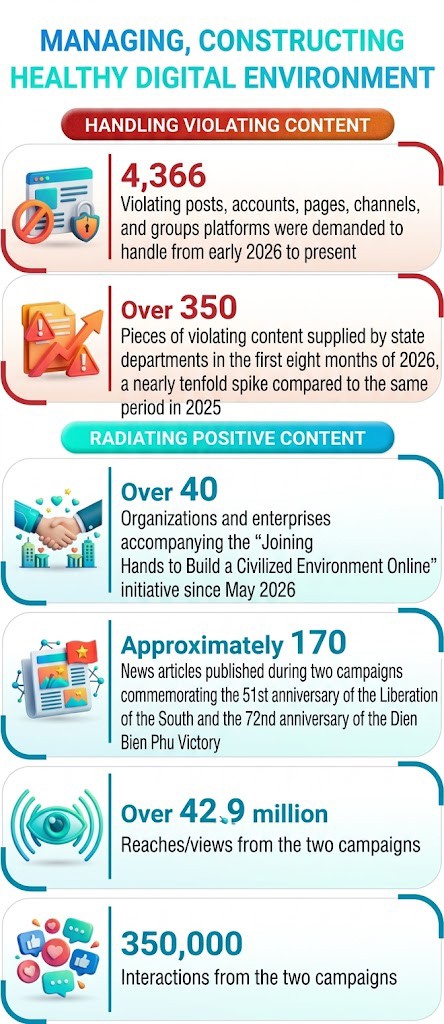
Since early 2026, these platforms have been demanded to handle 4,366 violating posts and accounts. Concurrently, the Authority of Broadcasting and Electronic Information has been heavily coordinating with various ministries, agencies and localities to rigorously scan sources disseminating illegal information. During the first eight months of 2026, the Authority received over 350 pieces of violating content, marking a nearly tenfold spike compared to last year.
Alongside punishing violations, the aggressive push to architect a healthy digital environment is accelerating by rapidly disseminating the Code of Cultural Conduct.
Furthermore, the “Joining Hands to Build a Civilized Environment Online” initiative has already attracted over 40 enterprises. Recently, multi-channel networks and content creators were called upon through massive communication campaigns commemorating national holidays, racking up over 42.9 million views. Media companies, Multi-Channel Network (MCN), and KOLs are continuously mobilized to jointly construct a highly responsible digital content ecosystem across the nation.
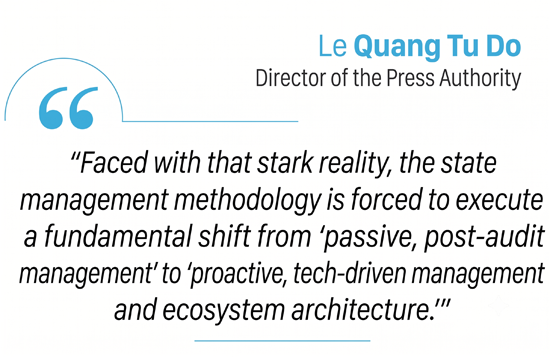
The rapid advancement of AI, especially generative AI and Deepfake, is making fake news, spliced images and videos, as well as distorted content increasingly sophisticated. This is presenting utterly unprecedented challenges to state management efforts. When the naked eye or intuitive reasoning is no longer sufficient to distinguish truth from falsehood, identifying misinformation has become exceptionally more challenging, aiming directly at the younger generation’s trust.
Currently, the Ministry of Culture, Sports and Tourism is coordinating intimately with information and communication agencies alongside tech giants to architect and master smart monitoring systems utilizing AI. These cutting-edge tools possess the capacity to automatically recognize digital signatures, flag Deepfake videos, spot fabricated images, or identify systematic fake news dissemination campaigns the moment they sprout in cyberspace, thereby issuing timely warnings to the community, particularly the youth.
In the AI era, state management isn’t about trying to stifle technology; it’s about mastering technology, utilizing tech to fiercely protect genuine cultural values, and above all, equipping the younger generation with adequate tools, knowledge, and bravery so they can confidently master the digital space safely, creatively, and proudly.
Content: Vinh Xuan, Tran Binh
Design: Minh Thu
Translation: Thanh Tam