Industry leaders call for stronger value chains to sustain export growth
SGGP
As more international buyers turn to Vietnam, industry leaders say future export growth will depend on quality, innovation and global standards rather than tariff advantages.
Quality and standards as competitive advantages
Mai Kieu Lien, CEO of Vinamilk, said Vietnamese companies must move beyond competing on price and scale by investing in technology, innovation and production capabilities.
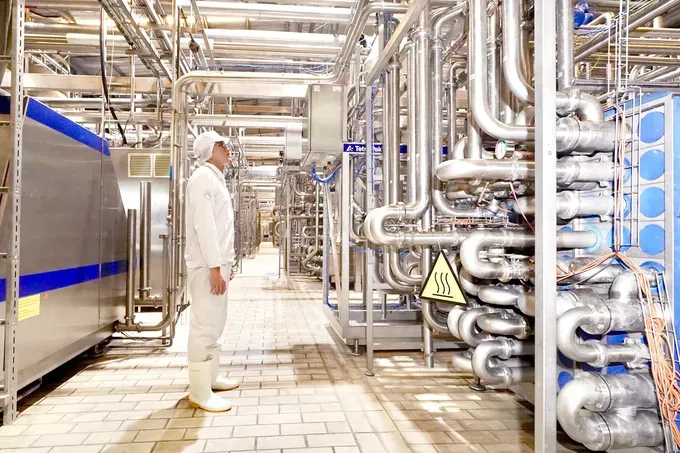
Vinamilk operates 16 factories and 15 farms certified under the Global S.L.P. standard, with a dairy herd of approximately 130,000 cows. The company exports its products to 65 countries and territories worldwide. In the first quarter of 2026, consolidated revenue increased 24.6 percent year on year to VND16.15 trillion (approximately US$615 million), while overseas revenue surged 39.1 percent to VND4.07 trillion (approximately US$155 million).
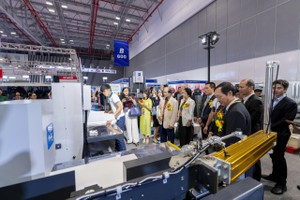
A production line at Vinamilk's dairy factory in Ben Cat Ward, Ho Chi Minh City. Photo: SGGP/ Hoang Hung.
As consumers and global retailers place greater emphasis on quality, food safety and sustainability, businesses must invest in research, technology and product innovation to meet international standards and strengthen their position in global supply chains, she said.
Nguyen Manh Hung, CEO of Nafoods Group, said that the company has invested heavily in laboratory testing, product traceability and food safety management to satisfy increasingly stringent import requirements.
The company's export value has grown from about US$20 million in 2015 to more than US$200 million after a decade. In the first quarter of 2026 alone, exports reached nearly US$31 million, up more than 70 percent from a year earlier. Recent market openings, including U.S. approval for Vietnamese passion fruit and rising demand for Vietnamese fruit and vegetables in the European Union, are expected to create further growth opportunities.
Industry experts noted that multinational retailers now assess the entire production chain rather than just the final product. As a result, businesses seeking to expand exports must invest across the entire value chain from raw material sourcing and manufacturing technology to quality management and product traceability.
Leading companies drive ecosystem upgrades
As competition shifts from individual products to integrated value chains, competitive advantage is no longer measured by the number of exporting enterprises but by the ability to cultivate leading companies capable of upgrading the entire production ecosystem.
According to Nguyen Ngoc Hoa, Chairman of the Ho Chi Minh City Business Association (HUBA), when these "leading enterprises" master technology, quality standards, branding and market access, they not only create greater value for themselves but also elevate networks of supporting businesses. This enables smaller firms to strengthen their capabilities and gradually integrate more deeply into global supply chains.
According to Nguyen Quoc Khanh, Chairman of AA Corporation and Vice Chairman of the Vietnam Timber and Forest Products Association, Vietnam's wood industry demonstrates how this model can drive long-term growth.
Driven by leading manufacturers, the sector has evolved from contract manufacturing (OEM) to original design and brand development (ODM/OBM), increasing exports from less than US$200 million in 1999 to around US$17 billion in 2025. Vietnamese wood products are now exported to more than 160 countries and territories.
However, business leaders stressed that stronger corporate capabilities must be matched by supportive public policies. They called for domestic standards to be aligned more closely with international requirements, the establishment of national databases for raw material areas, planting-area codes and product traceability, and earlier warnings on sanitary and phytosanitary (SPS) measures, technical barriers and trade defense actions.
Experts said that when businesses gain control over raw material sources, technology, quality standards and logistics, while the Government continues to improve infrastructure, institutions and regulatory standards, Vietnamese products will not only meet the requirements of individual export markets but also integrate more deeply into global supply chains.
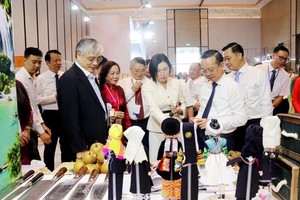
In that scenario, visits by international buyers will go beyond business matching activities and translate into long-term, high-value contracts, strengthening the global competitiveness of Vietnamese goods and enhancing their position in international trade.
Minister of Agriculture and Environment Trinh Viet Hung said sustainable export growth requires businesses to move from a production-oriented mindset to an agricultural economics approach driven by market demand.
He said the entire value chain, from seed development and raw material production to processing, storage, logistics, distribution and trade promotion, must be reorganized to increase value rather than volume.
The ministry will continue improving data-based governance, accelerate the issuance and management of planting-area and packing-house codes, strengthen product traceability and provide earlier warnings on technical trade barriers and trade remedy cases. It also pledged to reduce compliance costs and eliminate bureaucratic misconduct to create a more transparent business environment.
Deputy Minister of Industry and Trade Phan Thi Thang said that Vietnam's logistics costs remain at around 16 percent of GDP, significantly higher than those of many regional competitors.
The ministry aims to reduce logistics costs to about 12 percent of GDP by improving transport infrastructure, strengthening connections among seaports, logistics centers, industrial parks and border gates, expanding multimodal transport, promoting digital transformation and green logistics, and encouraging closer cooperation among logistics providers, exporters, shipping lines and ports.
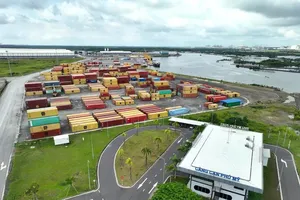
For Ho Chi Minh City, Vietnam's largest export hub, the ministry recommended ensuring stable supplies of industrial inputs, expanding supporting industries, strengthening manufacturing and logistics services, improving origin control and traceability, accelerating digital transformation and resolving bottlenecks affecting industrial projects.
Bruno Jaspaert, Chairman of the European Chamber of Commerce in Vietnam (EuroCham), said nearly half of total Vietnam-EU trade over the past three decades has taken place since the EU-Vietnam Free Trade Agreement (EVFTA) entered into force in August 2020. Of the more than US$900 billion in bilateral trade recorded between 1995 and June 2026, US$383.8 billion, or 42.6 percent, was generated after the EVFTA took effect.
As the agreement enters its seventh year and the EU completes tariff liberalization for 99 percent of Vietnamese exports, Mr. Bruno Jaspaert said new opportunities for trade and investment will continue to emerge.
To maximize these opportunities, Vietnamese enterprises must further strengthen production quality, enhance supply chain transparency and product traceability, and meet increasingly stringent environmental and sustainability standards. According to him, these will be the decisive factors in maintaining Vietnam's position as a strategic partner for European buyers.