
Deputy Prime Minister Nguyen Van Thang recently signed Decision No. 1413/QD-TTg, approving the “Comprehensive Reform Plan for Vietnam’s Financial Market Linked to Sustaining High Growth Targets by 2045” (the Plan in short).

Deputy Minister of Finance Nguyen Duc Chi emphasized that the Plan marks a vital milestone in refining institutions, modernizing, and boosting the operational efficiency of Vietnam’s financial market toward synchronization, transparency, sustainability, and international integration. It’s an initiative designed to build a solid foundation for mobilizing socio-economic resources efficiently, while ultimately sharpening national competitiveness.
The Deputy Minister also stressed the core goals that authorities are striving to achieve. The 2045 vision isn’t merely about numerical growth; it’s a fundamental qualitative transformation in the economic structure. The dominating stance is to position financial reform within the broader macroeconomic framework, leveraging institutional changes as a cornerstone to bolster state management capacity and transparency.
The general objective is to build a modern and deeply integrated financial market capable of allocating resources effectively. Vietnam seems to be steering toward a more balanced structure, easing excessive reliance on bank credit by aggressively expanding the capital market as a rule of thumb.
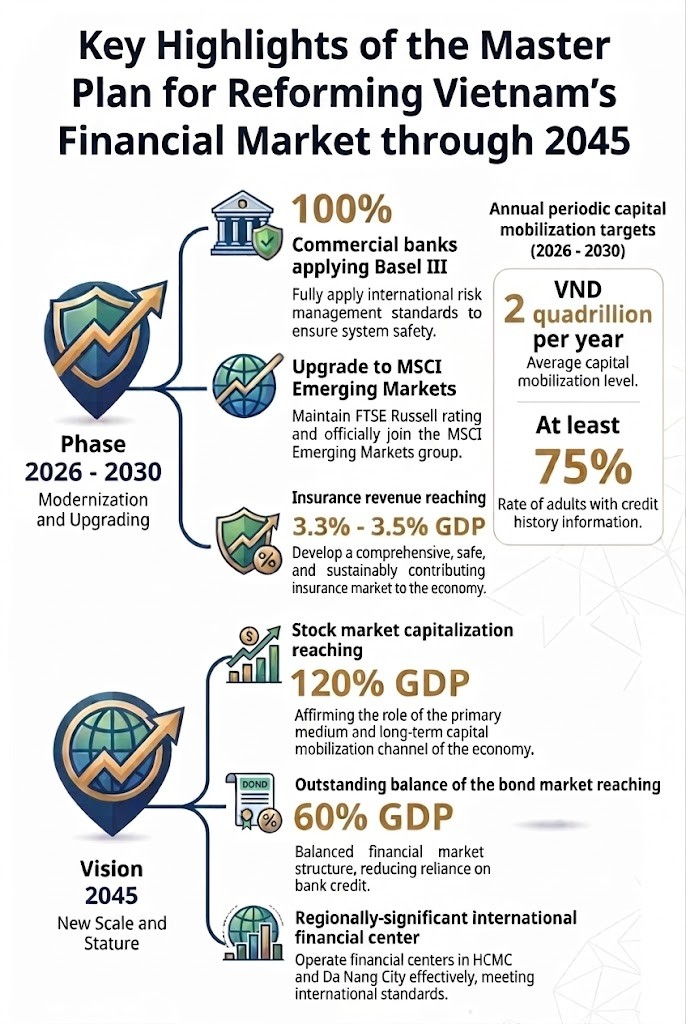
By 2045, it’s expected that stock market capitalization will have hit 120 percent of GDP, with the bond market’s outstanding debt reaching 60 percent of GDP. Simultaneously, 100 percent of commercial banks must approach Basel III standards by 2030 to guarantee systemic resilience against global financial shocks. In general, the key goal is to transform the market into a critical engine to maintain high, sustainable economic growth over the long haul.
The Plan cites digital transformation and financial technology as a “catalyst.” It outlines breakthrough solutions, particularly establishing a roadmap that begins with a controlled sandbox mechanism before expanding into tokenized securities, real-world asset (RWA) tokenization, digital bonds, digital funds, and DLT-based (distributed ledger technology) depository services.
Another major breakthrough involves establishing new asset trading platforms. The country is preparing to operate a crypto-asset market following pilot implementations with stringent financial capacity mandates. Crucially, to materialize Net Zero emissions targets, the Plan maps out an operational timeline for a carbon credit trading market starting in 2029, encouraging green bonds to get the ball rolling on long-term climate finance.
Regarding trading infrastructure, a significant leap forward is deploying the Central Counterparty (CCP) clearing mechanism for the underlying stock market by 2027. This mechanism reduces settlement risks and paves the way for day trading (T+0), controlled short selling, and complex orders, drastically boosting market liquidity.
One nearer-term objective is stock market status upgrading, preparing to become an MSCI Emerging Market by 2030 via four feasible actions:
- Improving capital market competitiveness remains a priority to attract international investment flows. The target is to maintain FTSE Russell standards while satisfying criteria for an upgrade to MSCI Emerging Market and FTSE Russell Advanced Emerging Market status by 2030. To materialize this, Vietnam will refine the legal framework, improve investor accessibility, and modernize settlement infrastructure.
- As to financial statement standardization, authorities are accelerating the roadmap for adopting International Financial Reporting Standards. This helps domestic enterprises speak the same language as global investors, enhancing comparability.
- Vietnam aims to elevate governance quality by adopting corporate governance standards of the Organization for Economic Cooperation and Development and ASEAN. It also encourages investment funds to adopt responsible institutional investor principles.
- Authorities wish to diversify commodities through the equitization of major state corporations, encouraging foreign direct investment enterprises to list and mandating credit ratings for individual corporate bonds.
To control newly arisen risks and protect investors, the Ministry of Finance and the State Bank of Vietnam will direct agencies to boost supervision efficiency by shifting to risk-based supervision, while intensifying the adoption of artificial intelligence and Big Data. Supervisory infrastructure and data centers will be developed synchronously to detect price manipulation and insider trading early, uncovering irregular cash flows.
The Plan also aims to refine a hybrid supervisory model combining functional oversight with cross-sector supervision across banking, securities, and insurance to prevent systemic risks and monitor capital flows through intermediaries. On that basis, coordination among the Ministry of Finance, the State Bank of Vietnam, and the Ministry of Public Security will be accelerated to handle complex cases promptly.
At the end of the day, with a methodical roadmap and decisive solutions, the Plan serves as a comprehensive reform blueprint, transforming Vietnam into a reliable destination for global capital.
Key highlights in the Plan on developing the Vietnam International Financial Center:
- Systemic Position: The Vietnam International Financial Center will gradually become a vital component connecting capital flows, financial services, and regional financial institutions.
- Objectives and Roadmap: Effectively operating the Vietnam International Financial Center in HCMC and Da Nang City under a “one center, two destinations” model, aiming for regional status by 2035 and international status by 2045.
- Implementation Strategy: Reviewing and evaluating current documents to draft and update development strategies for individual component markets of banking, securities, insurance, and the International Financial Center development strategy.
- Enacting Dedicated Legislation: Reviewing and refining legal documents to fully regulate relations between Financial Center members and domestic entities; finalizing operational regulations, reviewing policies applied within the International Financial Center, and moving toward drafting a dedicated Law on the International Financial Center.