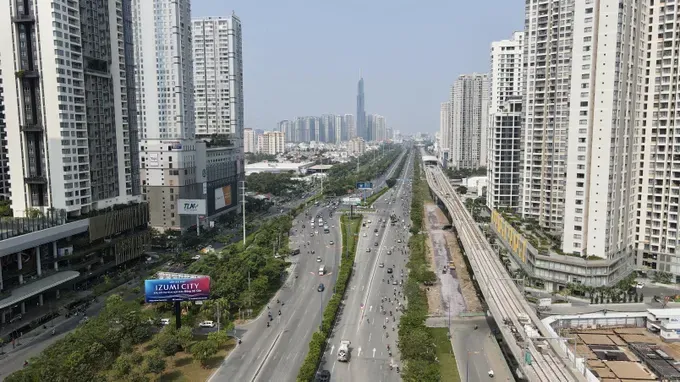
These intersections will be upgraded from at-grade crossings to grade-separated interchanges, with the aim of ensuring a main arterial route featuring six uninterrupted traffic lanes, eliminating the need to stop at traffic signals, and supporting a design speed of 80 km/h.
Regarding the expansion of Hanoi Highway, the Ho Chi Minh City People’s Committee has recently assigned a consortium of investors, including Ho Chi Minh City Infrastructure Investment JSC (CII) and Ho Chi Minh City State Financial Investment Company, to prepare a feasibility study report for the project to upgrade and expand the Hanoi Highway – Vo Nguyen Giap – National Highway 1 corridor from Saigon Bridge to Tan Van Interchange.
This is one of the city’s key transport infrastructure projects, holding significant importance in enhancing traffic capacity at the eastern gateway of Ho Chi Minh City.
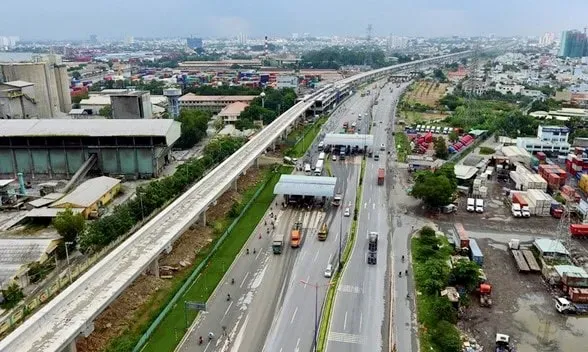
According to the initial proposal by Ho Chi Minh City Infrastructure Investment JSC, the project will focus on upgrading five key interchanges along the entire corridor, namely Tay Hoa, Thu Duc Intersection, Saigon Hi-Tech Park, Cat Lai, and An Phu. These junctions will be converted from at-grade intersections to grade-separated interchanges, ensuring a main arterial route with six uninterrupted traffic lanes, eliminating the need to stop at traffic signals, and enabling a design speed of 80 km/h.
The project’s preliminary total investment is estimated at approximately VND3.5 trillion (US$132.8 million) and is expected to be implemented under a public–private partnership (PPP) model, specifically a build–operate–transfer (BOT) contract, using 100 percent investor capital. The implementation period is projected at 24 months following the completion of all required procedures.
In reality, the Hanoi Highway corridor is currently under significant traffic pressure, particularly from heavy trucks and container vehicles traveling from key ports such as Cat Lai and Truong Tho. Traffic congestion occurs frequently, even outside peak hours, adversely affecting transport operations and residents’ daily lives.
Therefore, the investment in grade-separated interchanges is considered an urgent solution to alleviate congestion, reduce traffic accidents, and enhance the overall operational efficiency of the route.
During the study process, the investor consortium will continue to coordinate with relevant departments, agencies, and local authorities to finalize the optimal plan, ensuring overall consistency and synchronization. Notably, in the Tay Hoa – Binh Thai area, the proposed solution must be aligned with the three-level interchange project connecting Ring Road 2 to avoid overlaps and inefficient use of resources. Similarly, the Cat Lai interchange must be designed in harmony with the Rach Chiec National Sports Complex, a large-scale facility expected to accommodate tens of thousands of people, thereby requiring high traffic capacity during major events.
For the An Phu interchange, traffic organization plans should take into account flows from feeder roads such as Nguyen Hoang Street to prevent the emergence of new bottlenecks. Meanwhile, at Thu Duc Intersection, the option of constructing an underpass is being carefully studied, including a reassessment of the operational efficiency of the existing steel overpass.
Additionally, the Ho Chi Minh City Department of Construction stated that, within this year, the city will continue studying the investment in an additional nine steel overpasses at major traffic congestion hotspots.
In the immediate term, the Ho Chi Minh City People’s Committee has assigned the Department to coordinate with the Ho Chi Minh City Transportation Works Construction Investment Project Management Board to prepare dossiers for adjusting the investment policy for three overpass projects at major intersections that are currently operating at grade level.
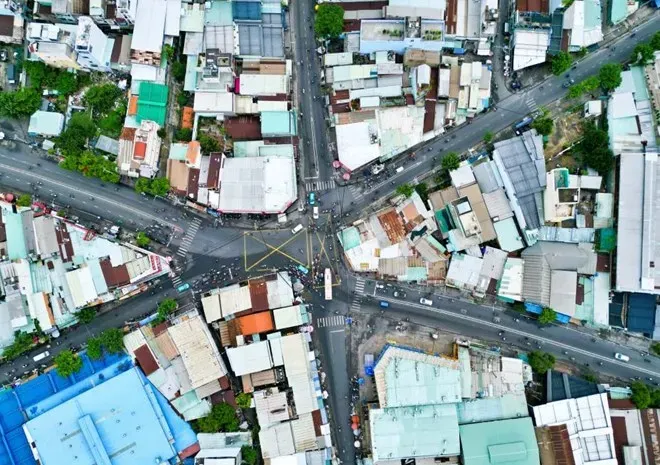
Specifically, at the Dien Bien Phu Roundabout, the project proposes the construction of a steel overpass along Ly Thai To Street, integrated with connecting branches along Le Hong Phong Street, with a total estimated investment of approximately VND420 billion (US$16 million).
At the Bon Xa Intersection, the proposed plan involves the construction of an elliptical central island combined with a four-lane overpass along the Hoa Binh – Le Van Quoi axis, with a total investment of around VND2.464 trillion (US$93.5 million).
As for the Nguyen Tri Phuong – Ngo Gia Tu Intersection, design options are currently under study to both address traffic congestion and minimize impacts on surrounding areas.
Under the plan, the investment policy proposal dossiers will be finalized and submitted to the competent authorities for consideration in the fourth quarter of 2025. Subject to approval, the projects will proceed with site clearance and are expected to commence construction in the second or third quarter of 2027, with completion projected after 12 to 15 months of implementation.
The synchronized rollout of these transport infrastructure projects is anticipated to make a significant contribution to easing traffic pressure, enhancing regional connectivity, and advancing the socio-economic development of Ho Chi Minh City and the Southern Key Economic Region.