Their journey reflects how farmers in Chau Pha Commune, Ho Chi Minh City, have transformed agricultural production to meet international standards and tap into global markets.
Inside vast greenhouse complexes, rows of bright red chilies are reaching peak harvest season. Nguyen Viet Tu, Director of Chau Pha Agricultural Production and Services Cooperative, walks through the fields with farmers, checking cultivation records and monitoring compliance with production standards.
Exporting herbs and spices to France, Sweden and other EU countries requires strict oversight at every stage, from planting to harvest, he said. Each crop follows its own production protocol.
Beyond the chili plots, farmers cultivate a wide variety of herbs, including scallions, culantro, Vietnamese coriander, basil, spearmint, perilla and Vietnamese balm, all grown under carefully controlled conditions.
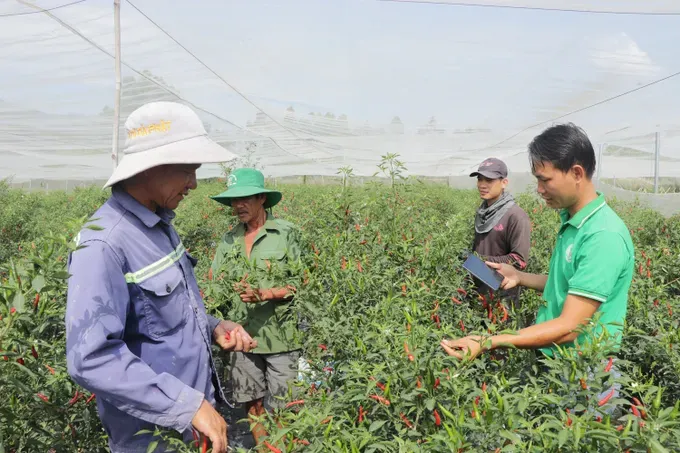
Mr. Nguyen Viet Tu recalled that the cooperative initially focused on leafy vegetables for the domestic market. After several years, however, it became clear that many herbs adapted exceptionally well to local soil conditions and delivered consistent quality.
This discovery prompted a strategic shift. In 2023, the cooperative launched a pilot project on one hectare of land, growing around ten varieties of herbs while exploring opportunities in overseas markets.
At first, he saw herbs as a product for the domestic market, Mr. Nguyen Viet Tu said. Then he discovered a large and underserved market in Europe, where Vietnamese and Asian consumers are seeking familiar flavors from home but often struggle to find products that meet quality standards.
Determined to enter overseas markets, he reached out to agricultural exporters and distribution partners across Europe. It took numerous discussions before the cooperative secured the right partners. Guided by customers’ requirements on quality, production processes and traceability, Chau Pha Cooperative gradually refined its cultivation methods and established export-compliant growing areas.
Just one year later, the cooperative successfully shipped its first 25-ton consignment of herbs to Europe. Encouraged by the results, he expanded the cultivation area from one hectare to 20 hectares. Today, 27 farming households are involved in herb production, and the cooperative exports about three tons of herbs to Europe every week.
Clean production as a foundation
Beyond its export success, Chau Pha Cooperative has also strengthened its domestic market presence through a strategy centered on clean production and value-chain integration.
Do Thanh Hien, a cooperative member, currently grows culantro and bird’s eye chili on a 4,000-square-meter greenhouse farm equipped with automated irrigation, fertilization and humidity monitoring systems.
Each year, he harvests approximately 120 tons of culantro from four growing cycles, selling the crop at around VND18,000 (US$0.68) per kilogram. His bird’s eye chili production reaches roughly three tons annually, with prices averaging VND60,000 (US$2.3) per kilogram.
After expenses, his family earns nearly VND300 million (about US$11,500) in annual profit from the two crops.
The herbs are cultivated according to strict cooperative standards and are fully purchased under contract, with stable prices. Farmers can focus on meeting export orders and following technical guidance from agricultural engineers instead of worrying about market access as they did under traditional production methods, Mr. Do Thanh Hien said.
Thanks to its value-chain model and export activities, the cooperative generated more than VND23 billion (US$874,962) in revenue from herb exports in 2025, achieving a profit margin of over 30 percent.
According to Duong Van Tram, Chairman of the Chau Pha Commune Farmers’ Association, the model has helped cooperative members secure stable incomes while creating additional employment opportunities for local residents and contributing to rural economic development.
Looking ahead, the cooperative plans to further expand its cultivation area, apply advanced technologies and invest in deep processing to increase product value.
In the coming period, Chau Pha Cooperative plans to expand its herb cultivation area and apply high technology to improve production efficiency. It also aims to move into deeper processing instead of relying on frozen exports, in order to increase product value. For example, qualified chilies will be processed into chili sauce and chili powder, while perilla leaves will be dried and finely ground into powder, Mr. Nguyen Viet Tu said.
The Chau Pha Cooperative’s herb-growing area covers around 20 hectares across Chau Pha, Xuan Son and Ho Tram communes in Ho Chi Minh City.