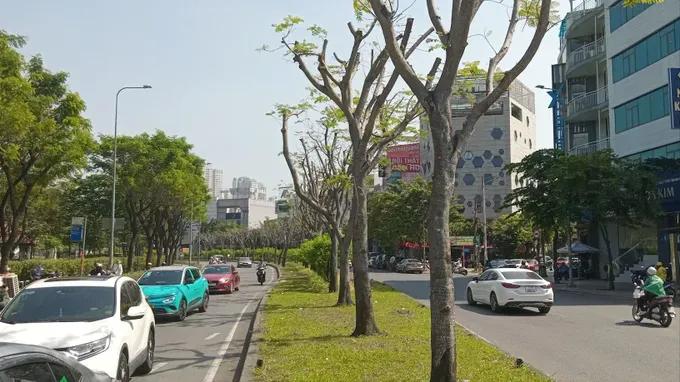
Observations at April 30 Park (Saigon Ward) reveal a stark scene: many tall, majestic trees have been pruned completely bare, stripped of branches and boughs, leaving only sparse foliage. Looking at this denuded green space under the glaring sun, many people express deep regret. Some are curious, questioning the standards and regulations upon which this pruning is based.
Le Lan Anh, a student at Saigon University, shared: “My group often comes to April 30 Park to study and hang out. This time, seeing so many trees stripped of their branches and tops, we felt a sense of loss. We don’t understand why the trees have to be cut so severely. The lush green canopies that used to provide shade have been removed, exposing rows of bare, dry, lifeless trees.”
Tran Van Toan, a resident living near the park, noted that he occasionally sees greenery company staff arrive to perform pruning. “A lot of branches are brought down, which means the green space is shrinking,” he said. “Trees in HCMC are already few and far between; seeing them pruned so heavily like this makes people frustrated.”
Similar scenes were noted on Xo Viet Nghe Tinh, Pham Ngoc Thach, Tran Nao, and Vo Van Tan streets, as well as the neighborhood of Turtle Lake. Many tall trees have been topped and stripped of branches, creating a highly unaesthetic appearance. Some of these trees have existed for decades, intrinsically linked to the cultural life and daily activities of residents. When trees are over-pruned, people lose their shaded resting spots, and the atmosphere becomes noticeably more stifling.
Nguyen Thi Tam, a resident of the Turtle Lake area (Xuan Hoa Ward), acknowledged that pruning for safety is necessary. However, she argued that functional units shouldn’t just hack them bare. Instead, they need to assess the quality of each tree and determine a pruning method that ensures both safety and aesthetics.
Regarding the pruning at April 30 Park, Chairman Vu Nguyen Quang Vinh of the Saigon Ward People’s Committee (HCMC) clarified that the park’s trees are managed by the HCMC Infrastructure Management Center (under the Department of Construction). This unit is tasked with maintenance and care. The pruning itself is carried out by a functional unit hired by the Center.
Before pruning, the implementing unit reportedly has a plan and follows the correct procedure. The Xuan Hoa Ward People’s Committee informed that for trees with broken branches reported by residents, the ward contacts the greenery company for handling. The pruning on certain streets within the ward is executed by this unit and does not fall under the ward’s direct management.
Deputy Director Nguyen Thi Huynh Anh of HCMC Greenery Parks Co. Ltd. stated that her company is one of the contractors currently maintaining and caring for trees on streets across 64 wards and communes in HCMC, as well as in major public parks like Tao Dan, April 30, Le Van Tam, Gia Dinh, and September 23. This is done through bidding contracts with the investor, the HCMC Infrastructure Management Center.
The company performs care and maintenance according to technical processes and plans approved by the investor. Depending on the level of defect or damage, the company will propose a handling direction to the investor (such as lowering the height or felling) to minimize tree-related incidents in the area.
As to the issue that the company’s “bare-bones” pruning causes a loss of aesthetics and public frustration, Deputy Director Nguyen Thi Huynh Anh replied: “Heavy branch cutting, canopy reduction, and height lowering sometimes lead to a state of bare branches for a certain period. These trees have been and are recovering; the company continues to monitor and care for them.”
From an expert’s perspective, Assoc Prof Dr Phung Chi Sy, Vice Chairman of the Vietnam Association for Conservation of Nature and Environment, argued that tree pruning cannot be sloppy; it requires thorough research and assessment. Furthermore, pruning needs to be done selectively, adhering to the principle of ensuring safety while still preserving the tree’s ecological role.
Additionally, the staff performing the pruning need high technical expertise. However, because residents don’t know how the pruning is done or if it meets technical requirements, it leads to reactions and frustration.
In 2021, the HCMC Department of Construction issued technical guidelines for urban tree pruning. According to these guidelines, for mature trees, “canopy thinning” is a form of pruning to remove weak, thin branches that cross others or grow inward, aiming to reduce foliage density.
Canopy thinning is to be performed on small branches and twigs (typically under 10cm in diameter). Each thinning session should not remove more than 20-25 percent of the living canopy (with a lower percentage for older trees) to avoid shocking the tree and limiting the production of excessive epicormic shoots (water sprouts).
If more cutting is necessary, it should be done in subsequent sessions. When thinning, one should not remove too many small living branches low inside the canopy, and should avoid leaving only clumps of foliage at the branch tips to prevent creating “lion’s tail” branches.



)