Partnering to build civilized city
When people mention Knight of the Grand Cross Le Duc Thinh, reportedly the first layman in all of Asia to be granted that high honor by the Vatican, they often use a specific phrase: “a bridge of love.” With an association spanning over 40 years with the Vietnam Fatherland Front Central Committee, Mr. Thinh has become a living symbol of this spirit of partnership and sharing. He’s a role model for parishes and dioceses, setting the example for the journey of “living the gospel in the heart of the nation.”
That spirit is being carried forward in concrete ways. At Thang Long Church (Phu Tho Ward), Pastor Nguyen The Thu revealed the “Thang Long Brotherhood” flower garden, a community park spanning nearly 500m2. “This whole area used to be just an empty lot. It was a mess of trash and upturned earth,” the Pastor recalls. “During a meeting with the ward leaders, I just proposed the idea of redeveloping it, receiving whole-hearted support immediately.”
Thanks to a swell of community support, work began just a week later. People pitched in whatever they could, be it a bag of cement, a few truckloads of stone, or cash. Some gave VND3-5 million (US$118-196), and others just a few hundred thousand VND. The ward People’s Committee chipped in for benches and stage decorations. Two months later, the nearly-VND200 million ($7,860) project was complete. It’s now a daily hub, connecting the local Chinese community with their Kinh neighbors and several other ethnic minority households.
“Every week,” adds Tran Van Chu, a member of the Pastoral Council, “the church gives out hundreds of free meals to the poor. Most of them are the Chinese, Buddhists, or even people with no religion. Compassion doesn’t distinguish, actually.”
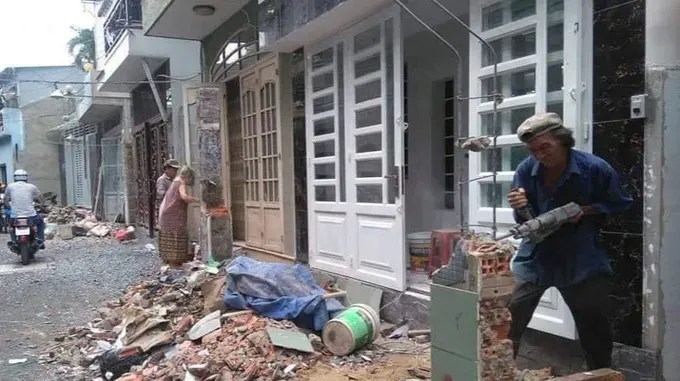
This same energy is found in Alley No.205 (Nhieu Loc Ward), where Bat Nha Pagoda and An Phu Parish are actively campaigning for residents to donate land to widen their alley. Venerable Thich Minh Thien and Pastor Le Hoang Chuong integrate the message into ceremonies and mass. In less than a month, over 200 households agreed.
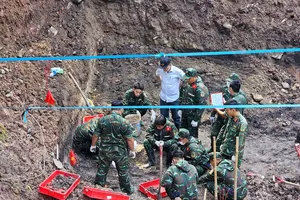
This collaborative spirit is spreading. Hop An Parish in Go Vap Ward, with parishioners and government, completed a 1km, VND1 billion ($39,300) canal-side road. In Binh Dong Ward, Binh An Parish and residents unified to clear a decades-old landfill.
These practical projects make the power of community unity, in hand with local government, crystal clear. Grassroots models like “Green Sunday,” “Charity Day,” and “For the Green Canal,” often born from these parishes, are helping to beautify the city, improve the environment, and, maybe most importantly, tighten neighborhood bonds, making each small alley and hamlet a true “common home.”
Pillar for vulnerable people
On a mid-September afternoon, as the last of the light faded, the yard of Pho Minh Pagoda (Cho Quan Ward) was already bustling with preparations for the Mid-Autumn Festival. More than 400 gift sets, packed with cakes, candies, and lanterns, were being carefully bundled by the monks, ready for the area’s disadvantaged children.
“We just want them, regardless of their circumstances, to have a real, proper Mid-Autumn Festival, with the sound of lion drums, bright star lanterns, and a feeling of being cared for,” shared Venerable Thich Giac Nghiem, the abbot.
In his 25 years with Pho Minh Pagoda, the Venerable has turned this small temple, tucked away in a residential neighborhood, into a familiar anchor of social welfare for the locals. Every Vu Lan festival, thousands of gifts are distributed. During storm seasons, the pagoda joins relief efforts. And during the most intense phase of the Covid-19 pandemic, Pho Minh Pagoda famously donated 10 tonnes of rice to the local Fatherland Front while mobilizing its disciples to support charity kitchens and field hospitals.
And it’s not just Buddhism. This spirit of sharing is just as evident in the activities of the Cao Dai Sai Gon community (under the Tay Ninh Holy See, also in Cho Quan Ward). Every morning, on Tran Hung Dao Street, more than 300 portions of steaming hot vegetarian rice are set out, a daily offering for poor laborers, lottery ticket sellers, the homeless, and the relatives of hospital patients.
From scholarships for students and dormitories for undergraduates to job placements and Tet gifts for the poor, the Cao Dai Sai Gon community has formed what it calls a “closed-loop” welfare system, caring for people from childhood through old age. Its charity kitchen kept its fires lit through the pandemic, and it’s still going, sharing 300-400 meals a day.
But perhaps their most well-known act of compassion is organizing free funerals for those in need. Everything, from the coffin and transport to the burial, even transporting the deceased to the Tay Ninh Holy See if the family wishes, is meticulously handled, all thanks to the collective contributions of the faithful.
Heritage of unity, strength for today
At an April 2025 meeting, HCMC Party Committee’s Propaganda and Mass Mobilization Commission affirmed that ethnic groups, especially the Chinese people and religious dignitaries, have dedicated their wisdom and “iron-clad faith” to the cause of national liberation and reunification. This, they stated, is a precious spiritual heritage and a “living symbol” of the great national unity bloc, forging HCMC’s strength.
According to the HCMC Fatherland Front, this spirit continues. Religious organizations are highly active in the “For the Poor” movement to care for the vulnerable, protect the environment, cope with climate change effects, and maintain social order. In the last five years, the HCMC Buddhist Sangha alone, with the Fatherland Front, has reportedly carried out social welfare programs totaling over VND4,000 billion ($157.2 million).
)