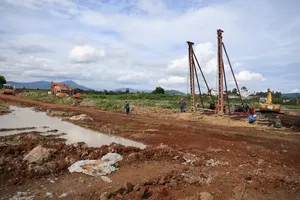
The project, with a total investment exceeding US$5.6 billion, will traverse four localities, namely Hanoi, Bac Ninh, Hai Phong, and Quang Ninh. Spanning a total length of 120.2 kilometers, the railway is designed to meet high-speed rail standards, featuring a double-track system with a standard gauge of 1,435 mm.
The entire line will be fully electrified, enabling trains to operate at a maximum speed of up to 350 kilometers per hour.

Speaking at the event, Vice Secretary of the Provincial Party Committee and Chairman of the Quang Ninh People’s Committee Bui Van Khang affirmed that the Hanoi–Quang Ninh high-speed railway is a strategic infrastructure project connecting four localities, namely Hanoi, Bac Ninh, Hai Phong, and Quang Ninh.
He stressed that the project holds special importance in concretizing the action program of the Party Central Committee to implement the resolution of the 14th National Party Congress, as well as Resolution No. 30 of the Politburo on socio-economic development and national defense and security in the Red River Delta. The project is also aligned with the Government’s action programs and the Red River Delta regional master plan for the 2021–2030 period, with a vision toward 2050.
The project is anticipated to enhance inter-regional linkages, particularly within the Northern Key Economic Region and the Red River Delta. Once completed, the railway will establish a high-speed transport corridor, significantly reducing travel time while improving connectivity capacity and facilitating broader economic spillover effects.
It is also expected to contribute to restructuring development space in a more modern and synchronized direction. The line will enable localities to better leverage their comparative advantages, forming economic corridors and regionally integrated value chains. This, in turn, is projected to enhance competitiveness and support deeper international integration.

The People’s Committee of Quang Ninh Province has approved the investment policy for the Hanoi–Quang Ninh high-speed railway project, a major infrastructure initiative with a total investment of over VND147,000 billion (US$5.6 billion).
The project is invested in by Vinspeed High-Speed Railway Investment and Development JSC under Vingroup. In addition to the total investment, site clearance costs are estimated at approximately VND10,270 billion (around US$396 million) to be funded by the State budget.
The railway runs through four localities, including Hanoi, Bac Ninh, Hai Phong, and Quang Ninh, with a total length of 120.2 kilometers. It is designed as a double-track line with a standard gauge of 1,435 mm, fully electrified, and capable of operating at a maximum speed of up to 350 km/h. In the Hanoi section, trains are designed to operate at a maximum speed of 120 km/h in accordance with urban conditions.

The project is expected to deploy a new generation of high-speed trains along with advanced signaling, communication systems, and state-of-the-art equipment supplied by Siemens Mobility. The system is also expected to gradually receive technology transfer to VinSpeed during the operation and maintenance phase.
The starting point of the line is located at Co Loa Station, Vietnam Exhibition Center, Hanoi, while the terminus is at Ha Long Station in Quang Ninh Province.
Along the route, the railway will include three intermediate stations, including Gia Binh in Bac Ninh, Ninh Xa in Hai Phong, and Yen Tu in Quang Ninh. In addition, a depot will be constructed at Ha Long Terminal to serve maintenance and operational needs.
According to the plan, the project is expected to be completed and officially put into commercial operation in 2028. Once operational, the high-speed railway is projected to reduce travel time between Hanoi and Quang Ninh from more than two hours to just 23 minutes, creating a highly efficient transport corridor across the northern key economic region.