South Central fisheries shift from nomadic voyages to tech-driven harvesting
Across Central Vietnam, fishermen are gradually transitioning from nomadic sea voyages to organized team models and long-term fishing conglomerates. This new harvesting approach not only saves fuel and energy but also improves the efficiency of sustainable exploitation.
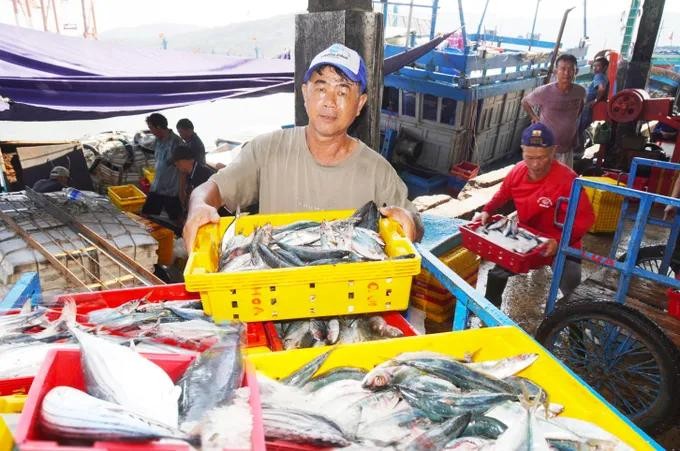
In early April 2026, coastal fishing ports across the South Central region were bustling as vessels returned to shore, reporting bountiful harvests. At Tam Quan fishing port in Hoai Nhon Bac Ward, Gia Lai Province, numerous ships returned from the Truong Sa and Hoang Sa archipelagos with holds overflowing with scad, skipjack tuna, and ocean tuna.
Le Thanh Toan, owner of four vessels utilizing FAD (fish aggregating device) trapping combined with purse seine nets, noted that local fishermen have shifted from nomadic fishing to fixed FAD trapping at sea for several years. These traps, fashioned from leaves and old fishing gear, are anchored to create shelters for fish, with nets cast for harvest only after several months. Each collective consists of 4 to 10 vessels, sometimes 15 to 20, linked together for harvesting, protection, and transport. According to him, this method saves fuel, reduces risks, and limits Illegal, Unreported, and Unregulated (IUU) fishing violations. His two boats have just harvested nearly 45 tons of fish, selling for nearly VND1 billion (US$38,024).
At Vinh Loi fishing village in An Luong Commune, Gia Lai Province, cutting-edge technology has brought greater prosperity. 54 year old Tran Van Lam, who operates four vessels with capacities ranging from 750 to 1,000 CV, has invested in Norwegian "super-sonar" systems valued between VND6 billion and VND10.5 billion. “Thanks to super-sonar technology, locating and identifying fish schools is highly accurate. Almost every trip is efficient with rarely any losses. Many ships bring in dozens to hundreds of tons per trip, earning billions of Vietnamese dong," he said.
At Tho Quang fishing port in Da Nang City, old fisherman Nguyen Tan Dung,73, owner of vessel DNa 90147 TS, is a "living witness" to the restructuring and modernization of fishing fleets in Da Nang and central provinces. The old fisherman recounted: “Fishermen now head out with sonar, satellite positioning, digital fishing ground maps, and rapid communication links to each other and the mainland. Specifically, technology helps save fuel and facilitates smooth cooperative teamwork.”
Nguyen Huu Vinh, Deputy Director of the Department of Agriculture and Environment of Quang Tri Province, argued that current realities necessitate an urgent restructuring of exploitation methods through digital technology and cost-saving measures. Quang Tri is currently focusing on three pillars such as applying science and technology, organizing production through linked chains, and transitioning vocations toward sustainable trends.
Da Nang City has over 4,000 fishing vessels undergoing restructuring toward modern sustainability, using digital transformation and science as pillars. Tho Quang fishing port serves as the “digital hub” for Central Vietnam’s fisheries; 100 percent of docking vessels are inspected, with yields verified and origins traced through digital systems, electronic logs, and VMS positioning.
Pham Trung Thanh, Deputy Head of the Da Nang Fishing Port Management Board, revealed that Da Nang City was preparing to introduce traders into a new wholesale market in May 2026 to stabilize prices and improve connections between fishermen and the market. Beyond Tho Quang, the city continues to digitize infrastructure, expanding anchorage zones and forming new fishery ecosystems in Hong Trieu, Tam Quang, Ky Ha, and Tam Tien.
Head Nguyen Huu Nghia of the Gia Lai Fisheries Department stated that the Hoai Nhon region has approximately 2,300 offshore vessels applying tuna anesthesia technology and piloting Ultra-Fine Bubble (UFB) preservation to form export chains to Japan. Gia Lai has issued a sustainable fisheries development plan for 2026–2030, with a vision toward 2050 and resources exceeding VND12,000 billion to restructure fleets and develop smart logistics.
This includes applications of AI, IoT, biofloc, and RAS, as well as managing farming areas in accordance with VietGAP, ASC, and BAP standards. The province is also establishing concentrated processing zones in Hoai Nhon Bac and Hoai Nhon Dong, linked with logistics in Tam Quan, Quy Nhon, and De Gi. Tam Quan fishing port will be developed into a smart port model using AI and automation, aiming to become a Southeast Asian-scale tuna auction hub.