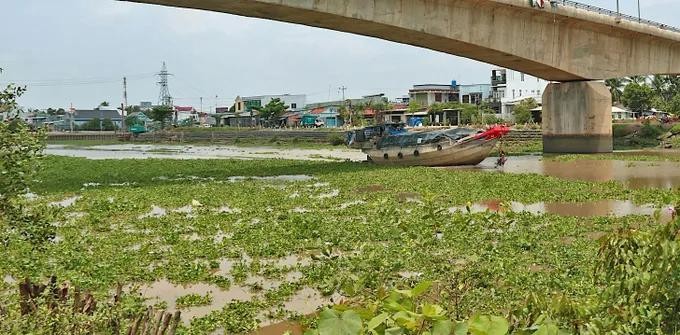
Since late March 2026, large stretches of the Vam Co Dong River in Tay Ninh Province have been blanketed by water hyacinth, causing frequent disruptions to this national inland waterway, particularly in Ben Cau, Thanh Duc, and Long Thuan communes.
“On some occasions, while transporting goods, I had to unload my cargo and switch to road transport because the water hyacinth was so dense that my boat could not continue,” said Danh Thanh, Chairman of the Members' Council of Thap Muoi Agricultural Cooperative in Dong Thap Province. The cooperative regularly ships agricultural products from the Dong Thap Muoi region to Ho Chi Minh City by water.
He lamented that the cooperative owns five 45-ton barges, but over the past three months, they have completed only two trips, while the rest have remained idle because of the water hyacinth infestation. To transport agricultural products to Ho Chi Minh City and southeastern provinces, the cooperative has been forced to hire trucks, nearly doubling transportation costs.
In Dong Thap Province, during the recent winter-spring rice crop, dozens of farming households in Phuong Thinh Commune had to sell their rice at prices VND200–VND300 per kilogram lower than those in other parts of the province. Traders deducted the additional fuel costs and expenses for mechanics needed to clear boat propellers when navigating waterways heavily clogged with water hyacinth to reach the fields.
Similar situations have become common in many areas of An Giang Province and Can Tho City. In Vinh Long Province, representatives from the provincial Department of Agriculture and Environment reported that in just five communes and wards comprising Ngu Lac, Hung Khanh Trung, Cho Lach, Phong Thanh, and Long Duc, more than 70 canals and waterways are currently covered by water hyacinth, affecting a total water surface area of hundreds of hectares.
For several months, hundreds of residents living along the canal leading to the Vam Rang sluice gate in Hon Dat Commune, An Giang Province, have had to endure polluted air. The canal is located at the end of a waterway system before it flows into the sea. Since the middle of the 2026 dry season, water management authorities have closed the sluice gate to prevent saltwater intrusion. As a result, water hyacinth from inland canals and waterways has accumulated in the area and gradually died off, creating foul odors and environmental problems.
Water hyacinth is choking canals across the Mekong Delta
According to environmental experts, water hyacinth is spreading extremely rapidly in the Mekong Delta. In some locations, two plants can multiply into more than 1,000 plants within just three months. Several factors contribute to this explosive growth.
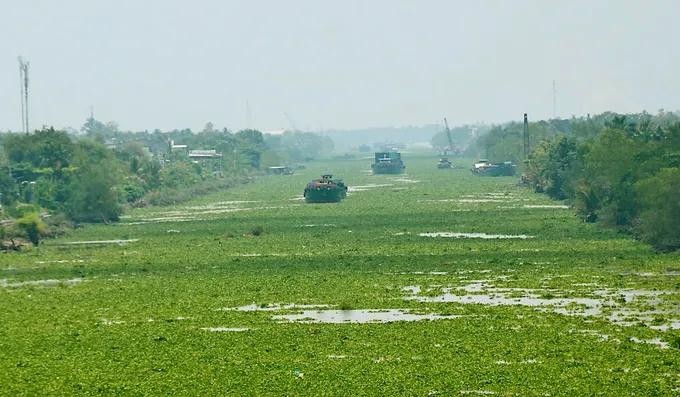
The primary reason is the increasingly slow water flow throughout the Mekong River system. Water hyacinth reproduces quickly in still or slow-moving water, and reduced upstream flows have created favorable conditions for its expansion. In addition, rivers, canals, and waterways in the Mekong Delta are becoming increasingly polluted by industrial production, agricultural activities, and household waste. These conditions provide abundant nutrients for water hyacinth, an aquatic plant capable of absorbing pollutants and heavy metals, to thrive.
Head Pham Thi Minh Hieu of the Crop Production and Plant Protection Sub-Department of Can Tho City said that local authorities have regularly organized collection and removal campaigns and promoted handicraft industries using water hyacinth as raw material. However, these measures have achieved limited success because the plant reproduces so quickly.
Some canal sections are cleared of water hyacinth, only to be covered again a month later, she said.
According to the Tay Ninh Department of Construction, responsibility for controlling water hyacinth on the Vam Co Dong River was assigned in late 2022 to Thanh Thanh Cong Agricultural Development Joint Stock Company, now known as AgriS Agricultural Development Joint Stock Company. The contract between AgriS and Tay Ninh Province expired at the end of November 2025.
The province is currently seeking new partners to participate in water hyacinth management efforts. At the same time, the Department of Construction is coordinating with specialized agencies on a scientific and technological research project focused on water hyacinth treatment. The results will be used to advise the provincial People's Committee on selecting a suitable long-term solution that ensures sustainable effectiveness.