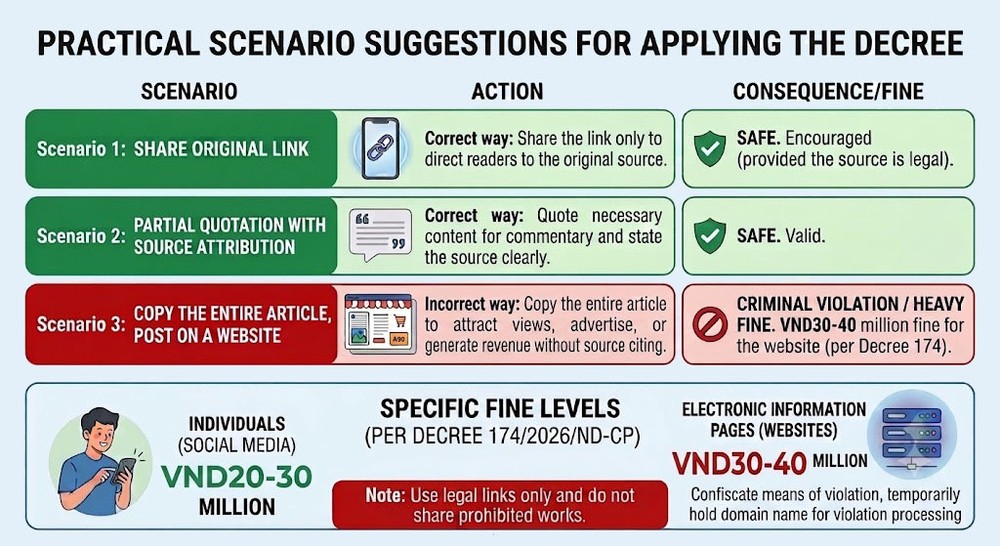
In recent days, directly following the official promulgation of Decree No.174/2026/ND-CP, quite a few inquiries concerning the strict penalty regulations for sharing articles have reportedly surfaced across numerous social media forums.
For Huynh Ngoc Yen from Thanh My Tay Ward in HCMC, navigating these rules is tricky since she participates in numerous Zalo groups spanning from family to close friends; whenever there’s vital information regarding scam warnings, new state policies, or fresh legal regulations from press agencies, she typically shares it so everyone can stay updated. “Ever since I heard that the act of sharing journalistic works on social networks could face penalties, I’m genuinely torn about whether I should send sharing links in the future,” she explained.
Meanwhile, for Tran Huu Van in Tan Hung Ward in HCMC, the new decree has created a sense of uncertainty regarding whether simply clicking the share button to let people read the original piece fundamentally differs from copying the entire article onto Facebook or a fanpage. It’s incredibly difficult for everyday social media users to identify the strict boundary between these two distinct acts if they don’t rigorously research the regulations.
According to legal experts, to accurately grasp the regulation, one must look at the scope of Point d, Clause 1, Article 95 of Decree No.174/2026/ND-CP.
Specifically, Article 95 of Decree No.174/2026/ND-CP explicitly dictates a “fine from VND20-30 million (US$760-1,140) for the act of exploiting social networks to provide or share journalistic, literary, artistic works, or publications without the explicit consent of the intellectual property rights holder, or for works not yet permitted for circulation, or those inherently subject to a circulation ban or strict confiscation decision.”
Thus, the primary target of this strict regulation isn’t universally every act of sharing information on social media, but rather the illicit use of journalistic works contrary to intellectual property rights regulations.
Nguyen Duc Hieu from the International University under Vietnam National University-HCM stated that Decree No.174/2026/ND-CP doesn’t stipulate that citizens will be penalized for sharing every piece of information or every single article on social networks.
The regulation heavily focuses on the illicit act of exploiting social networks to provide or share journalistic, literary, artistic works, or publications when there’s a glaring lack of consent from the intellectual property rights holder, or for works strictly unapproved for circulation, already banned, or confiscated.
For this specific violation, the penalty level is rigidly set from VND20-30 million and can potentially be accompanied by a compulsory measure strictly forcing the removal of the infringing content.
Social media users thus need to distinguish between sharing press information and illegally reusing press content. Posting a link to an article from a press agency with the aim of introducing or leading readers to the original information source isn’t, fundamentally, an act of copying or republishing a journalistic work. However, when sharing, people still need to ensure that the linked information source is entirely legal and doesn’t fall under cases where the content is strictly prohibited by law.
Conversely, copying an entire article and republishing press content on a personal page, website, or other platforms without the explicit permission of the intellectual property rights holder; or repurposing press content to heavily attract views, organically forge interactions, serve business or advertising purposes, and aggressively generate direct or indirect revenue can trigger complex intellectual property issues and legal liabilities, which undeniably constitutes a strict violation.
This rigorous regulation intrinsically aims to robustly protect the overarching rights of press agencies, authors, and related rights holders.
To securely share press information, everyone should proactively prioritize sharing links derived from official sources and explicitly cite the source when quoting. When sharing, digital citizens should solely utilize the essential portion of the content strictly for commentary purposes and rigorously avoid republishing the entire work when they don’t possess the explicit permission of the rights holder regarding the piece.
Websites illegally republishing articles to be penalized
Decree No.174/2026/ND-CP doesn’t merely regulate the act of sharing journalistic works on social networks, but it also explicitly stipulates distinct sanctions specifically targeting electronic information portals.
According to Point d, Clause 3, Article 93, the act of posting or broadcasting journalistic works completely without the explicit consent of the intellectual property rights holder, or handling works strictly unapproved for circulation, already banned, or confiscated, will heavily incur fines ranging from VND30-40 million ($1,140-1,520).
Besides the hefty monetary fines, Clause 4 of Article 93 also strictly dictates the confiscation of the violating exhibits and operational vehicles. Article 5 of Decree No.174/2026/ND-CP empowers competent authorities to temporarily seize the “.vn” domain name or the international domain name of organizations and individuals operating in Vietnam strictly to serve the handling of violations according to regulations.