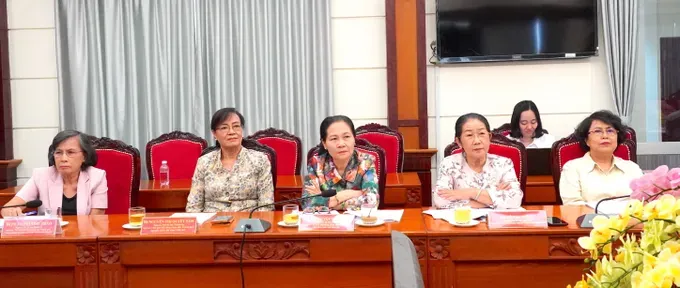
The seminar was co-chaired by Deputy Heads of the Ho Chi Minh City National Assembly Deputies' Delegation, Tran Thi Dieu Thuy and Vo Hoang Ngan.
Strengthening the accountability of local government leaders
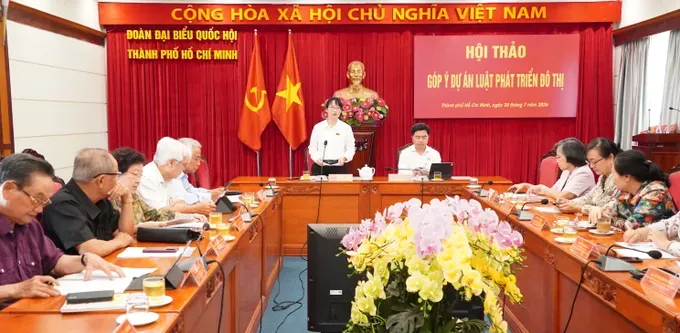
Addressing the seminar, Director of the Ho Chi Minh City Department of Justice, Nguyen Thi Hong Hanh, said the draft Law on Urban Development expands its scope to cover special urban areas and special economic zones, with the aim of establishing a unified legal framework for the country's key growth poles.
The draft law consists of five chapters and 68 articles. Chapter II, which sets out policies specifically for special urban areas, introduces seven major policy groups designed to strengthen decentralization and the delegation of authority while incorporating more robust mechanisms for oversight and accountability.
Commenting on the draft Law on Urban Development, Dr. Tran Du Lich, former Deputy Head of the Ho Chi Minh City National Assembly Deputies' Delegation during the 12th and 13th legislatures, said the legislation's foremost objective should be to deliver an institutional breakthrough that enables Ho Chi Minh City to develop in line with its role as the country's leading economic hub.
Instead of specifying what local governments are permitted to do, the law should define only those areas that remain under national jurisdiction, such as national defense, security, foreign affairs and religious affairs, while granting local authorities the autonomy to make decisions and assume responsibility in all other matters.
In parallel with greater decentralization, the law should establish mechanisms that allow urban governments to make decisions more swiftly. This could include transferring certain powers from the collective People's Committee to the Chairperson of the People's Committee, while clearly defining the accountability of the head of the local administration.
Sharing the same view, Assoc. Prof. Dr. Tran Hoang Ngan, Chairman of the Advisory Council for Development Breakthroughs at Saigon University, proposed that quantitative provisions or regulations likely to evolve in response to practical conditions should not be rigidly prescribed in the law. Instead, such matters should be delegated to local authorities to ensure greater flexibility in implementation.
Meanwhile, Ms. Nguyen Thi Quyet Tam, former Chairwoman of the Ho Chi Minh City People's Council, said the Law on Urban Development should establish a sufficiently flexible framework enabling special urban areas to proactively adopt policies suited to local realities.
Drawing on lessons from the implementation of previous pilot and special mechanisms, she stressed that the law should provide adequate legal space for Ho Chi Minh City to proactively adopt new regulations enacted by the National Assembly whenever they are more progressive and better aligned with the city's development needs.
She also cautioned against using exceptional or case-specific situations as the basis for universally applicable legal provisions, noting that such an approach could create difficulties for local authorities during implementation.
A vision for truly special urban areas
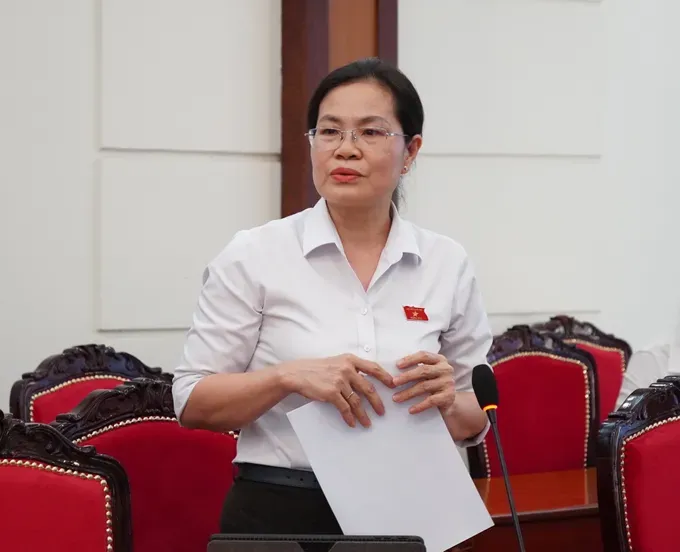
Regarding the scope of application, former Vice Chairman of the Ho Chi Minh City People's Committee, Duong Ngoc Hai, proposed that the law should be limited to special urban areas only, currently Ho Chi Minh City and Hanoi, as well as any future cities that meet the criteria for special urban status.
He warned that the draft law's provision allowing cities that have not yet attained special urban status to apply certain exceptional mechanisms and policies with approval from competent authorities could pose significant risks. Such overlapping application of legal frameworks could lead to conflicts between laws and create substantial legal uncertainties for localities, particularly during inspections and audits conducted by oversight agencies.
Sharing this view, Assoc. Prof. Dr. Phan Thanh Binh, former Chairman of the National Assembly's Committee for Culture, Education, Youth, Adolescents and Children, emphasized that the law should be designed with a long-term vision for truly special urban areas, rather than allowing virtually any locality to qualify.
To achieve this, he proposed that the draft law clearly define four core criteria for identifying special urban areas, serving as a national growth engine, a center for innovation, a regional development hub, and an international integration center.
Former Chairwoman of the Ho Chi Minh City People's Council Nguyen Thi Le further noted that the draft law should incorporate comprehensive mechanisms to capture land value increments for reinvestment in transport infrastructure under the transit-oriented development (TOD) model, rather than focusing solely on project development mechanisms.
She also stressed that TOD planning should integrate requirements for climate change adaptation and sea-level rise resilience, in line with the development conditions of Ho Chi Minh City following its administrative merger.
HCMC proactively prepares for implementation of the Law on Urban Development
According to Director of the Ho Chi Minh City Department of Justice, Nguyen Thi Hong Hanh, the city plans to propose that the National Assembly allow the Law on Urban Development to take effect on October 1, 2026, while tax-related provisions would become effective from the beginning of the 2027 fiscal year.
As the legislation is designed to significantly expand decentralization and the delegation of authority, no government decrees or ministerial circulars are expected to be issued to guide its implementation.
To ensure the law can be implemented immediately upon taking effect, Ho Chi Minh City has proactively reviewed and prepared 109 legal normative documents, including 79 resolutions of the City People's Council and 30 decisions of the City People's Committee.
To date, Ho Chi Minh City has completed draft versions of 99 documents, comprising 69 draft resolutions and 30 draft decisions, which have been incorporated into the dossier submitted to the Government.